Last Updated: 2026-10-13
One pallet arrives with no batch code and the line is already running. A handheld inkjet printer closes that gap, because the operator carries the coder to the pack instead of feeding the pack to a fixed head. Five jobs show where it pays.
What a Handheld Inkjet Printer Is Built For
It is a self-contained coder. A print module, an ink cartridge, a battery and a touchscreen sit in one body weighing about as much as a power tool, and a trigger starts the code. Nothing is bolted to the conveyor and nothing has to be wired in.
A fixed head is bought to keep pace with a line; a handheld unit is bought to cover the work a line cannot reach, from a reworked pallet to a drum that will not fit under a bracket.
Print quality now matches a fixed head on the short distances involved. A thermal inkjet module at 600 dpi produces the same character shapes whether it is mounted on a frame or held in a hand, as the published description of inkjet printing sets out.
The Five Jobs It Handles
Five jobs cover most of what a handheld unit is bought for, and each is a case where moving the pack would cost more than moving the coder.
- Rework and re-labelling. A pallet that failed inspection gets a corrected batch code without being broken down or sent back to the head.
- Oversized and awkward packs. Drums, coils and long extrusions that will not pass under a bracket are coded where they stand.
- Sporadic runs. Small orders between scheduled production, where setting up a line for twenty packs is not worth the downtime.
- Incoming goods marking. Internal lot and location codes added at goods-in, on a surface that never sees the main line.
- Site and field work. Pipes, cable drums and installed equipment marked on site, with no power or air supply to hand.
The common thread is the same: the code has to go on something that cannot be brought to a machine. Where those codes feed a traceability system, the record sits inside ISO 9001 quality management.
What to Check on the Unit
Three numbers decide whether a handheld unit survives a full shift rather than a single pallet. Height range sets which packs it can cover; battery capacity sets how long it runs between charges; and screen size decides how quickly an operator can change the code.
SHICAI builds the unit below with a 2 to 100 mm height range, a 2500 mAh battery and a 7-inch screen, so a shift change does not mean a charger hunt. Print quality is 600 dpi, which is the same class as the fixed heads on the same line.
Machine Questions
- Can it print a barcode or a QR code?
- Yes, as long as the code fits the height range. Text, numbers, pictures, QR codes and barcodes all print from the same screen, with no software change.
- How long does one cartridge last?
- It depends on coverage, not the number of packs. A single line of batch text covers a fraction of the area of a dense QR code, so a dense code uses the cartridge several times faster.
- Is it accurate enough for a regulated code?
- On a still pack it is, and the 600 dpi module holds character shapes that scanners read as reliably as a fixed install. Movement during the stroke is the main cause of a soft code.
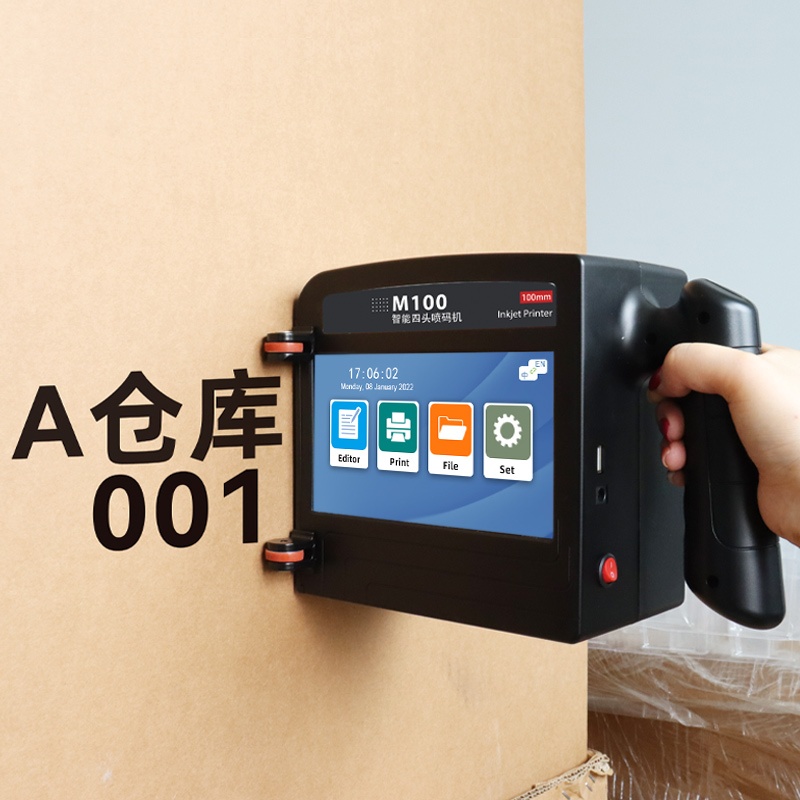
M100 Handheld inkjet printer
a full-shift handheld build:
- 2-100 mm print height for large characters
- 600 dpi print accuracy
- 2500 mAh battery for full-shift runtime
- 7-inch touch screen
Book a Sample
- See the machine: M100 Handheld inkjet printer
- Read next: moving a coder between benches, the fixed-head answer for the same problem
- Talk to us: send a photo of the pack and the code you need through our contact page. We reply within 24 hours with a height range and a no-commitment quote.
Need help choosing the right printer?
Talk to our engineers for a free production-line assessment and quotation.
Request a Quote