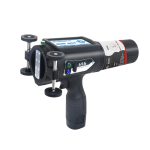
Recommended Equipment: G-20 Fiber Laser Marker
What problem does this solve?
Automotive parts manufacturers and metal hardware producers need to mark part numbers, serial numbers, QR codes, and certification marks on metal components that will be exposed to extreme heat, oil, friction, and weather. Inkjet-printed codes can fade or be removed; only laser engraving provides the permanent, indelible marking required for automotive safety-critical parts and industrial metal hardware.
Solution Description
The G-20 Fiber Laser Marker uses fiber laser technology to engrave permanent, high-precision marks on metals including stainless steel, carbon steel, aluminum, copper, brass, and titanium. With selectable laser power from 20W to 100W, it handles everything from fine precision marking (serial numbers on micro-components) to deep engraving (VIN plates, heavy-duty part numbers). The air-cooled design operates at 25°C ambient temperature with no water cooling required, simplifying installation and maintenance.
The highly integrated all-in-one motherboard ensures long-term stability in industrial environments. Laser marking is a non-contact, consumable-free process — no ink, no solvents, no replacement cartridges — making it the most cost-effective permanent marking solution over the equipment’s lifespan.
Key Benefits
- Permanent, indelible laser engraving that cannot be removed or altered
- 20W–100W selectable power for fine marking to deep engraving
- Consumable-free operation — no ink, no cartridges, no solvents
- Air-cooled design (no water chiller required) simplifies installation
- Non-contact process eliminates mechanical wear and contamination risk
- Prints on stainless steel, carbon steel, aluminum, copper, brass, and titanium
- Supports serial numbers, QR codes, barcodes, DataMatrix, logos, and 2D codes
- Highly integrated motherboard ensures 24/7 industrial reliability
Target Customers
- Automotive parts manufacturers (engine components, brake systems, transmission parts)
- Metal hardware producers (fasteners, hinges, brackets, tools)
- Motorcycle and bicycle component manufacturers
- Bearing and gear manufacturers
- Steel and metal fabrication shops
- Aerospace component manufacturers
Application Scenario
An automotive parts manufacturer produces 30,000 brake calipers per day. The G-20 Fiber Laser Marker (50W configuration) engraves a 2D DataMatrix code, part number, manufacturing date, and lot number on each caliper’s mounting surface. The laser marking process takes 2 seconds per part and creates a permanent mark that survives the caliper’s 150,000-mile service life, including exposure to brake fluid, road salt, and thermal cycling from -40°C to 300°C. The consumable-free operation saves the manufacturer $15,000 per year compared to their previous inkjet coding system.
FAQ
- Q: Is laser marking permanent? A: Yes. Fiber laser engraving creates permanent marks that cannot be removed without destroying the material surface, making it ideal for safety-critical automotive parts.
- Q: What metals can it mark? A: Stainless steel, carbon steel, aluminum, copper, brass, titanium, and most metal alloys used in automotive and industrial applications.
- Q: What power level do I need? A: 20W is sufficient for fine surface marking (serial numbers, QR codes). 50W is recommended for general automotive parts. 100W is used for deep engraving on thick steel components.
- Q: Are there any consumables? A: No. Fiber laser marking is a consumable-free process — no ink, no cartridges, no solvents. The only maintenance is periodic lens cleaning and eventual laser diode replacement (typically 100,000+ hours MTBF).