
Last Updated: 2026-10-22
A date coder high speed quotation usually leads with a belt figure, and that figure is the least useful number in the conversation. What a plant needs to know is how many codes per minute land legibly, which is a product of belt speed, product pitch and the length of the message.
What a Date Coder High Speed Figure Actually Means
A head rated at 400 metres per minute is stating the rate at which product can pass the nozzle without the mark distorting. It says nothing about how many products those metres contain. Long cartons at one metre pitch pass forty a minute; small pouches at 60 mm pitch pass far more, and the head works harder because it starts and stops the message more often.
So the honest conversion has three parts, and the belt figure is only the first of them.
Converting Speed Into Codes per Minute
| Input | Where to measure it | Why it changes the answer |
|---|---|---|
| Belt speed | Timed with a stopwatch over ten metres, loaded | Sets the window the head has |
| Product pitch | Centre to centre, on the conveyor | Sets how often the window opens |
| Message length | The printed block, not the field count | A long block needs a longer window |
Worked once, the arithmetic is simple: belt speed divided by pitch gives products per minute, and the message must fit inside the time each product spends under the head. A two-line date on a crate leaves room to spare; a block with a logo and a code at the same pitch does not.
Trigger Latency Comes Before Print Speed
The sensor fires, the controller wakes, the head prints. Each step costs milliseconds, and at high speed a millisecond is millimetres of travel. On a line that runs at 400 metres per minute, a delay of five milliseconds moves the mark 33 mm downstream, which is the difference between a mark on the panel and a mark on the flap.
That is a mounting question rather than an electronics one. The sensor sits upstream of the head at a distance that matches the delay, measured with the line running rather than calculated at a desk. A 3 to 30 mm throw distance gives the installer room to find that position.
Drying and Gap Set the Real Ceiling
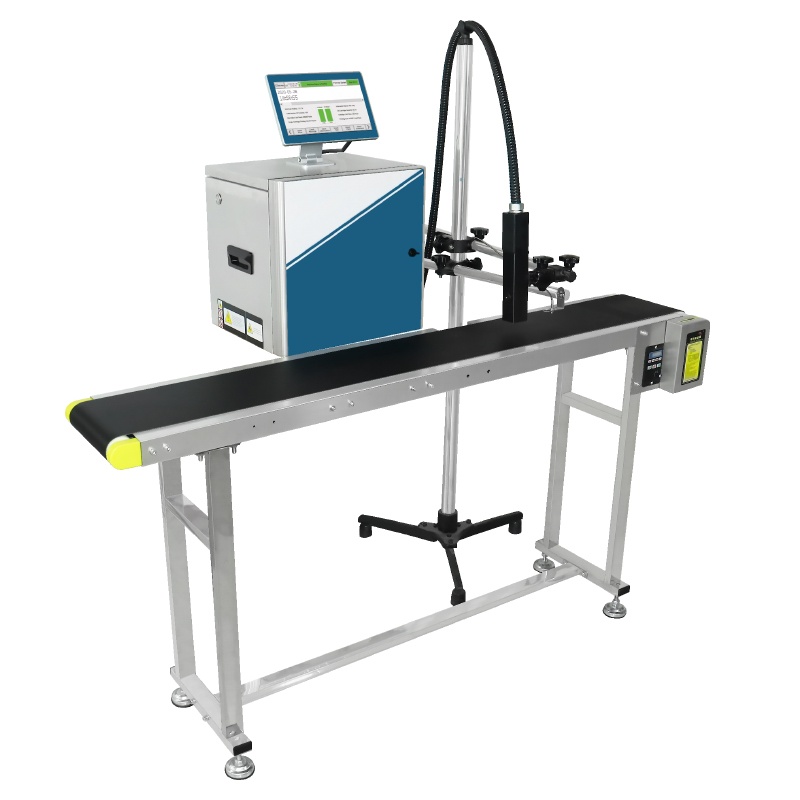
S1000 small character inkjet printer
the build quoted at line speed:
- Prints up to 400 Meters Per Minute
- 2-20mm print height
- 10.1-Inch Industrial Touchscreen
- 3-30mm throw distance
- Low 120W rated power
The last limit is the one buyers meet after installation. Ink that has not dried before the product reaches a guide rail is ink that smears, and on a non-porous surface at high speed the drying window is short. The fixes are practical: drop the print height towards the 2 mm end of the range, move the guide rail downstream, or accept a slightly slower belt for that product. A mark that rubs off at 400 metres per minute is slower than a mark that survives at 300.
Builds follow the route described in the ISO 9001 quality management standard.
Related Questions
- Does a higher belt figure cost more to run?
- Not directly. Consumption follows printed area, so a longer message at speed costs more ink than the speed itself does.
- Can one head serve two lanes?
- Only with a message that fits the shortest window and a trigger for each lane. Two lanes usually mean two heads.
- What print height is realistic at top speed?
- A narrower block holds better at speed. Use the full 20 mm for static work and a compact block on a fast belt.
Send Three Numbers, Not a Speed
Give us the belt speed, the product pitch and the block size. We return the codes per minute the date coder high speed build can hold, and the trigger distance to set.
Next Steps
- Send belt speed, pitch and block size. We return the achievable code count and the trigger distance.
- Start at the contact page, on +86 17625427465 or kuangcy@126.com. We reply within 24 hours.
Need help choosing the right printer?
Talk to our engineers for a free production-line assessment and quotation.
Request a Quote