Last Updated: 2026-09-02
When a printed label rubs off in transit, traceability dies with it. Fiber laser marking advantages start there: a fiber laser bonds a permanent, high-contrast mark into metal and hard plastic without ink, contact, or consumables, and the source runs for years with minimal service. Here is where the technology pays off.
The Short Answer
Six advantages explain why lines keep switching. Permanence: the mark is bonded into the material, so it survives solvents, abrasion, and years of service. No consumables: there is no ink, solvent, or make-up to buy, store, or run out of. Speed: a galvo steering mirror guides the beam with no moving mass, so marking keeps pace with production. Precision: a fine spot holds small serials and 2D codes readable. Consistency: a rated industrial source holds alignment for years with minimal service. Traceability: the marks scan reliably after coating, cleaning, and field handling.
Fiber laser marking advantages matter most where a failed code has real consequences, such as medical devices, automotive components, and serialized electronics. Where the substrate is organic, wood, glass, or clear film, a CO2 source is usually the better fit instead.
What to Know in Practice
Routine care is mostly prevention. Keep the lens and protective window clean, a speck of residue
absorbs power and turns into a weak, uneven mark long before the source fails. Check focus and calibration
weekly on daily-running machines, and keep spare lenses and a spare source on the shelf if uptime matters.
Stable power and ventilation prevent most intermittent faults. Ask builders for service intervals and parts
lists before you buy, and confirm spares ship to your region. A machine that is easy to maintain stays
productive.
Whatever technology you settle on, budget for consumables or source life, cleaning supplies, and a spare parts kit if uptime matters. These small costs are the difference between a unit that runs for years and one blamed for every late batch.
About SHICAI
SHICAI runs a full laser line: fiber, CO₂, and UV systems for continuous production. The company ships to overseas production lines and warehouses, and specifies genuine rated laser sources so the machine runs to its rated life. Service and spares are arranged for export markets, and the technical team answers questions directly rather than through a reseller chain.
Related Questions
- How long does a fiber laser source last?
- A rated industrial fiber source is commonly specified for 100,000 hours or more, which works out to years of two-shift operation.
- Do fiber laser marks wear off?
- On metals and many plastics the mark is structural, not a coating, so abrasion removes material before it removes the code. On some plastics it is a color change in the surface, which also resists normal handling.
- What can a fiber laser not mark?
- Organics such as wood, leather, and clear glass absorb the fiber wavelength poorly; a CO2 laser usually handles those better. Always test the actual substrate.
A Model Worth Looking At
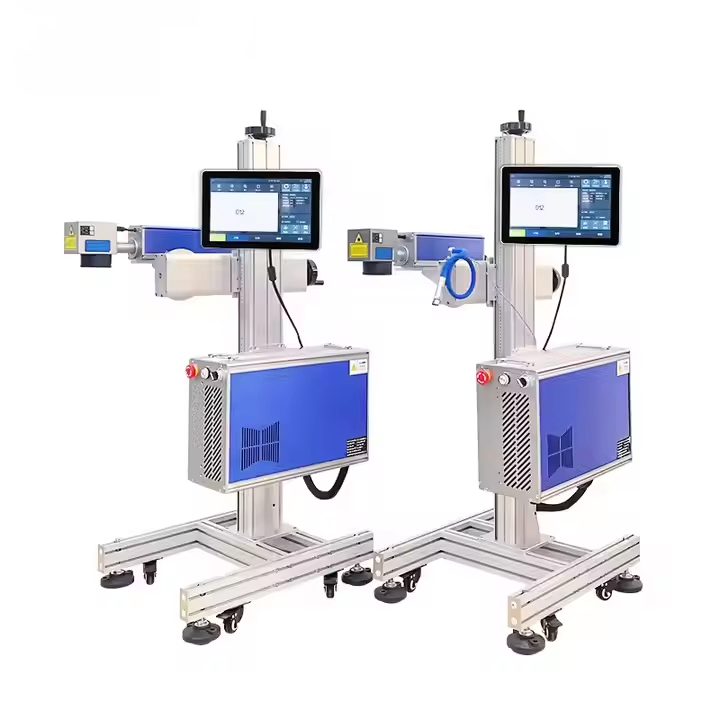
G-20 Fiber laser inkjet printer is built for this kind of work. Click the image to see the product page.
Learn more about laser engraving technology and ISO 9001 quality management.
Next Steps
- Read related FAQ guides on coding and marking basics.
- See the G-20 Fiber laser inkjet printer if you need a marker for this job.
- Get a free sample mark on your material. No commitment, reply within 24 hours.
Need help choosing the right printer?
Talk to our engineers for a free production-line assessment and quotation.
Request a Quote