Last Updated: 2026-10-27
An inkjet printer for cans is rarely beaten by resolution. It is beaten by a can that arrives at the head wet from a pasteuriser, by a curved body that puts half the block out of focus, and by a line speed that leaves a few milliseconds to fire.
What an Inkjet Printer for Cans Has to Beat
The first obstacle is water. A filled can leaves a warmer tunnel with condensation on the body, and a mark printed into that film spreads and fades. The second is the seam: a two-piece can has a dome, a shoulder and a straight wall, and only the wall is a stable surface for a head. The third is handling, because a can that goes into a shrink pack is rubbed by film within minutes of being coded.
All three are solvable, and none is solved by a higher specification number. They are solved by placing the head where the surface is dry, by keeping the block inside the flat wall, and by choosing a grade that keys to a lacquered aluminium or tinplate surface once it is dry.
Three Can Surfaces, Three Behaviours
| Surface | Behaviour | What to plan |
|---|---|---|
| Lacquered aluminium body | Ink sits on the coating, contrast is easy | Standard fast-dry grade, dry surface |
| Bare tinplate | Reflective, thin marks disappear at an angle | A darker grade and a slightly bolder dot |
| Domed end or shoulder | Surface curves away in two directions | Keep the block on the wall, not the dome |
The third row is where most layouts start and then have to be redrawn. A code placed on the shoulder looks neat on a drawing and reads badly in a chiller, because the far edge of the block has left the working distance and the drops land as a smear.
Speed, the Curve and the Working Window
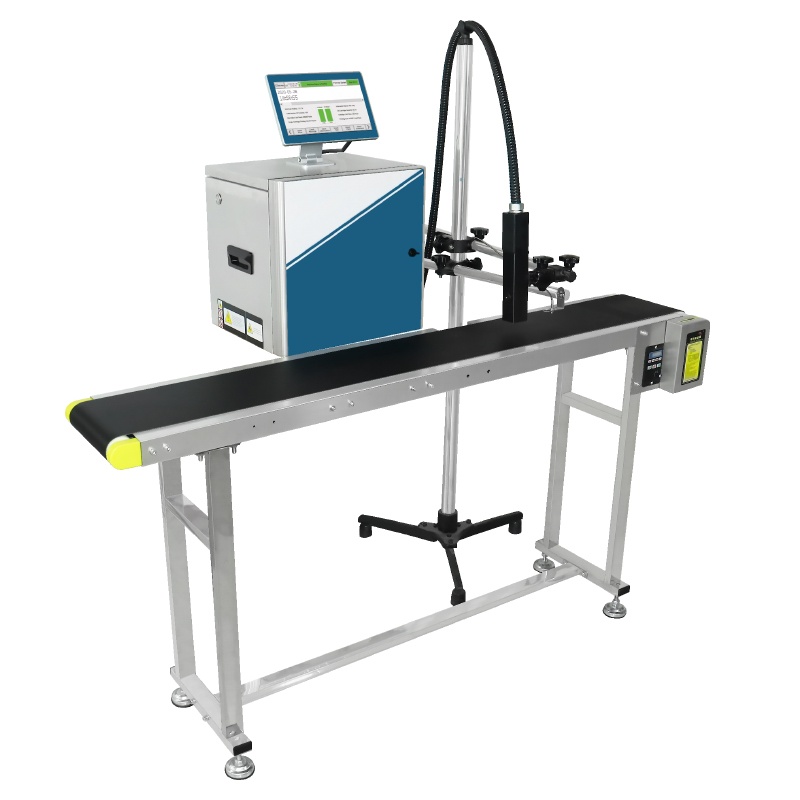
S1000 small character inkjet printer
the line build for beverage cans:
- Prints up to 400 Meters Per Minute
- 2-20mm print height
- 10.1-Inch Industrial Touchscreen
- 3-30mm throw distance
- Low 120W rated power
A can line spends its speed on pitch rather than on metres. At a 65 mm can pitch, 400 metres a minute is more than a hundred cans a second, which no single head manages because each can needs its own trigger. The figure that matters is cans per minute at the block you print, and the 3 to 30 mm throw distance is what lets the head clear a guide rail or a transfer star.
Two lines are worth measuring before an order: the distance from the filler to the coding point, and whether that section is open or inside a guard. A head inside a guard stays drier and warmer, and a head on an open run is the one that needs an air knife in a humid room. Builds follow the route described in the ISO 9001 quality management standard.
Related Questions
- Can the same head code bottles and cans
- Yes, with two saved jobs and two heights, though the changeover is worth scheduling rather than doing mid-shift.
- Does a shrink pack rub the code off
- It can, and a fast-dry grade plus twenty seconds of air before packing is the usual answer.
- Is a laser better on aluminium cans
- It is permanent on bare metal, and it is a different purchase with its own layout rules and its own safety enclosure.
Send a Filled Can
Send one can from the line, cold if that is how it reaches the head, and the pitch it travels at. We will mark it, leave it an hour and rub it, then return it with the grade and the height, so the inkjet printer for cans is proved on your own body.
Next Steps
- Send one filled can and the pitch. We return a marked can plus grade and height in writing.
- Start at the contact page, on +86 17625427465 or kuangcy@126.com. We reply within 24 hours.
Need help choosing the right printer?
Talk to our engineers for a free production-line assessment and quotation.
Request a Quote