
Last Updated: 2026-10-30
A code that stops printing at two in the morning is discovered at six, when four hours of product are already wrapped. An automatic inkjet printer earns the word automatic only when it stops the line or calls someone, rather than printing nothing quietly.
The Short Answer on an Automatic Inkjet Printer
It does three things without a person: it triggers on the product, keeps the code in step with line speed, and reports a fault instead of continuing. Everything else called automatic is convenience layered on those three.
The third item decides the night. A head that keeps firing after the ink runs low costs more than a head that stops, because the first produces unmarked product that looks like a shift worked.
What an Unattended Night Actually Asks For
| Requirement | Pass looks like | Fail looks like |
|---|---|---|
| Trigger | Code lands in the same place on every unit | Drift after a belt ramp |
| Consumable alarm | Warning before the last block | Empty at hour three, silent |
| Fault alarm | Line stops, phone rings | Print head continues, no code |
| Job recall | Next day’s code loaded from memory | Retype on the shift change |
| Restart | Clean first block after a stop | Smear for twenty units |
The fifth row is where cheap automation shows itself: a unit needing a purge and a test block after every stop is supervised from a distance, not unattended.
Presets and Alarm Tiers Do the Real Work
Saved jobs are not a luxury on a line that changes code four times a day. A preset holds layout, character height and trigger offset, so changeover is a selection rather than a retype at three in the morning.
Alarm tiers matter. Anything that stops production should stop the conveyor and call the phone on duty, while cosmetic faults log and continue, because an operator woken for a smudge stops trusting the alarm.
The consumable counter matters too. Life quoted in days means little when one cartridge prints a three-line date on light board and a dense block on dark, so the shift plan should run on dots consumed rather than on a calendar.
What SHICAI Ships With an Online Build
Our builds leave with the trigger offset and print height written down for the sample the buyer sent, so the first night run starts from a known setting. Export buyers draw spares factory-direct, with records kept under ISO 9001 quality management.
In our export work the repeated surprise is the sensor bracket, not the head. A plate fixed to a vibrating guard moves a millimetre a week, which puts the code on the flap instead of the panel.
The Head Behind Most Online Lines
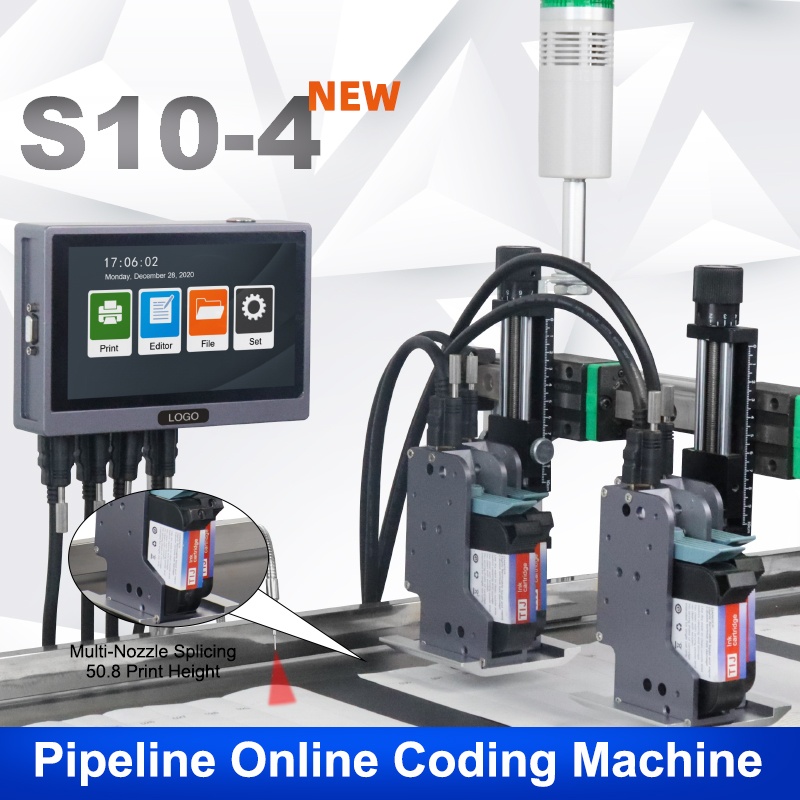
S10-4 online inkjet printer (standalone)
the four-head build for wide blocks in one pass:
- 2-50.8mm print height
- 2-5mm throw distance
- Prints Chinese, English, date, QR code and barcode
- Marks metal, plastic, pipe, foam and carton
- Industrial Grade Standard Protective Body/Aviation Aluminum/Industrial Stainless Steel body
The sealed body keeps a night shift predictable. Dust reaches a control board through a cracked case long before a nozzle, and a panel that closes properly is cheaper than a service visit. The mechanism is described under inkjet printing.
Related Questions
- Can it run with no operator at all
- For a single code and a stable line, yes, provided the fault alarm reaches a phone.
- Is a touch screen needed
- Not for printing, but it removes a laptop from every changeover.
- Does speed change the trigger
- Yes, and an encoder on the driven roller keeps the code in step through a ramp.
Send the Code File and the Line Speed
Send the layout, character height and belt speed at the head. We will set the trigger offset and print height on a sample and return the figures, so the automatic inkjet printer you buy arrives with a starting point.
Next Steps
- What a wide block does to cycle time: four speed traps on a conveyor line.
- Start at the contact page, on +86 17625427465 or kuangcy@126.com. We reply within 24 hours.
Need help choosing the right printer?
Talk to our engineers for a free production-line assessment and quotation.
Request a Quote