Last Updated: 2026-11-12
A barcode that fails a scan can cost a full pallet in a rework bay. A barcode printer covers two quite different machines, and the choice between them comes down to where the code has to live for the rest of the journey.
Two Machines Share One Name
The first prints onto a die cut label, which is then applied by hand or by an applicator. The second marks the board directly, with no liner, no roll and no applicator to buy.
Both are called a barcode printer in the trade, and buyers regularly compare quotes across the two. The comparison is unfair, because one sells a consumable and the other sells a head.
Bar Width Is the Only Number That Matters
A linear code is defined by its narrow bar, the X dimension, usually quoted in mil. Everything else in the symbol is a multiple of that one measurement, including the quiet zone at each end. The structure is defined under barcode.
A printer either holds the X dimension or it does not. A head that lays a wet dot down on absorbent board spreads it, which widens the narrow bar more than the wide bar and distorts the ratio a reader expects.
Direct Marking and the Board
Board is forgiving on size and unforgiving on spread. A direct mark at six hundred dots per inch keeps the bar edges tight enough for a code rated at ten mil, and no tighter.
The quiet zone gets forgotten. Ten times the narrow bar of clear space is part of the symbol, and a code printed hard against a printed panel fails for a reason no setting can fix.
Where a Barcode Printer Stops
Small symbols on glossy stock belong to the label route. A five mil code needs a surface that does not drink the fluid, and that is a label, not a carton.
High volume on flat cases belongs to the direct route. Once a plant is buying thousands of labels a month, the consumable cost overtakes the head cost and the arithmetic changes against an ISO 9001 cost base.
The Head We Use for Direct Marks
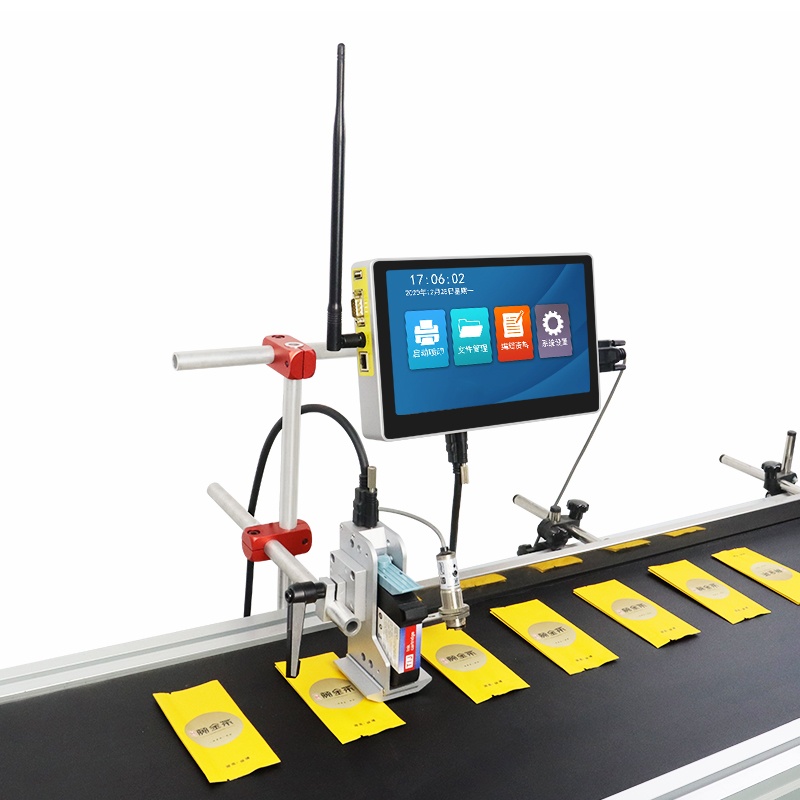
S100 Online inkjet printer
a ten inch screen and a three kilogram head for a case line:
- Prints up to 100 m/min
- 600dpi HD print accuracy
- 10-inch touchscreen
- 2-5mm throw distance
- Weighs only 3 kg
The two to five millimetre throw keeps the bar edges tight. Mounted close on a guide rail, the head lays the same dot in the same place on every case, and that repeatability is what a scanner reads.
Related Questions
- Can the same unit print a code and a date
- Yes. One layout can carry a linear symbol, a date and a batch block, which is why direct marking removes the label step entirely.
- Is a label sharper than a direct mark
- At small X dimensions, yes. Thermal label stock holds a five mil bar that board cannot, so the route follows the symbol rather than the budget.
- What about a two dimensional code
- Direct marking handles those better than linear codes, since a square grid forgives a little spread where a bar ratio does not.
Send the Symbol and the Substrate
Tell us the X dimension and what the code lands on. We will say whether a barcode printer should mark the board or lay a label, and send a scanned sample of the code on your own stock.
Next Steps
- Shop floor checks: five tests before you commit.
- The symbols involved: five symbol types explained.
- Start at the contact page, on +86 17625427465 or kuangcy@126.com. We reply within 24 hours.
Need help choosing the right printer?
Talk to our engineers for a free production-line assessment and quotation.
Request a Quote