
Last Updated: 2026-11-12
The wrong cartridge fails quietly, weeks later, when a code rubs off in a crate. An inkjet printer ink cartridge is a fluid matched to a surface, and the four families cover four very different jobs. Choosing between them is a paperwork exercise as much as a technical one.
Four Families, Four Surfaces
Solvent grades bite into non-porous surfaces such as film, metal and coated board. Water based grades suit absorbent stock, where the fluid soaks in and dries without attacking anything.
Food grade grades are chosen for what they may touch rather than how fast they dry, and invisible grades fluoresce under a lamp so a mark can be hidden until it is checked.
Solvent and the Non-Porous Job
On a glossy surface there is nothing to absorb the fluid, so drying has to happen by evaporation. That is why a solvent grade dries in seconds and why it smells the way it does in a closed room.
The trade is the print face. A solvent grade left uncapped skins over faster than a water based one, so the habit of capping between runs matters more, not less, with the fluid that dries fastest.
Food Grade and the Rules Behind It
A food grade cartridge is a documentation product as much as a fluid. The certificate names what may contact food, and an auditor asks for it before asking anything about the printer.
That is the reason to keep one grade per line rather than an assortment. Mixed stock on a shelf is how an unapproved cartridge ends up in a head on an inspection day, and no ISO 9001 audit will accept a verbal answer.
What a Wrong Inkjet Printer Ink Cartridge Costs
The first cost is a reprint run, which is visible. The second is a rejected pallet found at the customer, which is not, and that is the one that changes a supplier relationship.
The third is the head. A fluid that is not meant for the surface often needs a stronger carrier, and the carrier is what attacks the face over a few months rather than a few days. The mechanism of a print cartridge is described under ink cartridge.
The Grade We Stock for Food Packs
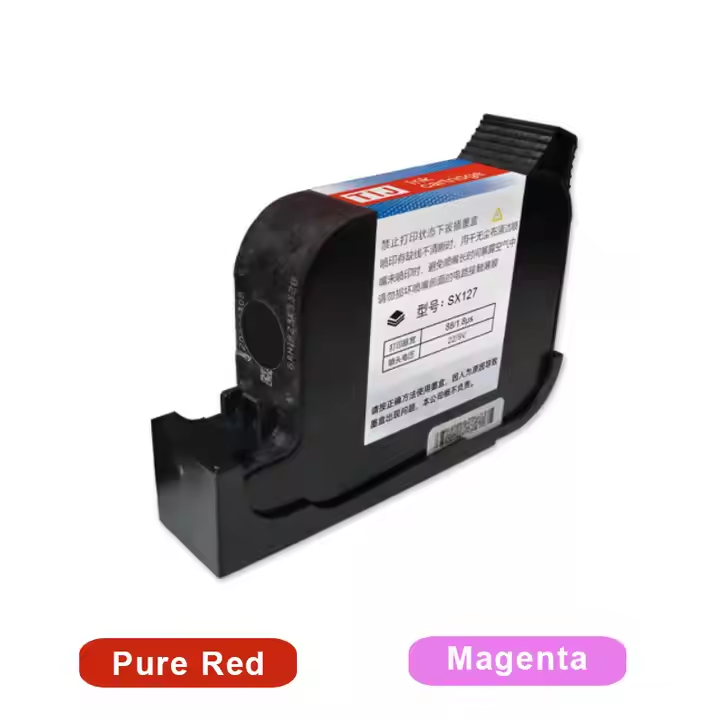
SX127 Food grade ink cartridges
a grade built for stock that touches food:
- 300 DPI print accuracy
- 2-6m throw distance
- Ink dries in 2-10s
- 12.7mm(1-inch) nozzle height
- Marks non permeable materials
The two to six metre throw is unusual and worth noting. It lets the head stand off from a curved or awkward pack, which on a food line is often the only position that clears the guarding.
Related Questions
- Can one cartridge cover several materials
- Rarely well. A grade proved on film and a grade proved on board behave differently, so most plants keep two rather than compromise on one.
- How long does a cartridge keep
- Months in unopened stock and weeks once opened. Writing the opening date on the body is the practice that keeps older stock moving first.
- Is a cheaper compatible cartridge safe
- Only against a certificate. The saving is real and so is the risk, and on a food line the paperwork decides.
Send the Pack and the Grade You Use
Send the pack and the grade currently on the shelf. We check the pairing and, where it is wrong, say so before the order, so the cartridge you buy matches the surface it has to sit on for the life of the pack.
Next Steps
- Where cartridges stop: the limit of a cartridge head.
- The solvent side: when a solvent grade is required.
- Start at the contact page, on +86 17625427465 or kuangcy@126.com. We reply within 24 hours.
Need help choosing the right printer?
Talk to our engineers for a free production-line assessment and quotation.
Request a Quote