
Last Updated: 2026-11-12
A mark that survives a wash and a hard rub is rarely printed at all. A laser coding machine alters the surface rather than laying something on it, so there is no drying time, nothing to smear and no consumable to reorder between the line and the pallet.
Six Parts, One Mark
The cabinet holds the source, the marking head carries the steering mirrors and the flat field optic, and the controller turns a layout into movement. Extraction, the fixture and the enclosure finish the list.
Each part owns a failure mode. Hazing on the optic, a fixture that lets the part shift, and weak extraction all read as a bad mark, so service is diagnosis rather than replacement. The principle is described under laser engraving.
What the Surface Decides
On metal the mark is usually a local melt or an oxide change, and it is permanent. On coated board the coating changes colour, which works until the coating runs out at a crease.
Transparent film is the awkward case. A mark that is invisible at one angle and obvious at another is a lighting problem rather than a setting problem, and it is settled by testing the actual film.
Contrast Is the Specification
Buyers ask for depth when they should ask for contrast. A shallow mark with strong contrast reads on a camera, while a deep mark on the same part can be invisible under the inspection light the customer uses.
So the sample matters more than the wattage. Two sources of the same rating can produce different contrast on the same alloy, and the only way to know is to mark the part the line actually handles.
Where a Laser Coding Machine Loses
Colour is the first limit. A laser changes what is already there, so a red mark on a white carton needs a coating that reacts, not a source with more power.
Cost per mark favours the class at volume. A plant printing a few hundred codes a week on board usually finds a fluid unit cheaper to own, and the crossover is worth calculating against an ISO 9001 cost model before the order.
The Build for Metal Parts
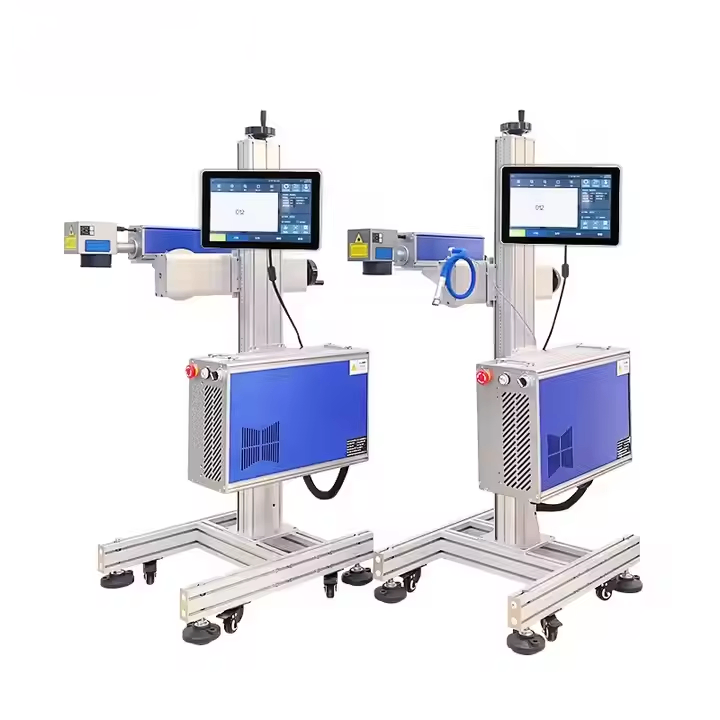
G-20 Fiber laser inkjet printer
an air cooled cabinet for a bench or a line:
- Fiber laser output options from 20W to 100W
- Permanent marks on metal without consumables
- Air-cooled design for continuous duty
- Marks hardware, electronics and metal parts
Air cooling is what makes a cabinet viable next to a line. There is no water circuit to service, so the maintenance list is a clean optic, a clear filter and a fixture check rather than a chiller.
Related Questions
- Can it mark a curved part
- With a rotary axis and the right fixture, yes. Without a fixture the focal distance drifts across the curve, and the mark fades at the edges.
- Does it need fume extraction
- On coated board, painted metal and most plastics, yes. The fume is the reason an enclosure is specified rather than optional.
- How long does the source last
- Long enough that it is rarely the first failure. Optics, fixtures and extraction cause most of the service calls on a properly cooled cabinet.
Send the Part and the Layout
Send one part and the layout you need on it. We mark it, photograph it under your inspection light and return the contrast reading, so the laser coding machine you order is specified by result rather than by wattage.
Next Steps
- The wider family: what a fiber marking system covers.
- The class in one page: what a laser coding machine is.
- Start at the contact page, on +86 17625427465 or kuangcy@126.com. We reply within 24 hours.
Need help choosing the right printer?
Talk to our engineers for a free production-line assessment and quotation.
Request a Quote