Fiber laser marking uses a glass-fiber amplifier rather than a gas tube or a crystal rod to generate a 1064 nm beam that marks metal and plastic with no consumables, no warm-up, and almost no maintenance. The fiber source is what sets it apart: it is sealed, air-cooled, and rated for tens of thousands of hours, which is why it has become the default for metal traceability on production lines.
The Short Answer
Four technical points explain why fiber laser marking dominates metal coding. The fiber source itself is the first: a diode-pumped rare-earth fiber delivers a near-diffraction-limited beam (M² < 1.2) that produces fine, high-contrast marks at small spot sizes. Source life is the second: a rated industrial fiber source runs 100,000 hours or more with no alignment, no mirror cleaning, and no gas refill, which is a different cost curve from a CO₂ tube that needs periodic replacement. Wavelength is the third: 1064 nm is absorbed well by most metals and many dark plastics but not by organics or clear glass, which need CO₂ or UV. Beam quality and galvo speed close the set: a fast scanner marks a 100-character data matrix in under a second at consistent depth.
In practice, fiber laser marking is judged like any production tool: does the code stay readable through handling, storage, and the customer’s checks? On metals, the answer is usually yes, because the mark is annealed into the surface, not printed on top.
It also helps to know what fiber laser marking is not: it is not a universal marker. Clear plastics, glass, and organic materials often need a different wavelength, so confirm the material list before specifying a fiber source.
What to Know in Practice
Routine care on a fiber laser marking system is light by design. Because the source is sealed and there are no mirrors to align, the main wear items are the F-theta lens and the protective window. Factory dust and marking fume settle on the glass and steal beam power long before the fiber source degrades. Inspect and clean optics weekly on daily-running units, verify focus with a test mark when the part height changes, and keep a spare window on the shelf. A stable mains supply and fume extraction prevent most downtime that gets blamed on the laser.
Whatever your throughput target, budget for optic cleaning supplies and a protective window replacement, and plan for a source retrofit only after many years of multi-shift running. The low running cost is the main reason lines move to fiber laser marking.
About SHICAI
SHICAI supplies fiber laser marking systems built around genuine rated fiber sources for metal traceability on production lines. The company ships to overseas factories, confirms source brand and rated life at spec, and arranges service and spares for export markets. The technical team answers questions directly rather than through a reseller chain.
Related Questions About Fiber Laser Marking
- How long does a fiber laser marking source last?
- A rated industrial fiber source is commonly specified for 100,000 hours or more, which is several years of two-shift operation with no mirror alignment or gas refill.
- Can fiber laser marking work on plastic?
- Many dark and pigmented plastics mark well at 1064 nm, but clear or light-coloured plastics often need a UV source. Ask for a sample mark on your actual material before specifying.
- How do I keep a fiber laser marking system running reliably?
- Clean the F-theta lens and protective window on a schedule, verify focus when part height changes, and run a test mark at each shift start. The fiber source itself is essentially maintenance-free.
Fiber Laser Marking Worth Looking At
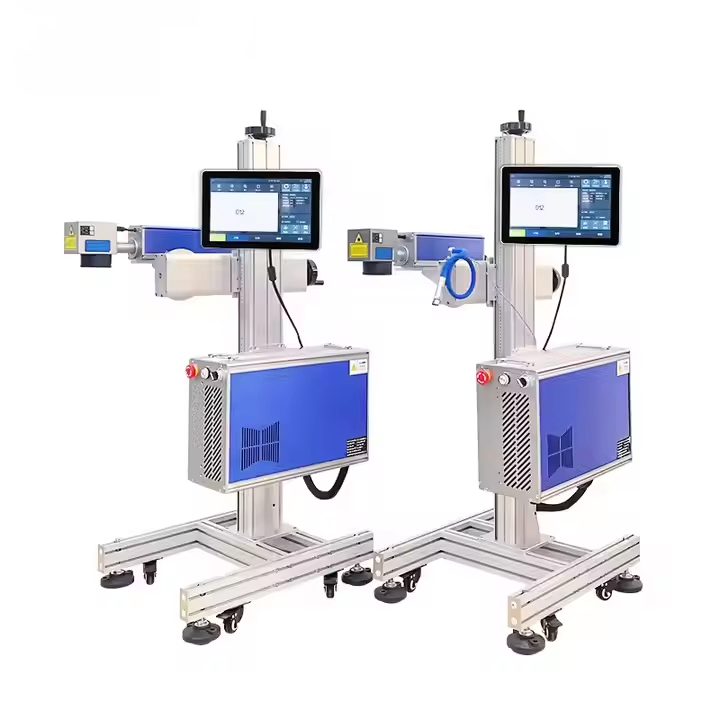
G-20 Fiber laser inkjet printer is built for this kind of work. Click the image to see the product page.
laser engraving technology See also: ISO 9001 quality management.
Need help choosing the right printer?
Talk to our engineers for a free production-line assessment and quotation.
Request a Quote