Last Updated: 2026-09-02
A smeared date code can send a whole pallet back to relabeling. The CIJ vs TIJ printer choice comes down to speed, substrate, and how much maintenance your team can absorb: CIJ prints fast on almost any surface with solvent inks, while TIJ runs cleaner from sealed cartridges at moderate speeds. This guide breaks down which fits your line.
The Short Answer
Both technologies put ink on a moving product, but they get there differently. A CIJ printer pushes a continuous, electrically charged ink stream through a nozzle and deflects it into characters, so it keeps up with fast lines and prints on curved, coated, or greasy surfaces. A TIJ printer heats tiny resistors inside a sealed cartridge to release drops on demand, which keeps day-to-day handling clean and makes the consumable a simple swap.
| CIJ | TIJ | |
|---|---|---|
| Line speed | High, built for continuous production | Moderate, suited to short runs |
| Substrates | Almost any, including curved and coated | Best on cartons and porous materials |
| Daily care | Ink and make-up checks, scheduled flush | Cartridge change, light head wipe |
| Typical job | Date coding on filling and packing lines | Case coding, labels, workbench marking |
Pick CIJ when the line runs fast, the surface is difficult, or the code must survive handling. Pick TIJ when volumes are moderate, the substrate absorbs ink well, and the team values simple consumables. In the CIJ vs TIJ printer debate the honest answer is application-driven, and the table above is the fastest way to test your case.
What to Know in Practice
Routine care is mostly prevention. Keep the printhead clean, run the cleaning cycle at start and shutdown, and flush the nozzle edge when codes start to blur or skip. Check ink and make-up levels daily on running lines; running dry pulls air into the system and causes the faults people blame on the machine. Change filters and consumables on the schedule the builder gives you.
About SHICAI
SHICAI builds a complete continuous inkjet (CIJ) line for high-speed production coding. The company ships to overseas production lines and warehouses, and specifies genuine industrial printheads and ink systems so the machine runs to its rated life. Service and spares are arranged for export markets, and the technical team answers questions directly rather than through a reseller chain.
Related Questions
- How often does a CIJ printer need maintenance?
- Modern CIJ heads run a cleaning cycle automatically, but daily production still means checking ink and make-up levels; most lines budget a short weekly flush to keep the nozzle edge clean.
- Which is cheaper to run, CIJ or TIJ?
- TIJ costs less to service because the cartridge is the consumable; CIJ usually wins on cost per code at high volume. Compare on your actual monthly output, not on the sticker price.
- Can a TIJ printer mark plastic or film?
- It can, with the right cartridge formulation, but adhesion and durability should be verified on your actual material before you commit. Ask for sample prints first.
A Model Worth Looking At
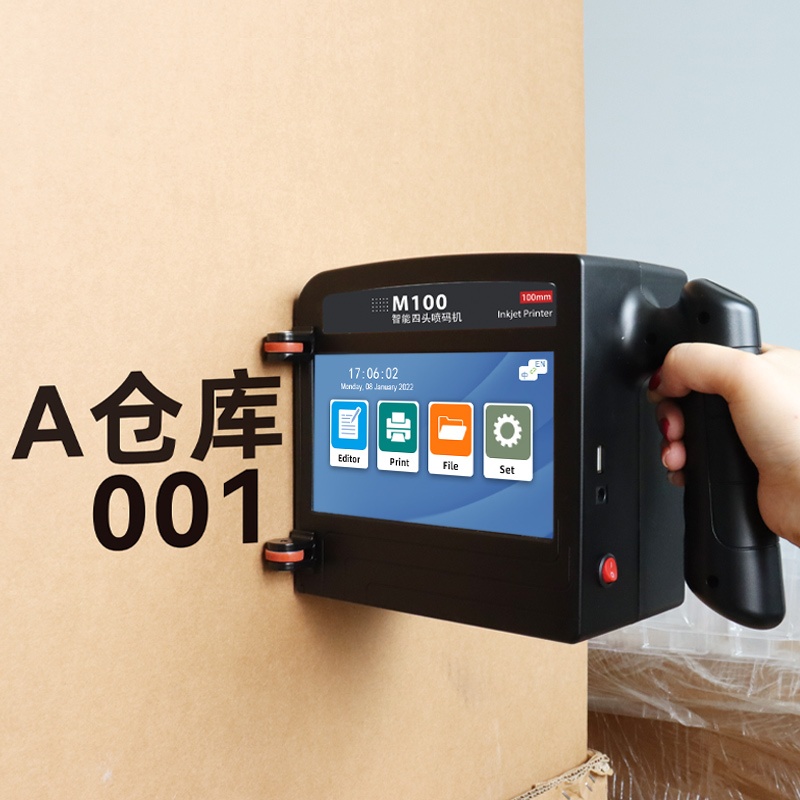
M100 Handheld inkjet printer is built for this kind of work. Click the image to see the product page.
Learn more about continuous inkjet technology and ISO 9001 quality management.
Next Steps
- Read related FAQ guides on coding and marking basics.
- See the M100 Handheld inkjet printer if you need a coder for this job.
- Get a free sample print on your material. No commitment, reply within 24 hours.
Need help choosing the right printer?
Talk to our engineers for a free production-line assessment and quotation.
Request a Quote