
Last Updated: 2026-10-09
The continuous inkjet printer working principle is easy to state and hard to hold. A nozzle breaks ink into a uniform droplet chain; each drop is charged, deflected by a field, and either lands as a code or is caught and recirculated. Five steps keep that chain clean.
The Continuous Inkjet Printer Working Principle in Five Steps
Start at the nozzle. Ink is pumped through a small orifice under steady pressure, and a piezoelectric crystal vibrates the stream so it breaks into a chain of identical drops at a fixed rate. An uneven break-off is the root of most later faults.
A charging electrode then gives each drop a value. Drops that will form the character receive a charge and the rest receive none. Downstream, a pair of deflection plates pushes the charged drops sideways by an amount set by that charge, which is how one stream writes a character while the pack keeps moving.
Drops with no charge fly straight into a gutter and return to the ink system. Nothing is wasted and nothing touches the pack until the moment of printing, which is why CIJ suits a surface that will not hold a stencil or a label.
Why the Same Principle Decides Your Maintenance
The continuous inkjet printer working principle rarely fails on its own. Because the drop is built from a fluid, three things away from the printhead decide whether the code reads:
- Ink viscosity. The chain breaks evenly only inside a narrow viscosity band, so temperature and solvent loss matter more than most operators expect.
- Nozzle condition. A partial blockage skews the whole chain, so one dirty nozzle softens every character rather than one.
- Charge timing. The electrode has microseconds to set each drop, so a drifting encoder shows up as wavy characters rather than a missing one.
None of these is a printer fault in the ordinary sense. All three are settled by the ink grade and by a start-up routine that checks the chain before the line runs. The published description of inkjet printing covers the same physics from the other direction, and ISO 9001 quality management is where the ink grade for your surface gets approved.
How SHICAI Builds a CIJ Head
SHICAI builds continuous inkjet units around the same principle, with one difference in practice: every head leaves with a start-up routine written for the ink the customer will actually run, not for a lab fluid.
The frame below is a CIJ inkjet printer built for high-speed lines, and its rated power is low enough to share a standard panel. Heads are set for the character height you need, and a 400 m/min ceiling leaves headroom for a conveyor that is not perfectly steady.
Related Questions
- What happens if a CIJ printer is left idle for a week?
- The nozzle dries and the chain will not break evenly on restart. A short purge before start-up, and a sealed nozzle cap while idle, prevents most of it.
- Why does a CIJ printer need a solvent top-up?
- Ink loses solvent as it circulates, so the viscosity band has to be restored. The top-up rate is a consequence of the working principle, not a fault.
- Can CIJ print on a curved surface?
- Yes, because the head never touches the pack. Deflection does the work, so a drop reaches a curve much as it reaches a flat panel.
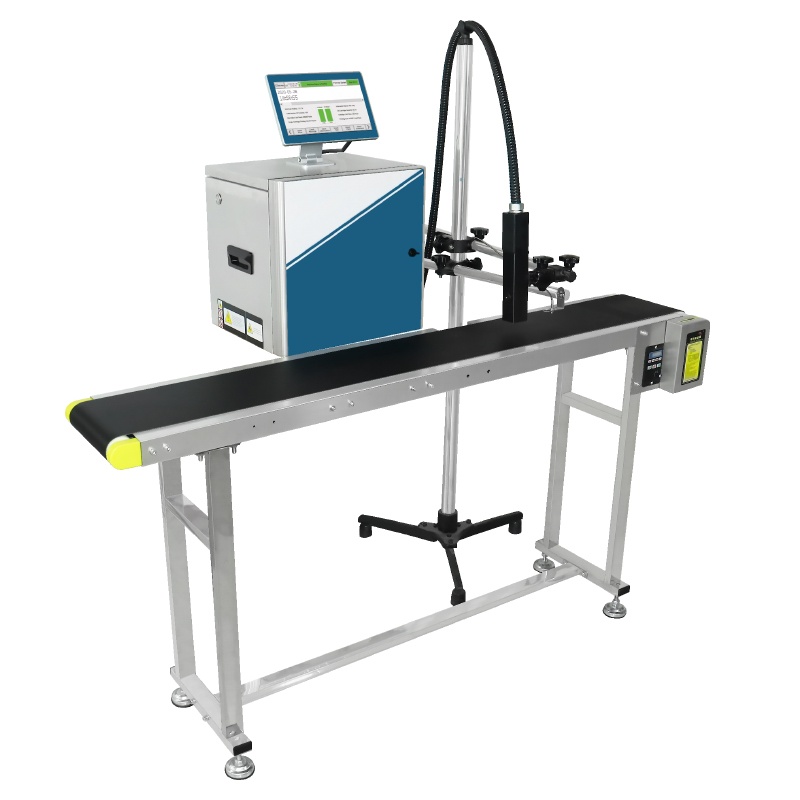
S1000 small character inkjet printer
a CIJ head built for a line that never slows:
- Prints up to 400 Meters Per Minute
- 2-20mm print height
- 10.1-Inch Industrial Touchscreen
See the Principle Running
- See the machine: S1000 small character inkjet printer
- Read next: what 400 m/min really asks of a printhead, which is the same chain under load
- Talk to us: send your substrate and line speed through our contact page. We return the ink grade and head setting for your line, free of charge.
Need help choosing the right printer?
Talk to our engineers for a free production-line assessment and quotation.
Request a Quote