Last Updated: 2026-09-30
An unreadable egg cannot be traced. An egg marking machine works against three things at once: the shell is curved, porous, and usually cool and wet where the mark has to land. A legible code past wash, grading and candling comes down to grade, height and presentation.
Why an Egg Marking Machine Meets a Hard Surface
An eggshell is calcium carbonate with a bloom of cuticle over it, and it carries moisture from washing. Ink cannot soak into it the way it soaks into carton board, so the mark has to sit and set on a curved, cool, partly wet surface while the egg is still moving. Print too little and the code vanishes in transit; print too heavy and the droplets run down the curve.
That is why egg grading and marking usually sit at the same station: the grader has already presented the egg the right way up, dry enough, at a fixed height, which is precisely the condition a legible mark needs. How inkjet printing places and sets droplets covers the mechanism behind the wetting problem.
What a Practical Egg Line Needs
| Requirement | Why it matters on shell | What to check |
|---|---|---|
| Ink grade | The mark contacts a food shell, not a package outside it | Food-grade, water-based and oil-based ink options offered for the machine |
| Height control | A small curved face has no room for a tall block | 2-12.7 mm adjustable print height |
| Code content | Pack and lot identity has to travel with the egg | Prints letters, numbers, logos, QR codes and dates on eggs |
| Operator interface | Lines change grades and layouts through a shift | 5.0-inch touch screen editable at the machine |
| Shell condition | Moisture and cuticle break ink contact | Print after wash and dry, before nesting |
How SHICAI Approaches It
SHICAI builds coding equipment for export markets, and egg lines are where a general-purpose coder most often fails, because the substrate does the testing. The approach is to specify the grade first: food-grade, water-based or oil-based ink options are chosen against how the shell leaves your washer, then the height and layout are set around it. A sample of your own eggs is printed and inspected before a machine is proposed. That is the order an egg marking machine should be specified in, and it is what ISO 9001 quality management asks of any supplier whose mark has to survive a wash line.
Egg marking questions
- Can eggs be marked after they are packed?
- Not practically. The shell has to be dry and presented to the head, and once eggs are nested in a pallet the surfaces are too close together for a clean pass. Marking sits before packing in most lines.
- What decides whether the mark stays legible?
- Shell condition and ink grade. A clean, dry shell takes the mark; oil, cuticle residue or wash water on the surface breaks contact and the code beads. Food-grade water-based and oil-based options exist for exactly this reason.
- Is a larger print height better on eggs?
- Only up to the point the shell allows. Height costs contact pressure and ink volume on a small curved surface, so most egg marks stay in the low millimetre range and rely on contrast rather than size.
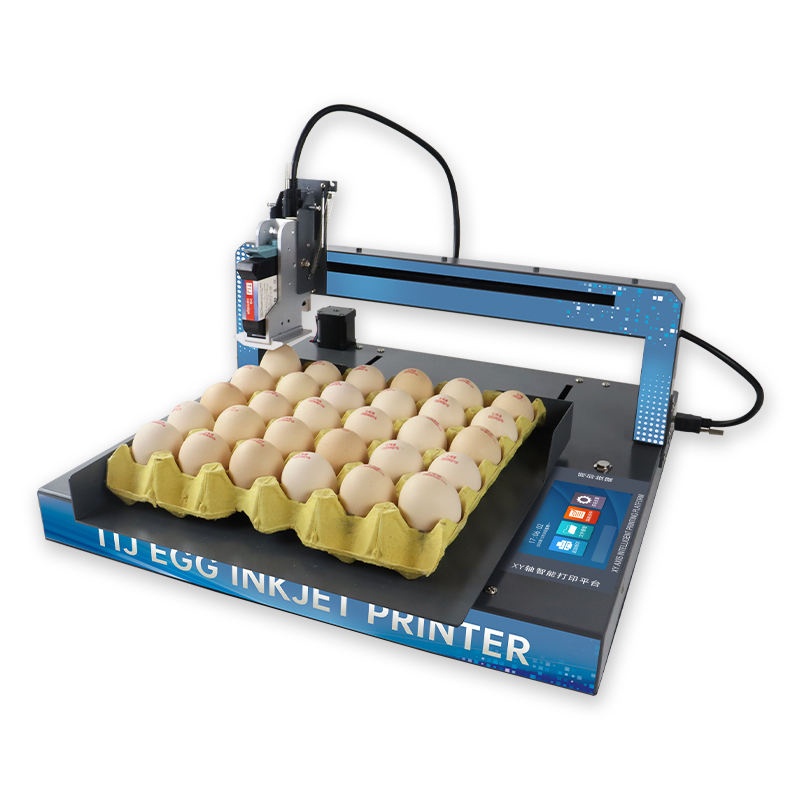
XY110 Egg inkjet printer
the frame for this duty:
- Food-grade, water-based and oil-based ink options
- 2-12.7 mm adjustable print height
- Prints letters, numbers, logos, QR codes and dates on eggs
Where to check next
- Check the consumable side first: what a food-grade ink cartridge is and when it is required.
- Compare frames in which egg coding machine fits your farm.
- Send a dozen of your eggs through our contact page. We mark them and tell you what survives handling, free of charge, reply within 24 hours.
Need help choosing the right printer?
Talk to our engineers for a free production-line assessment and quotation.
Request a Quote