
Last Updated: 2026-09-07
Eggs are porous, curved, wet, and eaten, which makes them one of the hardest surfaces to code. How to print on eggs comes down to five requirements, and skipping any one of them produces codes that fade, smear, or fail a food-safety audit.
The Short Answer
Five requirements cover the job:
One: food-grade ink certified for direct contact in your market, because the code sits on a shell that is handled and sometimes eaten through. Two: a non-contact method, since eggs crack under pressure, which rules out anything that touches the shell. Three: correct throw distance, typically a few millimeters, so drops land sharply on a curved surface. Four: clean, dry shells, because dust and moisture defeat adhesion no matter how good the ink is. Five: verification after handling, not just at the printer.
| Requirement | Why it matters |
|---|---|
| Food-grade ink | Direct contact with an edible product |
| Non-contact printing | Shells crack under pressure |
| Short throw distance | Curved surface, small code |
| Clean dry shells | Dust and moisture block adhesion |
| Post-handling check | Codes must survive packing and transport |
Speed matters too: grading lines move fast, so multi-head arrays keep pace where a single head would bottleneck the line.
What to Know in Practice
Test the way eggs actually travel. Print a sample tray, run it through your washer, chiller, and packing line, then read the code under the lighting your graders use. Shell quality varies with flock age and diet, so a formulation that holds on one batch can fade on the next.
Keep the certification paperwork with the line. Auditors ask which ink, which standard, and which jurisdiction, and the answer should be a document rather than a memory. Verify the certificate scope names direct food contact, not just general food-safe handling.
About SHICAI
SHICAI builds industrial coding and marking equipment across inkjet and laser lines, for production and warehouse use. Machines ship with genuine components and tested consumables, and service and spares are arranged for export markets. The technical team answers directly rather than through a reseller chain.
Related Questions
- What ink is used for printing on eggs?
- Food-grade water-based inks certified for direct contact with eggshell. The certificate should name the standard and jurisdiction that applies to your market.
- Can eggs be coded at grading-line speed?
- Yes, with multi-head arrays that print several lanes in parallel. A single head suits small flocks; high-speed grading needs parallel nozzles.
- Do egg codes survive washing?
- They can, with the right formulation and full cure time before washing. Always verify on actual shells from your line rather than on a sample carton.
A Model Worth Looking At
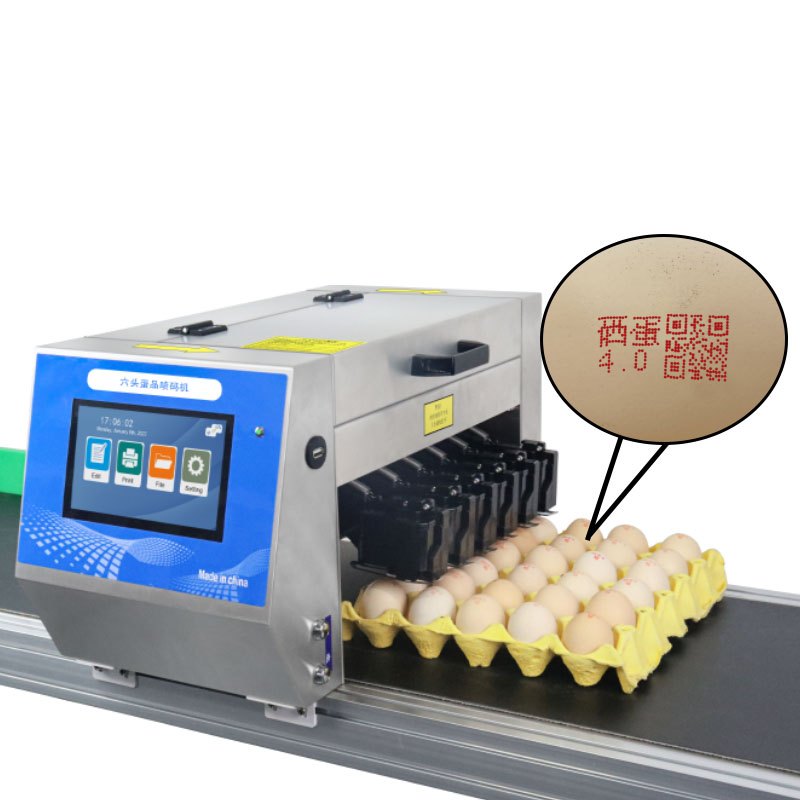
Six head egg inkjet printer (D100-6) is built for this kind of work:
- Prints up to 20 trays per minute (5 x 6 trays standard)
- 2-5 mm optimal throw distance
- Food-grade water-based red ink
Click the image to see the product page.
Learn more about traceability and ISO 9001 quality management.
Next Steps
- Read related FAQ guides on coding and marking basics.
- See the six-head egg inkjet printer for grading-line throughput.
- Get a free sample print on your material. No commitment, reply within 24 hours.
Need help choosing the right printer?
Talk to our engineers for a free production-line assessment and quotation.
Request a Quote