
Last Updated: 2026-10-28
A manual inkjet printer is accurate enough whenever the operator, not the belt, sets the pace. The print head resolves 600 dpi on a still surface and smears the moment the hand accelerates, so the practical limit is not the specification, it is how evenly a person can sweep past a carton.
The Short Answer on a Manual Inkjet Printer
Yes, for short runs, oversized parts and sites with no conveyor. The unit fires dots on a fixed clock while the operator moves the head, so a steady sweep gives a clean block and a jerky one gives a stretched one.
What it controls is the electronics, not the human. Two operators on one unit can produce two very different marks from the same file.
Where a Manual Inkjet Printer Stops Being Enough
Three conditions end the argument for hand-held work. Volume is the first: past a few hundred pieces a day, fatigue shows in the last hour of the shift. Character height is the second, because a 2 mm font forgives a wobble far less than a 12 mm one.
The third is regulatory. A code reconciled against a production record needs a trigger that fires at the same point on every item, which a human hand cannot promise in an audit.
| Job | Hand-held verdict | Why |
|---|---|---|
| Pallet and drum marking | Good fit | Large block, few pieces, no line |
| Cartons in a storeroom | Good fit | Operator places each box anyway |
| 500 bottles an hour | Poor fit | Fatigue and drift over a shift |
| 2 mm batch code | Poor fit | Tiny type exposes hand speed changes |
Most buyers disappointed by a hand-held unit bought it for a job on the bottom two rows.
Three Habits That Keep It Accurate
Rest the nose of the unit on the surface and slide rather than holding it in the air. A head that touches the substrate keeps a constant throw distance, and that keeps the block the same height from the first carton to the last.
Set the speed to how fast the operator actually moves, not how fast the datasheet allows. Mark ten pieces, read them at arm’s length in the light the customer uses, and adjust height rather than speed when edges soften. Ink follows the surface: a porous carton takes a water-based grade, and a shrink-wrapped pallet needs one that keys to film.
What SHICAI Ships With a Hand-Held Unit
Our hand-held builds leave with a printed reference block at the height the buyer sent, so a new operator compares against a known good sample instead of guessing. Spares and support are organised for export markets under ISO 9001 quality management.
The Unit Most Buyers Start With
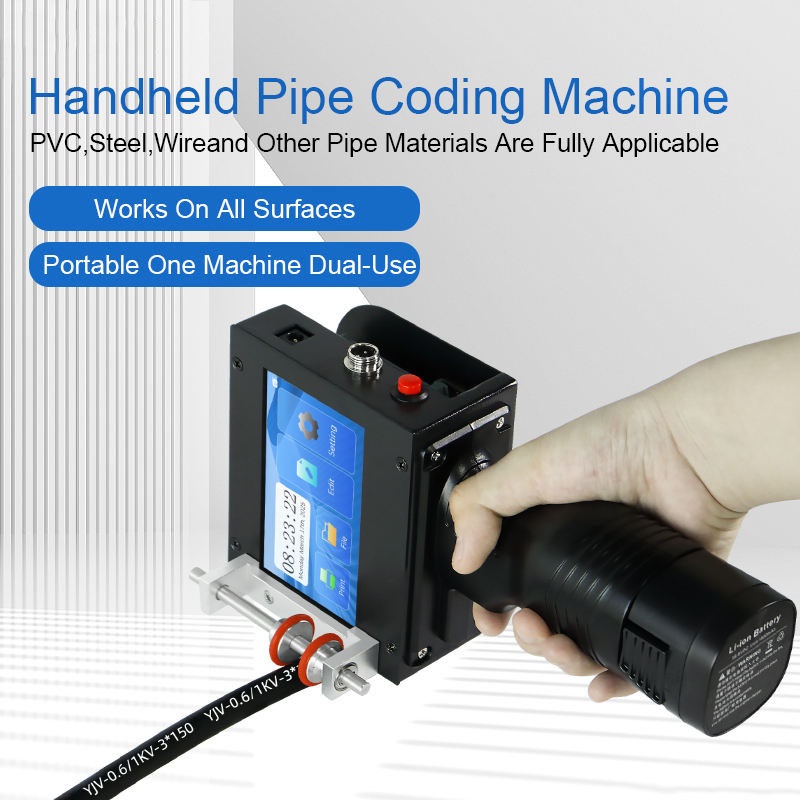
MX3-G Handheld Inkjet Printer
the touch-screen build behind most of these jobs:
- 600dpi print accuracy
- 2-12.7mm print height
- 4.3 Inch Touch Screen
- 2-5mm throw distance
- Available in 7 ink colors
The 2 to 12.7 mm range lets one unit serve a pallet and a small carton, and seven ink colours matter once a buyer marks dark board with a light grade. It is inkjet printing on demand, so there is no make-up fluid between shifts.
Related Questions
- Can a hand-held print a scannable QR code
- Yes, at 12 mm square or larger, and the code needs a slower sweep than a date line.
- Does it print on curved surfaces
- On gentle curves with the nose held square, and poorly on a tight radius without a guide.
- How long does a cartridge last
- Longer than most buyers expect on large type and far shorter on dense codes, so buy on dots rather than days.
Send a Carton and the Type Height
Send one carton from the actual run and the character height you need. We mark it, photograph the block at reading distance and return the setting, so the manual inkjet printer is proved on your board.
Next Steps
- Where hand-held work ends: what 50 m/min hides.
- Start at the contact page, on +86 17625427465 or kuangcy@126.com. We reply within 24 hours.
Need help choosing the right printer?
Talk to our engineers for a free production-line assessment and quotation.
Request a Quote