Last Updated: 2026-09-30
A line that stops for a printhead teaches you faster than any datasheet. So when people shortlist an alternative to Markem Imaje, the useful comparison is not brand against brand: it is print capability, consumable route, support reach and integration work, measured on your own product.
What the Comparison Is Actually About
Continuous inkjet is a mature category served by several long-established suppliers as well as newer factory-direct builders. The machines in that band do broadly the same job, so a decision framed as brand loyalty tends to reproduce the same invoice with different paperwork. What differs in practice is how a fault is reached, how quickly consumables arrive, and how much of the specification is negotiable.
That is also why an alternative to Markem Imaje should be tested on your substrate and your line, not on a demonstration board. The mechanics of charging and deflecting droplets are described in the Wikipedia article on continuous inkjet printing, which is a neutral reference when two suppliers describe the same duty in different words.
Four Things to Compare Before Choosing an Alternative to Markem Imaje
| Dimension | What to ask of each supplier | SHICAI position |
|---|---|---|
| Print capability | Height range and rate at your character size, on your product | Prints up to 400 m/min, 2-20mm height on the small character frame |
| Code content | Dates, lot codes, serials and symbols from one controller | Prints multilingual characters, variable QR codes, barcodes, dates and serial numbers |
| Integration | What the coder connects to on your line | USB/RS232/TCP/IP Network Interface connectivity |
| Support route | Who answers, in what language, with what parts on hand | Factory-direct, engineers who assembled the unit, spares arranged for export markets |
What SHICAI Brings to It
SHICAI builds industrial coding and marking equipment in China and sells direct, without a reseller layer in the price. On the small character range that means a head rated at 400 m/min, a code that can carry dates, lot numbers and serials in the same pass, and network interfaces so the machine talks to what is already on the line. Our own build process sits under ISO 9001 quality management. If a comparison ends with staying where you are, that is a legitimate answer, and we say so rather than quoting to win.
Switching questions
- What is the first thing to compare when replacing a CIJ printer?
- Print capability on your own pack, at your own speed. Character height, throw distance and drying window decide whether a candidate fits before price enters the conversation.
- Is a distributor or a factory-direct builder the safer choice?
- Neither is safer by default. A distributor usually answers on site and stocks parts locally; a factory-direct builder answers from the engineers who built the machine, with a shorter route to customization and no reseller margin. Choose against the support you can prove you have.
- How do I check a replacement will not slow the line?
- Run it at throughput on your product for a full shift and count misplaced or faint codes. A bench demo proves the head works; only a shift-length run proves it holds.
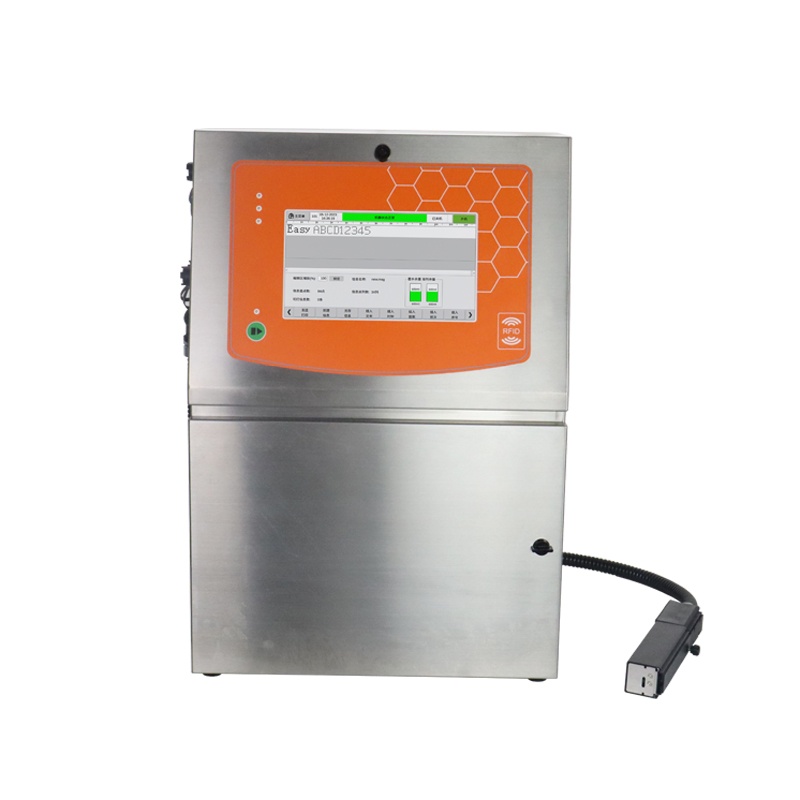
Small character inkjet printer
the CIJ frame described above:
- Prints up to 400 m/min
- Prints multilingual characters, variable QR codes, barcodes, dates and serial numbers
- USB/RS232/TCP/IP Network Interface connectivity
What to do next
- Start with the mechanism rather than the brand: how does a CIJ printer work.
- Then read six tests to run on any coding machine manufacturer.
- Tell us your line speed and product through our contact page. We print your code on your pack free of charge, with no commitment.
Need help choosing the right printer?
Talk to our engineers for a free production-line assessment and quotation.
Request a Quote