
Last Updated: 2026-10-20
An egg coding machine small business owners buy on price usually replace inside two seasons. What survives the second year is decided by four items that cost little at the start and a great deal later: ink access, height range, panel usability and a spare parts path.
What the First Year Hides From an Egg Printer Small Business
In the first season almost any unit appears to work. Volumes are modest, the same date string runs for weeks and one person marks every tray. The failures appear later, when a retailer adds a field, a second house joins the run, or the person who set the machine up leaves.
A small operation has no maintenance department, so whatever is bought must be adjustable between collections by the person loading trays.
Four Items an Egg Coding Machine Small Business Must Hold
| Item | What good looks like | What it prevents |
|---|---|---|
| Height range | One adjustment that covers a date line and a two-line batch string without swapping hardware | A second machine for a longer code |
| Panel | Editing a date with gloves on, standing at the bench | Retyping by trial and error in a cold shed |
| Ink path | Cartridges bought as a consumable, not as a proprietary kit | A code that is abandoned because ink is hard to restock |
| Spares | A named nozzle or print module available as a unit | Scrapping a working frame over one part |
None of the four is a number a catalogue highlights, and all four are answerable before the order. For an egg coding machine small business buyers should ask them in this order.
Matching the Build to Real Volume
Volume is where a small purchase goes wrong in both directions. A carried single-head build handles a few hundred trays a week comfortably and becomes the bottleneck at a few thousand. A six-nozzle bank makes light work of a graded line and is wasted money where there is no line to feed it.
The useful number is not the annual total but the busiest week, and within that week the busiest two hours. A flock that peaks on collection day needs a build that clears the peak without a second operator.
Where the peak is seasonal, one modest unit plus a bench jig beats an idle bank.
The Ink Question Settles Compliance
Shell contact is the constraint. Ink offered in food-grade water-based and oil-based options covers the porous shell and the coated one, and the grade must be declared for direct eggshell contact rather than for carton printing.
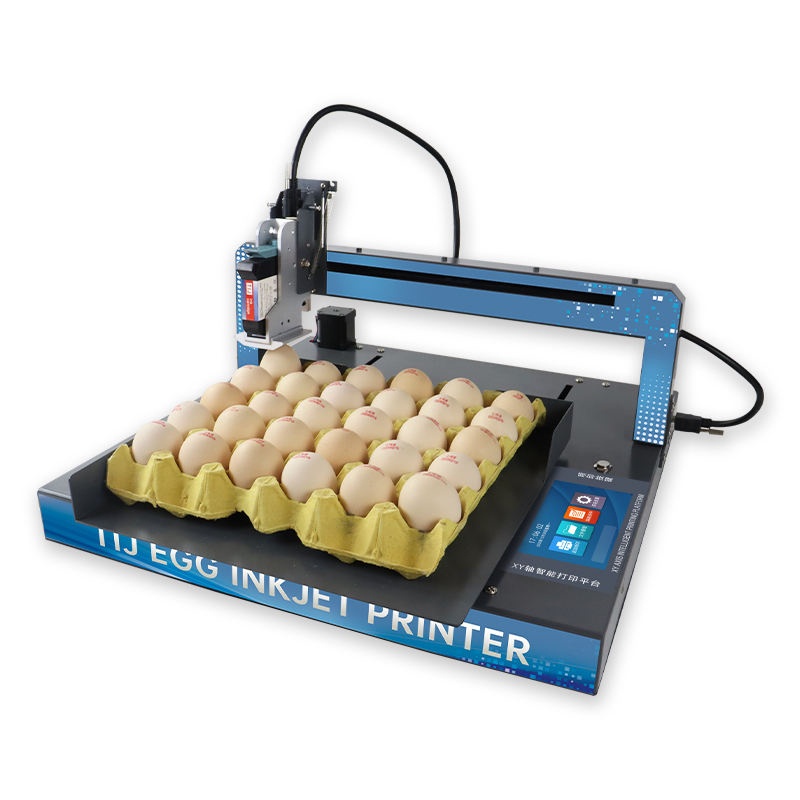
XY110 Egg inkjet printer
the entry build that covers the first years:
- 2-12.7 mm adjustable print height
- 5.0-inch touch screen
- Food-grade, water-based and oil-based ink options
- Prints letters, numbers, logos, QR codes and dates on eggs
It prints a date and a QR code in one pass, which answers a retailer who adds a code later. The build is produced under a documented ISO 9001 quality management system, described in ISO 9001 quality management.
Related Questions
- How many trays a week can one carried head manage?
- Several hundred, provided the trays are loaded one at a time at a bench. Past that the operator becomes the limit rather than the printer.
- Is a fixed bank ever cheaper than a portable unit?
- Only where a line already exists. Without a belt to dock to, the frame and installation cost more than the coding head itself.
- Can a small operation add a second field later?
- Yes, if the panel keeps templates. Adding a customer code is then an edit rather than a new purchase.
Send One Tray and Your Busiest Week
Tell us the busiest week and the fields the retailer asks for. We will name the build that clears that week without a second operator, and mark a sample tray before you decide.
Next Steps
- Send one loaded tray and the exact date string you print. We mark the shells and return the tray with a written setting sheet.
- Start at the contact page, on +86 17625427465 or kuangcy@126.com. We reply within 24 hours.
Need help choosing the right printer?
Talk to our engineers for a free production-line assessment and quotation.
Request a Quote