Last Updated: 2026-10-30
A drop on demand printer fires a drop only where the code needs one, so nothing circulates between marks. That single design fact explains the short flush at start-up, the cartridge rather than a fluid train, and the volume above which a continuous system becomes the cheaper answer.
The Short Answer on a Drop on Demand Printer
It prints on command. A thermal head boils a thin layer of ink so a bubble pushes a drop out, and a piezo head flexes a crystal; both wait for the signal and neither runs a pressurised stream. A continuous system charges drops and deflects them in flight.
The practical result is a machine that starts clean in seconds, sits idle without a flush cycle, and takes a sealed cartridge an operator can swap by hand. What it gives up is speed on very small characters.
Two Families Under One Name
| Family | How the drop forms | Where it fits |
|---|---|---|
| Thermal (TIJ) | A heater boils ink into a bubble | Cartons, labels, film, short and medium runs |
| Piezo (PIJ) | A crystal flexes and pushes the drop | Dense small text, solvent inks, longer duty |
| Continuous (CIJ) | Drops charged and deflected in flight | Very high speed, tiny characters, deep shifts |
The first two rows are both drop on demand and are often confused in a quotation. A thermal unit costs less to own; a piezo unit takes a wider ink range and holds a tighter dot at small sizes.
The third row is the one buyers compare against by mistake. A continuous head is not a better drop on demand printer but a different mechanism, and it pays only when the line runs fast enough to fund the fluid handling.
Where Drop on Demand Stops Paying
Three conditions push a plant back to continuous: characters under about 1.5 mm at speed, a duty cycle that runs three shifts without a stop, and a solvent outside the cartridge range.
Below those conditions the arithmetic favours on demand: no make-up fluid, no gutter cleaning, and a spare cartridge in a drawer instead of a service call.
Print quality rarely decides it, because at 600 dpi the limit on porous board is ink spreading, not resolution. That leaves the surface as the next question.
What SHICAI Ships With an On-Demand Build
Our builds leave with a printed reference block at the character height the buyer sent, so a new operator compares against a known good mark. Spares are organised for export markets under the ISO 9001 quality management route.
In our export work the repeated surprise is the ink, not the head. A grade chosen for a porous carton beads on coated film, and no setting recovers a drop that landed on the wrong surface chemistry.
The Head Behind Most On-Demand Lines
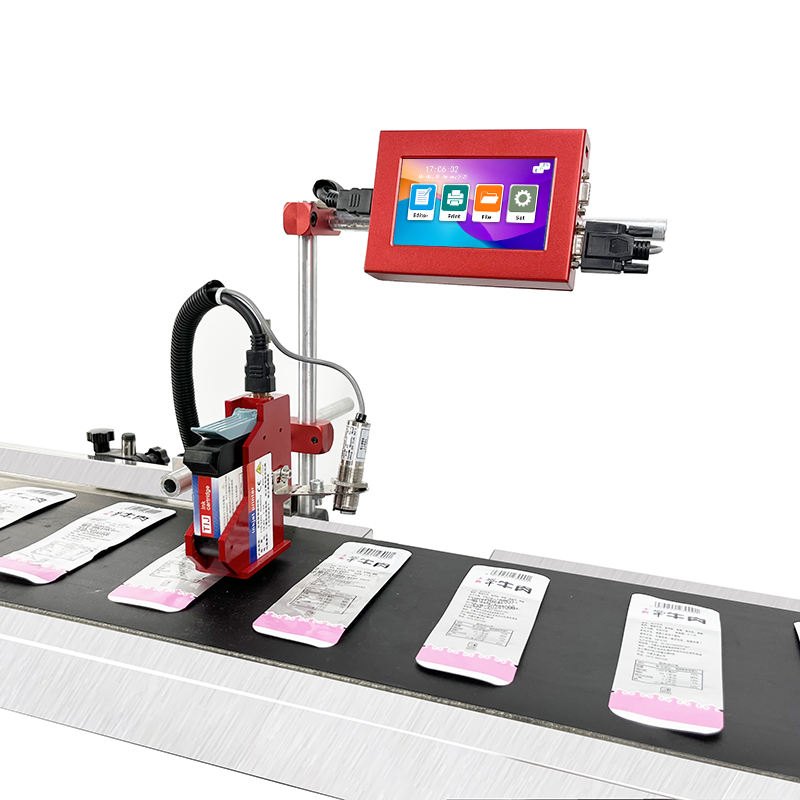
Y110 Online inkjet printer
the compact online build for cartons and film:
- 300-600dpi print accuracy
- 2-12.7mm print height
- 4.3-inch touch screen
- Weighs only 3.0 kg
- food-grade/water-based/oil-based/42ml ink cartridge ink
The weight matters on a retrofit. At 3.0 kg the head mounts on an existing frame without a new gantry, which is the difference between an afternoon and a shutdown. The technology is described under inkjet printing.
Related Questions
- Does it need make-up fluid
- No, and that removes the daily top-up and the gutter cleaning from the shift routine.
- Can one unit run solvent ink
- A piezo build can, and a thermal build is limited to the cartridge chemistry on offer.
- Is a cartridge refill safe
- Rarely, because pressure and chemistry are set at the factory and a refill moves both.
Send the Board You Print On
Send one carton or film sample, the character height and the marks per shift. We will mark it, photograph the block and return the grade and setting, so the drop on demand printer you buy has already printed on your board.
Next Steps
- Where the two mechanisms part company: continuous inkjet vs drop on demand.
- Start at the contact page, on +86 17625427465 or kuangcy@126.com. We reply within 24 hours.
Need help choosing the right printer?
Talk to our engineers for a free production-line assessment and quotation.
Request a Quote