
Last Updated: 2026-10-29
An expiry date printer is judged in the chiller, not on the line. A date that reads perfectly at the head can fail after a week on a shelf because the pack was rubbed, chilled or stacked against another carton, and the failure is a customer complaint rather than a coding alarm.
The Short Answer on an Expiry Date Printer
It needs three things: a grade that keys to the pack surface, a position off the wear band, and a block that stays inside the flat face. Get those right and the date survives; get the surface wrong and no resolution setting rescues it.
A date sits on the outside of the pack, which is the part that gets handled, stacked and refrigerated. Whatever protects the food does nothing for the mark.
Three Ways an Expiry Date Dies in Retail
| Failure | Where it happens | What prevents it |
|---|---|---|
| Rubbed off | Shelf stacking and carton handling | Code placed off the wear band, fast-dry grade |
| Condensation blur | Chiller cabinet and cold chain | Solvent grade plus a dry surface at the head |
| Half a date | Code printed across a fold or curve | Shorter block inside the flat panel |
The third row catches more plants than the first two. A date that runs from the panel onto a crease looks fine on a drawing and splits in the pack, leaving two unreadable halves.
The second is a temperature argument. A water-based grade that dries in a warm room can re-wet in a chiller, and a date that blurs at four degrees gets flagged.
Ink, Format and the Retail Read
Two grades cover most expiry work: water-based for porous board and paper labels, solvent for film, foil and anything chilled or frozen. The choice is a match to the surface, decided on a real pack rather than a sample sheet.
Format is the other half. A day-month-year string, a month-year string and a week code need different block widths, and the widest must fit the flat panel. Retail partners specify both string and position, so the block is a constraint to design around.
What SHICAI Ships for Date Work
Our date builds leave with the grade that was proved on the buyer’s own pack written on the carton, plus the block height and the position used in the trial. Spares and support are organised for export markets under the ISO 9001 quality management route.
In our export work the usual correction is not the ink but the position: a date moved fifty millimetres down the panel stops rubbing and starts reading, for the cost of a bracket adjustment.
The Head Behind Most Date Lines
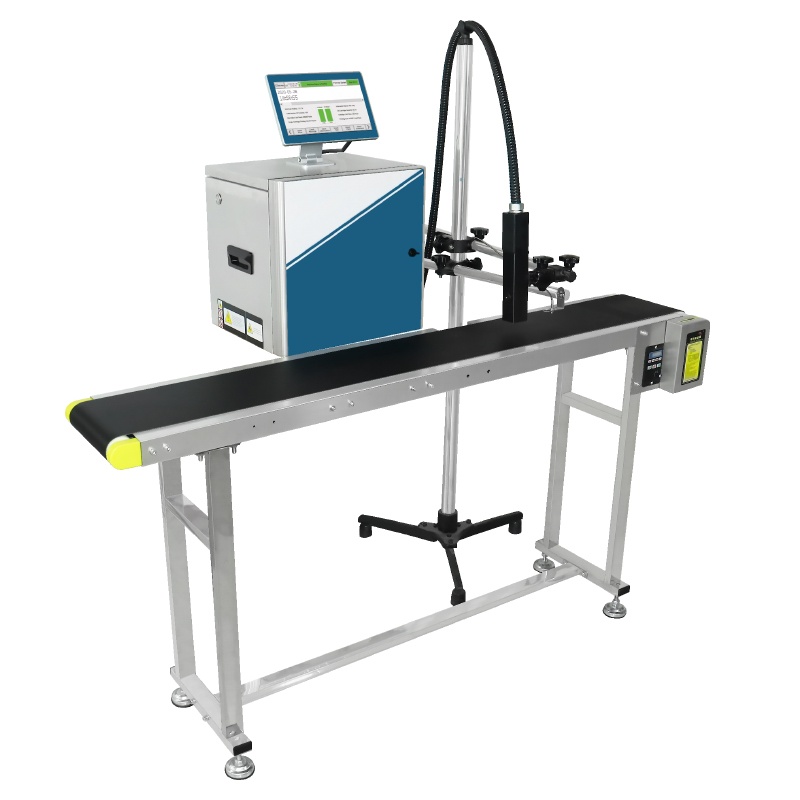
S1000 small character inkjet printer
the high-speed build used where dates run all shift:
- Prints up to 400 Meters Per Minute
- 2-20mm print height
- 10.1-Inch Industrial Touchscreen
- 3-30mm throw distance
- Low 120W rated power
A 2 to 20 mm height covers a three-line date with a batch code, and the 3 to 30 mm throw lets the head clear a filling-line rail. At 400 metres a minute the limit stops being the printer and becomes drying time.
Related Questions
- Can one grade cover chilled and ambient packs
- Rarely, and a solvent grade that works cold usually needs the surface dry at the head.
- Does the date need to be black
- No, contrast matters more than colour, and a light grade on a dark pack reads better.
- What about a best-before week code
- It needs a wider block than a day-month string, so check the panel before agreeing the format.
Send One Pack From the Chiller
Send a filled pack, cold if that is how it reaches the shop, plus the string and position your retailer requires. We mark it, chill it overnight, rub it and return the grade and block in writing, so the expiry date printer is proved on the pack.
Next Steps
- How a cold surface changes adhesion: coding on glass and condensation.
- Start at the contact page, on +86 17625427465 or kuangcy@126.com. We reply within 24 hours.
Need help choosing the right printer?
Talk to our engineers for a free production-line assessment and quotation.
Request a Quote