
Last Updated: 2026-09-23
A recall you cannot trace starts with a lot code nobody can read. A lot code printer marks that identifier on the pack as the lot is made, alongside the production date and shift, so one carton can be isolated instead of a whole shipment. Here is what the block must carry, and when a bench coder is enough.
What a Lot Code Printer Marks
A lot code is the production identity of the goods in front of you: which run made it, when, and on which line. The product code says what the item is. The lot code answers the question an auditor asks months later, when a complaint arrives and someone must work out which material batch and which shift produced the pack.
Inkjet does it in one step. The coder prints the block onto carton, label or rigid surface as the pack passes, so the mark is created with the product instead of applied later by hand. Pre-printed packaging cannot carry a variable number, and stickers add a step and a way to fail.
The Five-Field Checklist
| Field | Why it is there | GS1 reference |
|---|---|---|
| Lot or batch number | Isolates the affected production group | Application identifier 10 |
| Date of production | Anchors the lot in time for supplier claims | Application identifier 11 |
| Best before or expiry | Where shelf life applies to the product | Application identifier 17 |
| Line or shift identifier | Narrows a fault to one coder or one crew | Internal scheme, or prefix plus qualifier |
| Product or SKU code | Ties the trace back to a saleable item | Application identifier 02 |
Numbers alone do not make a readable block. Character height, quiet space around any symbol and contrast against the surface decide whether it survives being read by a person and scanned by a customer. The GS1 application identifier list is the authority on which identifier belongs in which position, and ISO 9001 quality management covers how the printing process is verified.
When a Bench Coder Is Enough
Small runs, made-to-order packs and job shops rarely need a coder built into a line. A bench unit marks the block on a carton placed under the head and keeps the format in the machine rather than on a sticker. Two questions settle it: can one operator feed the print area, and is the surface porous or coated? When volume outgrows manual feeding, the lot code printer moves from the bench to an inline frame without changing the block.
Where SHICAI Fits
SHICAI builds coding and marking equipment for export markets, including bench coders for lot marking. We ask for the actual pack first: the block is printed on it, and the ink grade is chosen against your surface, not a catalogue. Builds run under ISO 9001 quality management, with spares arranged for overseas customers.
Related questions
- What is the difference between a lot code and a batch code?
- The terms overlap and are often used interchangeably. A batch code usually names one production run; a lot code can cover a lot assembled from several runs. Under GS1 both share application identifier 10.
- Does every unit need its own lot code?
- Commonly yes, on each unit or grouping that can be separated from the lot, because a trace that stops at the outer carton cannot isolate one pallet. Confirm it with the receiving customer.
- Can a desktop coder mark cartons?
- Yes. A bench coder marks cartons, labels and rigid parts placed under the head, and 2 to 12.7 mm of print height covers most lot blocks.
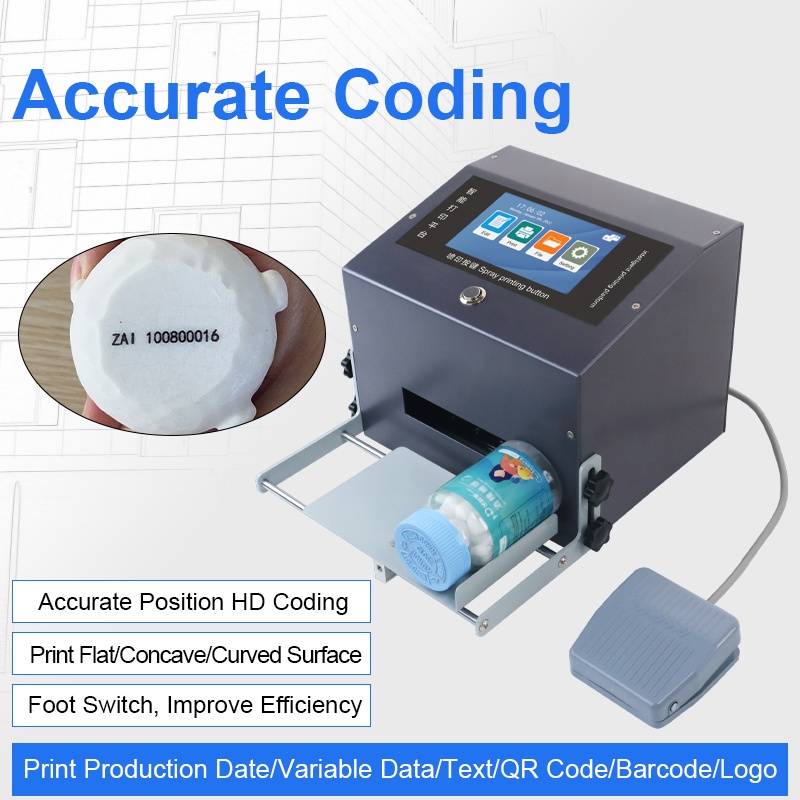
G12 Desktop inkjet printer
one bench coder built for this job:
- 2-12.7mm print height
- 2-5mm throw distance
- Available in 7 ink colors
Next Steps
- Read what a batch code is and the five things it must carry, where lot and batch terms part company.
- If the block prints but rubs off in transit, see how to choose an inkjet printer for industrial marking.
- Send the pack and the block you need marked through our contact page. We print it and return the result at no cost, with no commitment.
Need help choosing the right printer?
Talk to our engineers for a free production-line assessment and quotation.
Request a Quote