Last Updated: 2026-11-12
A date on a shell that can never be washed has to land right. An egg printer marks that shell with food-grade fluid, and the specification follows from two facts: the surface is porous, and the product itself is food that someone will eat.
The Shell Is the Substrate
A shell is a porous calcium surface with a natural bloom on it. Fluid that sits on top smudges in the tray; fluid that soaks in too far loses the character edge.
Surface condition decides more than any setting. A dirty shell and a clean shell take the same fluid differently, which is why grading and marking sit close together, and the shell itself is described under egg as food.
Food-Grade Is a Constraint, Not a Feature
The fluid is chosen for what it may legally touch, not for how well it prints. That narrows the range to grades approved for food contact, and the print result follows from that shortlist.
It also sets the record keeping. A plant that marks shells needs the grade certificate on file, because the question from an auditor is what went onto the food, not what the printer model was. The record side sits under ISO 9001.
Why Six Heads
Throughput comes from heads, not from speed. Six heads marking in one pass cover a row of eggs at the rate a grader delivers them, and a single head would have to move instead.
The trade is alignment. Every head has to be set to the same throw and the same height, or the row comes out with one faint character, and that is a service visit rather than an adjustment.
Where an Egg Printer Struggles
Cracked and soiled shells are out of scope for any fluid. A mark on a leaking shell is a hygiene problem rather than a printing problem, and it belongs upstream at grading.
Very high line rates test the class. Beyond the rate the heads can cover in one pass, the answer is a second lane rather than a faster printer.
The Single Head Build
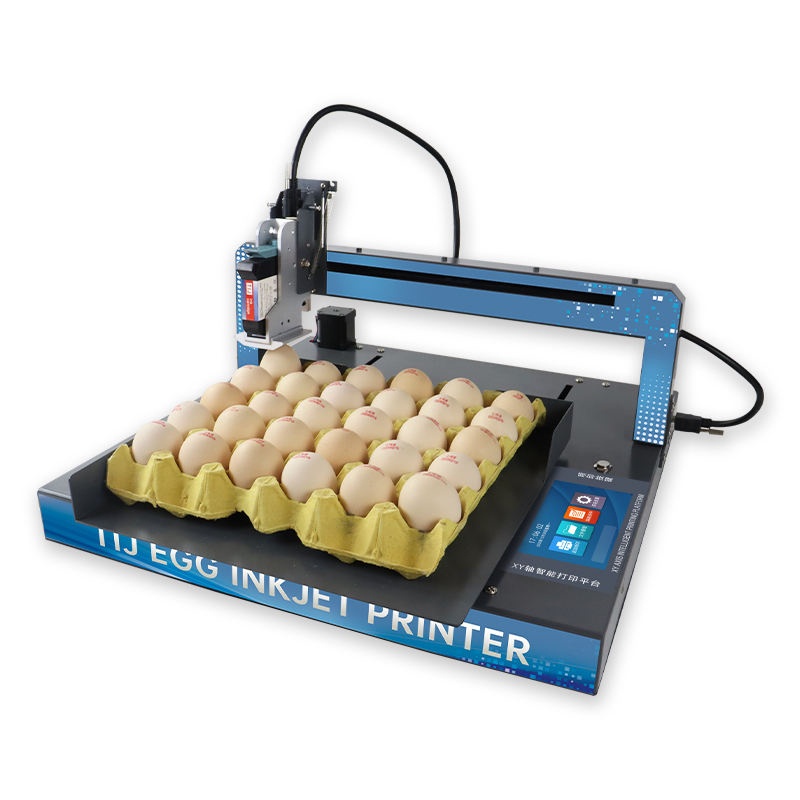
XY110 Egg inkjet printer
one head for a slower grader line:
- 2-12.7 mm adjustable print height
- 5.0-inch touch screen
- Food-grade, water-based and oil-based ink options
- Prints letters, numbers, logos, QR codes and dates on eggs
Two fluid families on one head is the practical point. A water-based grade suits a dry shell, an oil-based grade holds up where the shell is damp, and having both listed means the choice is made by the grader rather than by the catalogue.
Related Questions
- Can it print a QR code on a shell
- On a smooth shell and at a small size, yes. The curvature is the limit, so the code goes on the flattest part of the shell.
- Is the fluid safe for hatching eggs
- That is a grade question rather than a printer question, and it has to be answered by the certificate before any trial.
- Does it crack shells
- The marking head does not touch the shell. Breakage in practice comes from the handling before and after marking.
Send the Grader Rate and the Shell
Send the eggs per hour your grader delivers and a photo of the shell condition. We match the head count and the fluid grade, so the egg printer you install keeps a legible date at the rate the packing station actually runs.
Next Steps
- Docking numbers for a line unit: five numbers to check.
- The category in brief: what an egg coding machine is.
- Start at the contact page, on +86 17625427465 or kuangcy@126.com. We reply within 24 hours.
Need help choosing the right printer?
Talk to our engineers for a free production-line assessment and quotation.
Request a Quote