Last Updated: 2026-10-20
An egg printer with conveyor is chosen against the belt it joins rather than against its own specification sheet. The head can be excellent and the install still fail, because a tray that arrives half a pitch late cannot be marked in the right place by any nozzle count.
Why an Egg Printer With Conveyor Is a Docking Problem
Two installations with the same printer and the same trays can behave completely differently, and the difference is geometry rather than electronics. A tray travelling on a belt passes the head for a fixed window of time. Inside that window the shells must sit at the right distance, the row at the right angle, and the belt at the speed the mark was timed for.
Get all three right and a six-nozzle bank marks a five-by-six tray in one pass. Get one wrong and the fault arrives as a smear, a missing column or a mark that walks across the shell.
Five Numbers That Decide the Docking
| Number | What to measure | Why it decides the install |
|---|---|---|
| Tray pitch | Centre-to-centre distance between trays on the belt | Sets the gap the head must clear between marks |
| Belt speed | Metres per minute at the marking point, loaded | Converts into the time a row sits under the nozzles |
| Throw distance | Gap from nozzle face to shell crown | The build below is specified at 2-5 mm optimal, and the frame sets it |
| Tray height | Top of shell above the belt surface | Fixes the head height and any lift needed |
| Line rate | Trays per minute the grader actually releases | Decides whether 20 trays per minute is headroom or a limit |
The fourth number is the one buyers measure on an empty tray. A loaded tray sits higher because the shells compress, and two or three millimetres is enough to move a mark off the crown.
Where the Frame Bolts and What It Must Not Touch
The frame usually lands on the belt side rail, with the head cantilevered over the marking point. Three constraints fix the position: the frame must not obstruct a tray that jumps on a worn belt, the head must clear the tallest tray at the upper lift stop, and the marking point must sit far enough from the infeed.
A second position behind the first is worth agreeing at the same time; it costs almost nothing on the drawing.
Changeover on a Moving Belt
An egg coding machine with conveyor rarely stops for a new batch. The date and the batch reference are edited at the panel while trays keep coming, and the new string applies from the next release. That is easy with a screen at waist height.
Two habits keep the changeover honest: the first tray of a new batch is read against the collection sheet in full, and the height setting is written down.
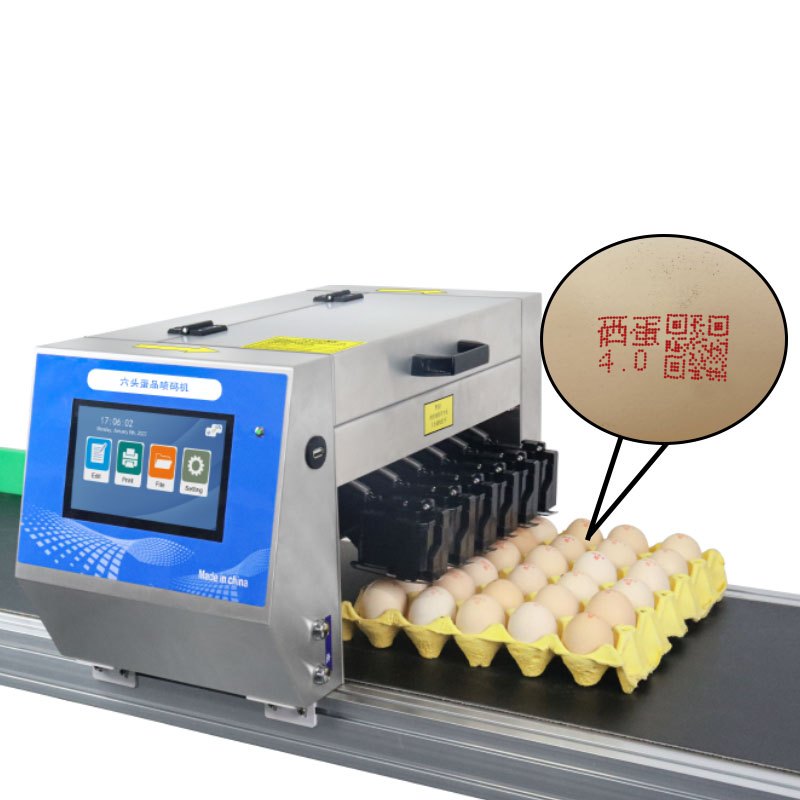
Six head egg inkjet printer(D100-6)
the bank built for a graded line:
- Prints up to 20 trays per minute (5 x 6 trays standard)
- 2-5 mm optimal throw distance
- Food-grade water-based red ink
- Marks eggshells with dates, batch and traceability codes
The electric lift on that build exists for the fourth number above: head height is set against the tray in front of it rather than against a nominal figure. Frames are made from the belt drawing, and the ISO 9001 quality management route covers fabrication.
One more point keeps an egg printer with conveyor accurate in month six: the belt is checked for wear at the marking point. A worn belt lets a tray ride a few millimetres lower, and the mark fades on one side.
Line Questions
- Can the printer be fitted to a belt that is already running?
- Yes, on a planned stop. The frame is bolted to the side rail and the marking point is set with a loaded tray, so the line restarts with the height already proved.
- What happens when the belt speed is raised for a promotion?
- The mark window shortens. Either the string is shortened to what fits, or the marking point moves back to buy time.
- Is a separate conveyor needed to use the printer?
- No. It docks to the belt you have. A dedicated conveyor is only added where there is no line at all.
Send the Belt Drawing
Give us the five numbers and a photograph of the side rail at the marking point. We return the frame position and the height to set.
Next Steps
- Send one loaded tray and the belt speed at the marking point. We return the docking sheet with the sample.
- Start at the contact page, on +86 17625427465 or kuangcy@126.com. We reply within 24 hours.