Last Updated: 2026-11-18
Most egg inkjet printer failures trace back to the building, not the machine. Dust, ammonia, washdown water, mains sag and ink temperature each attack a different part of the same build, and a unit picked for a clean packing hall can lose a week inside a layer house.
What a Layer House Does to an Egg Inkjet Printer
A layer house is warm, humid and full of airborne dust from feed and feathers. None of it appears on the specification sheet you receive.
The machine is not fragile. The build is simply specified for a room, and a room is not a shed. Five conditions separate the two.
Dust Is the First Condition
Feed dust is abrasive and settles within minutes. A head left open between trays collects it, and the cleaning cost lands on the operator every day, at the busiest hour.
Ask how the print zone is covered when the line stops for a break. A shutter or a parking cap saves a cleaning cycle each afternoon.
Ammonia Changes the Ink, Not the Head
Litter gives off ammonia, and ammonia is alkaline. A water-based ink that dries well on a clean shell can change its drying time in that air, and the change shows up as a smeared date.
So the ink question comes before the machine question on a farm. Name the gas and the ventilation first, then choose between the water-based and oil-based food-grade options. Our note on which ink holds on a shell covers the trade-off.
Washdown Water and the Standing Machine
Many sheds are washed between flocks, and the machine is usually still mounted when the hose comes out. Water that reaches a connector does its damage weeks later, which is why the fault looks unrelated.
Plan the mount so the unit lifts clear before the wash, or specify the cover that stays on. Either answer is cheaper than a board replacement mid-flock.
Mains Sag and the Five-Inch Screen
A farm supply is not a factory supply. Starting a feed motor can pull the voltage down for a moment, and a screen that reboots takes the batch counter with it.
Check what the screen does on a dip and whether the job resumes at the same count. A machine that restarts from zero costs more in paperwork than in parts.
Ink Temperature, and Why It Matters More on a Shell
A shell is curved and porous, with a fraction of the printable area of a carton panel. Throw distance and ink viscosity sit inside a narrow band, and a cold morning moves both.
Two to 12.7 mm of print height is generous for a date and a batch code. The range is adjustable, so one unit covers a small stamp and a two-line traceability mark.
The Unit We Quote for These Sheds
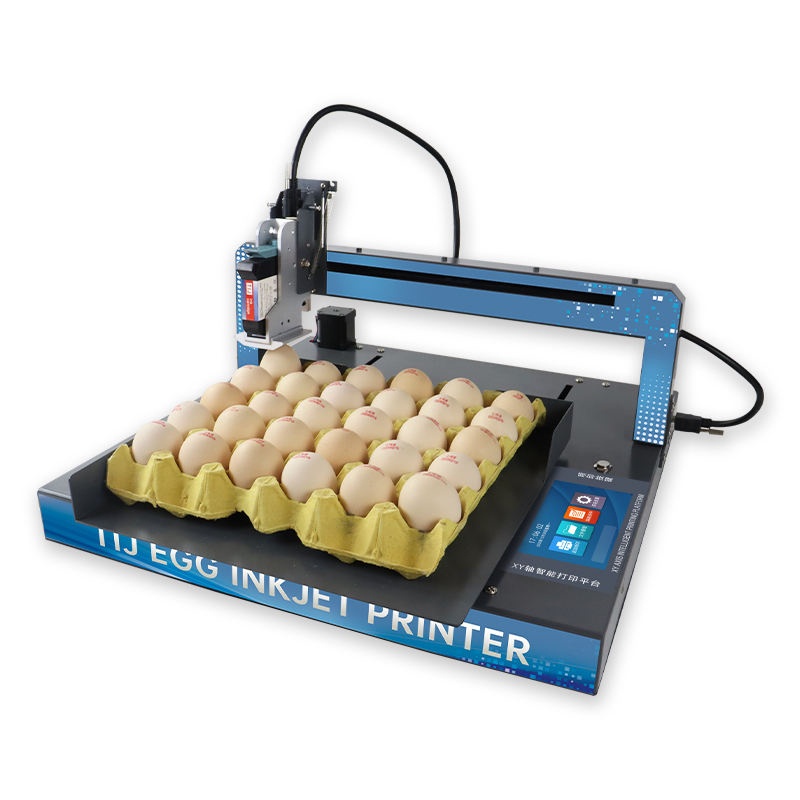
XY110 Egg inkjet printer
a compact build for a packing table rather than a grader:
- 2-12.7 mm adjustable print height
- 5.0-inch touch screen
- Food-grade, water-based and oil-based ink options
- Prints letters, numbers, logos, QR codes and dates on eggs
That sheet answers four of the five conditions and leaves the fifth to the installation. A compact head on a bench mount suits a shed that codes by hand, not one that feeds a grader.
Send the Shed Conditions First
- Will it run in a dusty house
- Dust is managed at the print zone rather than by sealing the machine. Tell us how far the head sits from the feed hopper and we size the cover and the cleaning interval to match.
- Which ink for a warm house
- Water-based and oil-based food-grade inks are both available. The choice follows the ventilation and the wash routine, not the price list.
- What supply does it need
- Confirm the voltage at the shed rather than at the meter. A screen that reboots on a motor start will lose the count, so the answer belongs in the quotation.
Send the shed type, the dust source, the wash routine and the supply. The egg inkjet printer we quote then matches the building, and the cleaning interval becomes a number in the offer.
For a line that feeds a grader, the docking figures sit in egg printer with conveyor. Background sits under egg as food, and export builds follow ISO 9001.
Next Steps
- If the rate is the problem rather than the building: where the rate is won.
- Start at the contact page, on +86 17625427465 or kuangcy@126.com. We reply within 24 hours.