Published 2026-09-20 · Last Updated 2026-09-20 · SHICAI technical team · Coding and marking equipment guide
Buyers who search for an egg printer high speed build usually discover that the printer was never the constraint. The rate is won at singulation, at the seconds the mark gets to key in, and at how far the head stands off a curved, rotating shell. Four settings move those, and only one sits inside the printer.
Where the Rate Is Won on an Egg Printer High Speed Build
Tray handling, candling, weighing and carton feed set the pace of an egg line in that order. A coder marks in microseconds; what costs minutes is a head that cannot cover the lane, or a mark redone after the pulp tray. Cover the lane in parallel, mount the head where the eggs are driest, and the rate follows.
Stand-Off and Mark Range
This is where a small character build earns its place on a high-rate egg line. A 2-20 mm mark range carries a date, a flock code and a small QR symbol on one shell and a 3-30 mm working distance absorbs the height difference between a pullet egg and a jumbo without re-shimming the bracket between grades. A shorter-throw cartridge head prints beautifully and then has to be re-set every time the grader changes size, which on a two-shift line costs more minutes than the machine ever saves.
The technology trade-off behind an egg printer high speed choice is set out in why a TIJ printer is chosen over CIJ, read from the other side: where cartridge simplicity wins, and where the continuous stream and longer throw take the line back.
CIJ or TIJ on Eggs
| Dimension | Small character continuous | Cartridge thermal inkjet |
|---|---|---|
| Lane coverage | Parallel nozzles cover the tray cycle | One head, one band per pass |
| Stand-off | 3-30 mm working distance | Typically 2-5 mm |
| Consumables | Ink, solvent and make-up loop | Sealed cartridge, minimal upkeep |
| Best fit | Continuous high-rate grading lines | Short runs, sampling, spot coding |
Both classes are built by SHICAI and both mark eggs; the deciding question is how your lane presents the shell and how many grades you run in a shift.
Four Settings to Fix
| Setting | Fix it as | What it buys |
|---|---|---|
| Mark range | 2-20 mm, smallest height that still scans | Date, flock code and QR on one shell |
| Stand-off | 3-30 mm across grades | No stopped shift for a format change |
| Ink | Food-grade, qualified for shell contact, red where the grader reads | Marks that survive the pulp tray |
| Power and mount | 150 W rated draw, mount to suit the lane | Standard-supply installation |
Feeding the Grader Rather Than the Head
The build accepts dynamic serial-port data and dynamic database fields, so the batch that prints is the batch the grader recorded. Content covers text, date, pattern, dynamic barcode and QR code in thirteen languages. Where traceability has to survive an audit, that interface is the setting to verify first, and the shell-contact framing follows the same reference on food contact materials used across this sector. Rated draw is a low 150 W, so the cell installs on a standard supply.
How SHICAI Quotes It
SHICAI configures the tier per line and lists nozzle layout, ink family, mount and interface on the quotation. Build documentation is available for buyer review under ISO 9001 quality management.
The Build Itself
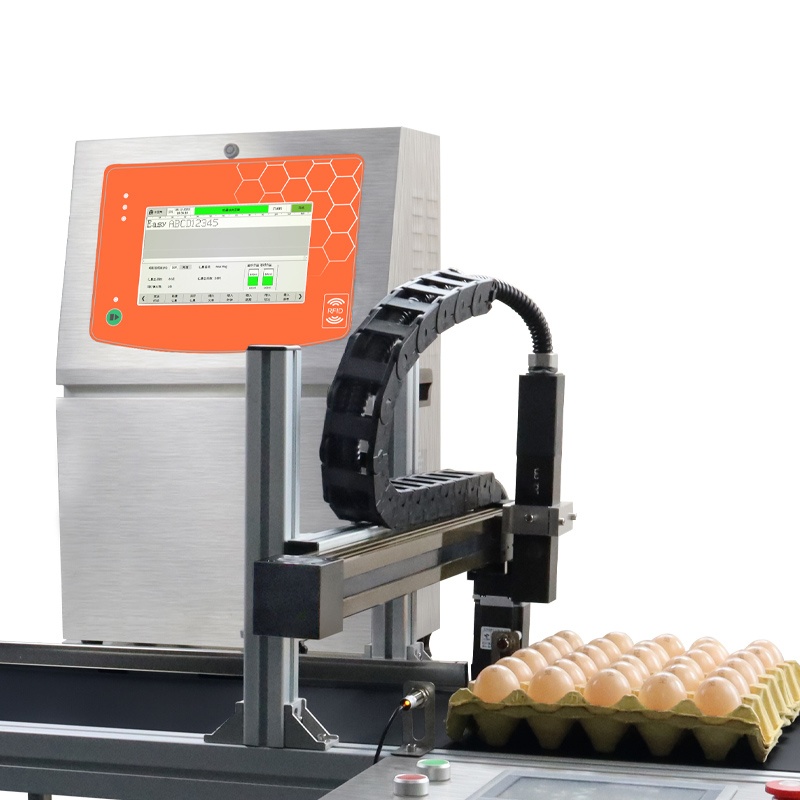
Small character egg printer
is the small character build for continuous egg lines:
- 2-20mm print height
- 3-30mm throw distance
- Low 150w rated power
Speed Questions
- Where is the real speed ceiling on an egg line?
- In singulation and tray handling. Eggs arrive one per lane on a cycle, and a coder that cannot cover the lane in parallel forces the belt down. Print engine speed is rarely the constraint.
- Why does throw distance matter at high rate?
- Because grades differ in height and shells rotate in the lane. A 3-30 mm working distance absorbs that variation without re-shimming the head between formats.
- CIJ or TIJ for a high-rate egg line?
- Continuous inkjet covers the lane in parallel and tolerates a longer stand-off, which suits continuous high-rate grading. Cartridge thermal inkjet suits shorter runs and simpler cells. The honest answer is per line, not per technology.
Next Steps
- For the tray-side build, compare Six head egg inkjet printer (D100-6).
- Read the 2026 egg printer buying guide for the wider range.
- Send lane width, grade range and grader data fields to +86 17625427465 or kuangcy@126.com. We mark your own eggs at your cycle rate and quote the configuration in writing, at no charge.