Last Updated: 2026-11-19
Every egg printer supplier sends a video of a machine printing on a clean shell. The sample that matters is the one printed on your own eggs, in your shed, at your line speed, and most quotations arrive without one at all.
An Egg Printer Supplier Is Chosen on the Sample, Not the Quote
Quotations are easy to compare and easy to fake. Two suppliers can quote the same cabinet and delivery week, and only one has printed on a shell from a real shed.
So the useful question is not what the machine can do. It is what the supplier will put in writing after it has done it on your material, because that document is the only part of the offer that survives the first complaint.
Why the Sample Has to Be Your Egg
Shell thickness, cuticle and surface temperature vary between farms, and a head set up on a smooth sample egg prints differently on a warm one off a grading line. That is not a defect. It is a setting.
Send eggs from the shed the machine will run in, and send them the way they arrive at the head: at line temperature, not chilled and wiped. A supplier who asks for that is telling you something about how the setting is found.
What the Sample Report Should Contain
A photograph of a printed egg is not a report. Ask for four numbers: the print height used, the throw distance, the line speed at which the sample was made, and the ink reference including its food-contact status.
Those four turn a photo into a setting. Anyone can repeat them on the day the machine arrives, and a disagreement in week two becomes a measurement rather than an opinion about what the picture showed.
The Acceptance Clause Nobody Writes
Most orders state a delivery date and a warranty period and stop there. Add a line that names the four numbers above as the acceptance criteria, and a second line that says what happens if the machine cannot hit them on arrival.
The second line is the one that matters. A renegotiation after the crate is open is expensive for both sides, and a supplier who resists writing it is telling you where the risk is going to sit.
Spares and the First Year
Ask for the consumable list with part numbers before the order, not after the first fault. On a small character unit that means the ink, the make-up and the parts that touch the shell path, each with a lead time attached.
A year-one spares package beats a discount on the cabinet. It converts a breakdown into a shelf, and shows whether the supplier stocks what it sells.
The Build We Quote for a First Order
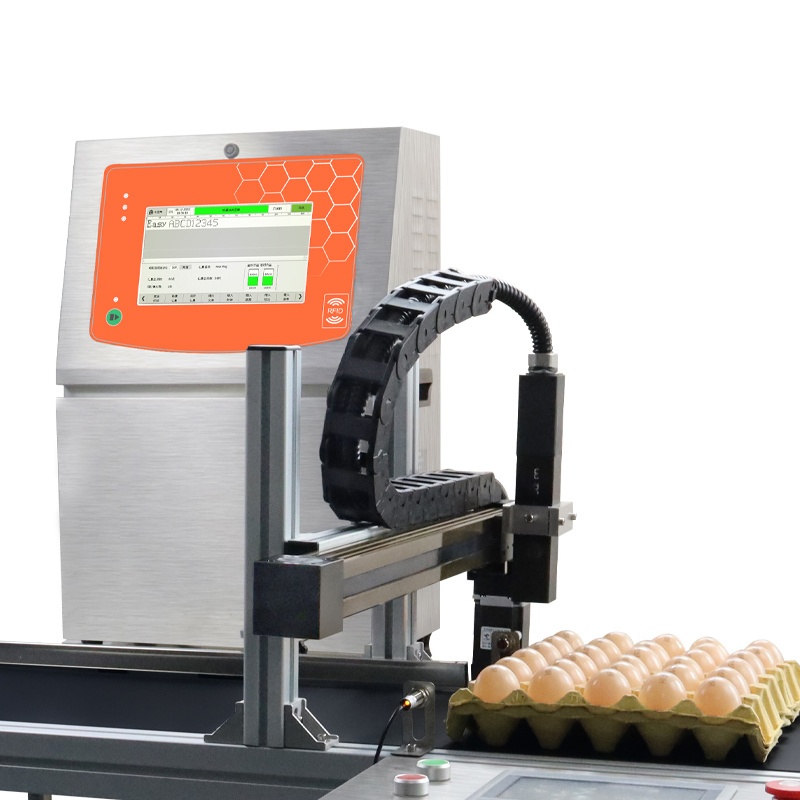
Small character egg printer
the small character route onto a shell:
- 2-20mm print height
- 3-30mm throw distance
- Low 150w rated power
- Prints text, date, pattern, dynamic barcode and QR code
- Marks eggs
A 3 to 30 mm throw is the number to test first on a farm, because a grading line moves the shell through a wider band than a packing table does. A unit that holds a code across that band removes a fixture rather than adding one.
Send the Egg and the Volume
- Will you print on eggs we ship
- Yes, and that is the point of the sample. Send a dozen from the shed, at line temperature, and the report comes back with the height, throw, speed and ink used.
- How long does a sample take
- Days rather than weeks once the eggs arrive. The slow part is the shipping and the customs paperwork on a perishable parcel, not the printing.
- What if the sample fails on arrival
- Then the acceptance clause is doing its job. Name the four numbers in the contract so a failed arrival is a documented event rather than an argument.
Send the egg type, the line speed and the annual volume. We return the sample report and the consumable list, so the egg printer supplier you order from is one whose four numbers you have already seen on your own shell.
The build comparison across the range sits in the five site conditions. Shell marking background is under egg marking, and export builds are checked against ISO 9001.
Next Steps
- If the handover is the weak point rather than the supplier: the date is the easy part.
- Start at the contact page, on +86 17625427465 or kuangcy@126.com. We reply within 24 hours.