Published 2026-09-20 · Last Updated 2026-09-20 · SHICAI technical team · Coding and marking equipment guide
A date coding machine for egg fails predictably: the mark prints cleanly, then lifts off in the pulp tray because the shell was damp and the ink suited the machine rather than the surface. Holding a date is an ink and process decision first: what holds, what the standards ask, and where a six-head cell fits.
Why the Shell Sets the Rules
Eggshell is calcium carbonate under a cuticle, and eggs arrive at the coder at wash-house temperature, often with surface moisture. A water-based mark keys into a clean dry shell; an oil-based formulation tolerates residual dampness; and the colour is usually red food-grade because it reads against a brown shell. Shell-contact framing follows the reference on food contact materials.
Curvature is the second constraint. A shell rolls slightly in the lane, so one head marks a band and the shoulders stay blank. Lane coverage, not print quality, is why egg lines move to multi-nozzle builds.
What the Standards Ask of a Date Coding Machine for Egg
Schemes differ by market, but three requirements recur: a lot or flock identifier that ties the egg to its source, a best-before date that survives to the shelf, and legibility that a warehouse or a consumer can read without training. The coder therefore has to accept the scheme your market uses, hold it through a full tray cycle, and place it where a scanner or an eye can find it. For a date coding machine for egg, the record has to travel beyond the shell too: what a batch code printing machine does is the shorter read.
Which Ink Holds
| Ink family | Where it holds | Watch for |
|---|---|---|
| Water-based food grade | Clean, dry shells straight from grading | Residual wash moisture lifts the mark |
| Oil-based food grade | Damp or chilled shells, and waxed cartons downstream | Slower to set; give the eggs travel time before stacking |
| Red pigmented | Readable against brown shells at retail | Confirm the pigment is qualified for shell contact in your market |
Test all three on your own eggs across a full tray cycle before you accept any quotation. The droplet mechanism is common to the range, described in the public reference on inkjet printing.
The Six-Head Cell
A six-head build covers the lane in parallel, so every egg in a 5 x 6 tray cycle is marked without slowing singulation. The reference configuration on this class marks up to 20 trays per minute with food-grade water-based red ink, and carries dates, batch and traceability codes on the shell in one pass. Placement matters as much as coverage: mark before candling and packing so the ink has time to key in, and take the batch data from the grader rather than from a message typed at the head.
How SHICAI Configures It
SHICAI builds the egg cell around your grading system and quotes per configuration: nozzle layout, ink family, lift and data interface are named on the quotation. Build documentation travels with the unit and buyers may request ISO 9001 quality management scope before ordering.
This Build
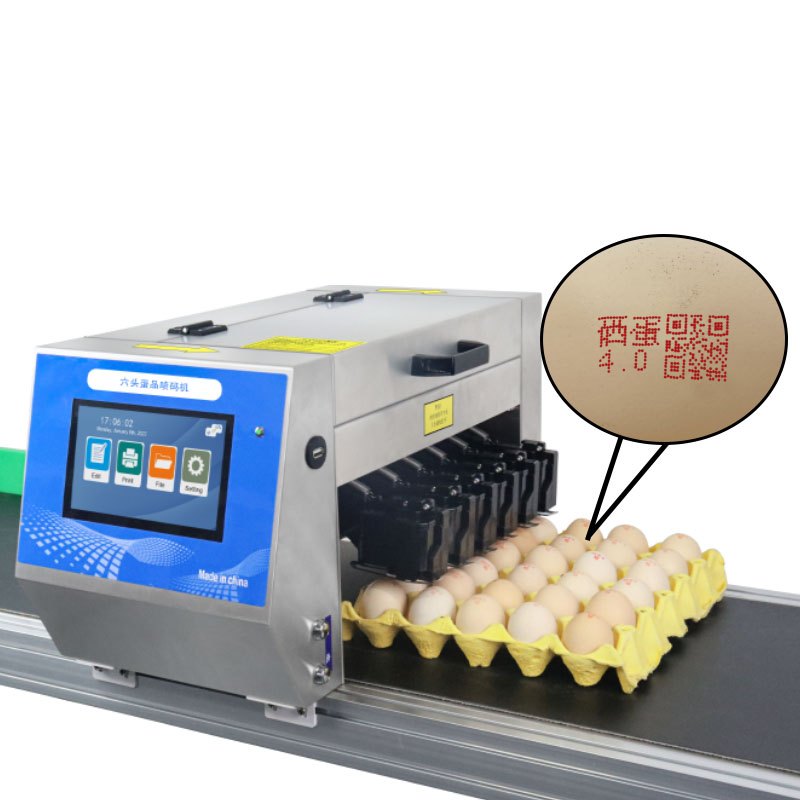
Six head egg inkjet printer (D100-6)
is the six-head cell behind this class:
- Prints up to 20 trays per minute (5 x 6 trays standard)
- Food-grade water-based red ink
- Marks eggshells with dates, batch and traceability codes
Egg Coding Questions
- What do egg marking standards actually require?
- Most schemes ask for a lot or farm identifier, a best-before date and legibility through packing. The exact format differs by market, so the coder has to accept the scheme your market uses rather than a fixed template.
- Which ink holds on a wet shell?
- Water-based marks key into clean dry shells; oil-based formulations tolerate residual moisture; red food-grade ink is the usual choice because it reads against a brown shell and is qualified for contact.
- Why six heads for a date code?
- Because the shell is curved and small. Six nozzles cover the lane in parallel, so every egg in the tray cycle gets its mark without slowing singulation.
Where to Go From Here
- For the shell-side requirements, read the five requirements for safe codes on eggs.
- Compare the wider egg range in the 2026 egg printer buying guide.
- Send washed/damp condition, line rate and the scheme you must follow to +86 17625427465 or kuangcy@126.com. We mark your own eggs and quote the cell in writing. No charge for the trial.