Last Updated: 2026-10-13
A production line printer high speed reel rarely fails on the head, it fails on coverage. One head codes a fixed width, so a wider case needs either a second pass or a stitched set. Two, four or six S10 heads decide that trade.
Why Coverage, Not Speed, Sets the Ceiling
Belt speed is the figure buyers ask about first, and it is seldom the binding limit. A thermal inkjet head prints as fast as the belt moves; what runs out is the width one head covers in a single pass.
On a 600 mm case, a head set for 12.7 mm characters leaves most of the panel bare. The usual answers are a second pass, one wider head, or a set of heads stitched along the direction of travel. The third option holds both throughput and print quality, which is why the S10 family ships as two, four and six head sets rather than as one wide head. Where a permanent record is needed, the coding standard behind it is documented under ISO 9001 quality management.
Three Lines, Three Head Counts
Three line profiles decide the head count more than any spec sheet does:
- High-volume cartons. One pass per case, with the date on the left panel and a barcode on the right. Four heads usually close it.
- Metal and pipe marking. A long mark along a tube needs the heads stitched in sequence, so six heads buy one unbroken line of text.
- Trays and pouches. Narrow stock rarely needs more than two heads, and the spare width is better spent on a second lane.
All three come back to the same number, which is the widest mark the line will ever have to place.
Choosing a Production Line Printer High Speed Build
Match the head count to the panel, and treat line speed as a separate question.
| Build | Heads | Print height | Best for |
|---|---|---|---|
| S10-2 | 2 | 2-25.4 mm | Narrow panels and reels that need a single row |
| S10-4 | 4 | 2-50.8 mm | Mid-width cases where a second pass would halve throughput |
| S10-6 | 6 | 2-76.2 mm | Full-width cartons and multi-row date plus barcode panels |
A practical rule is to measure the widest mark you expect and add a fifth. Heads overlap when they are stitched, so a set rated for the current panel usually covers the next case size without a new machine. The published account of inkjet printing sets out why thermal heads scale in this way.
How SHICAI Stitches S10 Heads
SHICAI builds the S10 series as stitched sets because that is what a real panel asks for. A four-head frame is aligned on a jig before it leaves the plant, so the overlap between heads is set in the factory rather than by eye on the line.
The unit below is a four-head build on a stainless frame. Its head set covers a 2 to 50.8 mm height in one pass, and the body is specified for a wash-down area rather than a clean room.
Head-Count Questions
- Do more heads mean a slower line?
- No. The heads are driven in parallel from one encoder, so a four-head set prints a wider panel at the same belt speed as a two-head set. Only the stitching alignment changes.
- Can heads be added later?
- On a splicing frame, yes, up to the six-head limit of the series. A standalone frame is fixed at build, so it is worth ordering the head count you expect to need in two years.
- How close can two heads be stitched?
- The seam is set with an overlap of a few millimetres, so a character can cross between heads without a visible break. Alignment is mechanical, not optical, and it holds once set.
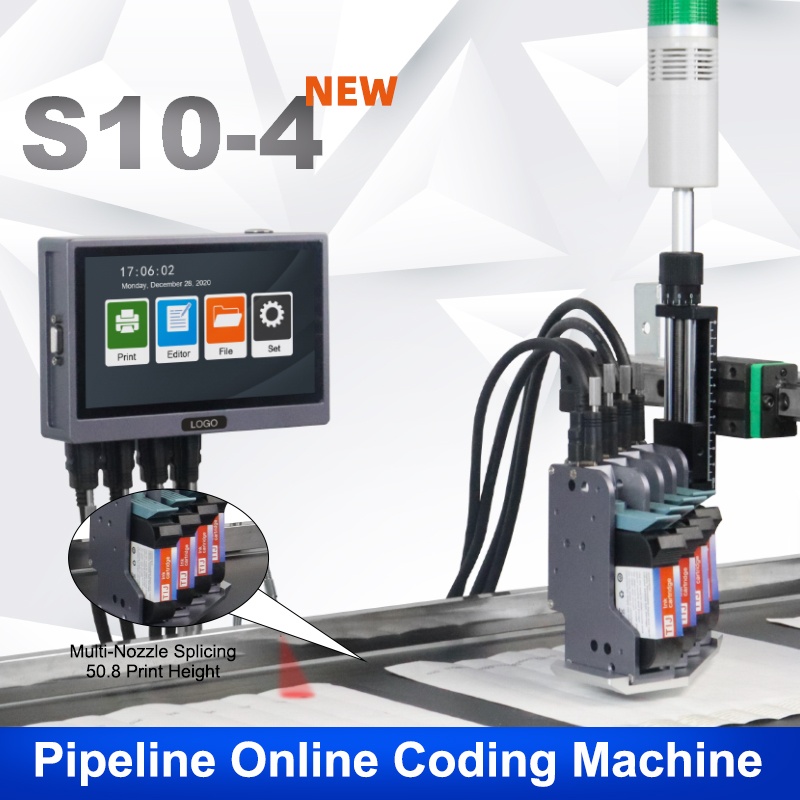
S10-4 online inkjet printer (splicing)
a four-head set for the mid-width case:
- 2-50.8mm print height
- 2-5mm throw distance
- Prints Chinese, English, date, QR code and barcode
- Marks metal, plastic, pipe, foam and carton
Size Your Panel
- See the machine: S10-4 online inkjet printer (splicing)
- Read next: five specs that matter on an online line, which is where head count sits next to throw distance
- Talk to us: send the widest mark and the panel width through our contact page. We reply within 24 hours with a head count and a no-commitment quote.