Last Updated: 2026-10-19
An egg printer automatic is bought to take the trigger away from the operator, not to raise the head count. Six checks decide whether a tray line runs unattended or still needs somebody at the infeed all shift, and each one is cheaper to change on paper.
Why an Egg Printer Automatic Is a Trigger Question
Almost every egg line already runs faster than the head has to print. A tray of thirty eggs passing a six-nozzle block is marked in the time the tray travels one pitch, and that pitch is set by the grader rather than by the coder. The number that goes wrong in month one is not throughput. It is the interval between the tray arriving and the head firing, which on a hand-fed line depends on a person noticing the tray.
Automation changes who owns that interval. A self-triggered unit fires on a pulse from the line, holds a fixed delay, and repeats it for ten hours without drifting. A hand-fed unit fires when somebody presses a pedal, which is fine for a hundred trays and not fine for eight thousand. The published account of inkjet printing explains the drop; it does not explain an afternoon lost to a pedal.
Three Places a Hand-Fed Tray Line Loses Its Rate
- The swap at the infeed. One operator feeding and triggering at once means a tray arriving while the previous one is nudged gets marked late or not at all.
- The changeover between grades. A new batch means a new date string, and a manual unit waits while somebody walks to the panel.
- The last ten minutes. Rate holds while attention holds, and the trays marked during the sweep are the ones that come back blank.
None of those is a printer fault; all three are bought on the trigger line.
Six Checks on an Egg Printer Automatic Build
| Check | What the answer must state | What it prevents |
|---|---|---|
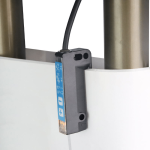
| Trigger source | Sensor type, mounting point and the pulse expected from the grader | A unit that only fires on a pedal |
| Delay stability | Whether the delay sits in hardware or is re-derived per tray | A mark that drifts across a long shift |
| Nozzle count and pitch | How many nozzles fire at once and the shell spacing they cover | One nozzle doing six trays of work |
| Ink contact safety | The grade declared for direct eggshell contact, in writing | A carton grade used on shells |
| Recovery after a stop | What happens to the tray under the head when the line halts | A double-marked tray at every restart |
| Data path | How the batch and date string is loaded, and from what | Retyping a batch number every changeover |
The second row is the one buyers skip, and a delay re-derived per tray behaves differently after four hours of vibration.
Where SHICAI Puts the Sensor
The frame is set against a real tray before shipping, because shell spacing on a loaded tray is not the spacing on an empty one. Six nozzles fire in parallel on the build below, so one pass covers a full row instead of walking across it.
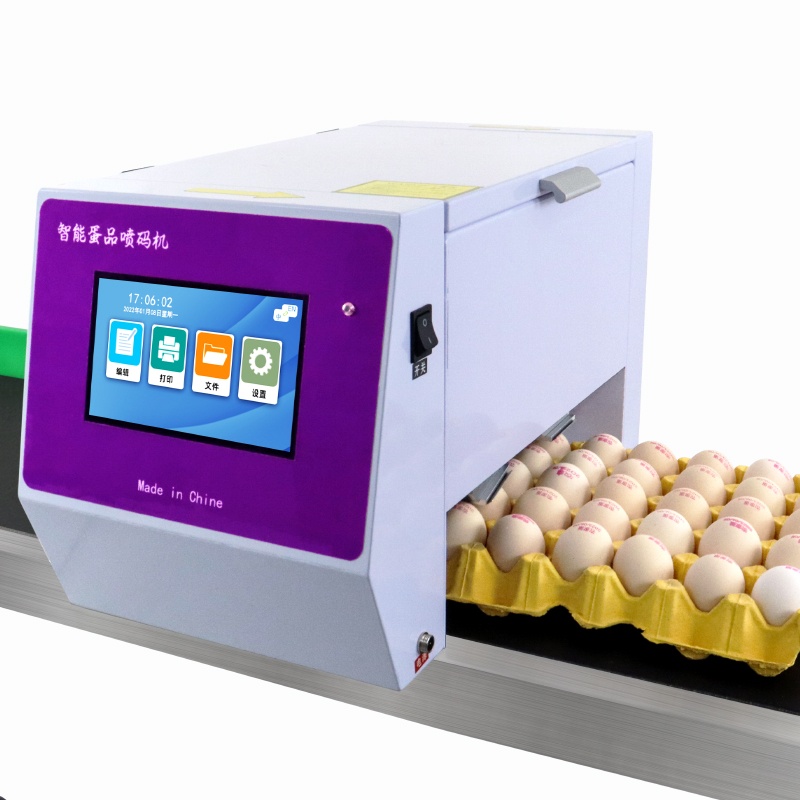
Six head egg inkjet printer
the parallel-head build for a tray line:
- Six individual nozzles print in parallel
- 7.0-inch capacitive screen
- Food-grade ink safe for eggshell contact
- Prints Chinese/English characters and dynamic QR codes
Ink is agreed in the same conversation, and the grade is declared against the shell rather than the carton. A unit sold as an egg coding machine automatic has to hold that claim through ISO 9001 quality management.
Tray-Line Questions
- Can an automatic unit be fitted to a line that already has a grader?
- Yes, provided the grader supplies a pulse or a dry contact. The unit reads the same signal the grader uses to release a tray.
- Does automation remove the operator completely?
- It removes the trigger, not the supervision. Somebody still loads trays, checks the first mark of each batch and tops up ink.
- What happens if a tray arrives out of pitch?
- A fixed hardware delay marks it in the wrong place rather than skipping it, which is easier to catch at the outfeed than a blank shell found later.
Time One Shift of Trays
Count the trays in one shift and the seconds lost at each changeover. Send the tray spacing and the grader signal you have, and we will name the mounting point before a quotation is written.
Next Steps
- Send a loaded tray and the date string you print. We mark the actual shells and return the result free of charge.
- Start at the contact page, on +86 17625427465 or kuangcy@126.com. We reply within 24 hours.