Last Updated: 2026-10-20
An egg printer wholesale quotation usually arrives as one number per unit, and that number hides six terms that decide what the shipment actually costs. Two buyers can order the same head and land it at prices a third apart, because the terms were agreed differently.
An Egg Printer Wholesale Price Is a Set of Terms, Not a Figure
Distribution of egg coding equipment is a small world with long lead times. A buyer ordering two units for two sheds is doing something different from a dealer ordering twenty for a market, and the difference is not simply the discount column. It sits in how the goods are packed, what spare parts travel with them, which ink family is committed, and who trains the first operator.
Those four items are negotiable in every serious wholesale conversation. They are also the four items that produce the surprise costs after the container is opened, which is why a term sheet matters more than a price list.
Six Terms That Move the Landed Price
| Term | What to agree | What it changes |
|---|---|---|
| Quantity breaks | The exact quantity at which the next band applies | Whether a mixed order is worth splitting |
| Incoterm | EXW, FOB or CIF, named port | Who carries freight and insurance risk |
| Packing | Export carton, pallet footprint, container loading plan | How many units fit and what is damaged on arrival |
| Spares kit | Which parts ship with the order and at what ratio | The first breakdown, months later |
| Ink commitment | Family, grade and the reorder lead time | Whether the machine stays in service |
| Training and documents | Language, format and who delivers it | The first week of marks |
Read the table in the order written. Quantity and Incoterm set the arithmetic; the remaining four decide whether the arithmetic survives contact with a working shed.
MOQ, Mixed Containers and the Dealer Calculation
A minimum order quantity exists because a production run has a fixed setup. On a six-nozzle egg build the setup is frame fabrication and head calibration, so the useful question is not the MOQ on its own but whether a mixed order reaches the same band. A dealer who needs four egg units, two small character units and a paging machine is usually better served by building one mixed container than by three separate orders.
Ask for the loading plan in writing. A pallet footprint agreed before production prevents the classic outcome where the last four units are left at the factory because the container is full.
Where volume is close to a band but not over it, the honest options are to take the lower band and accept the price, or to add consumables to reach the band. Consumables are the cheapest way to bridge a gap, because they will be used anyway and they carry no installation cost.
Building the Landed Cost Before You Compare
Landed cost is the only comparable figure. Take the unit price, add freight and insurance to your port, add duty and clearance, add inland transport to the shed, and then add installation. Two quotations that look ten percent apart often converge once installation is priced, because one includes a commissioning visit and the other does not. An egg printer wholesale offer that excludes it is not cheaper; it is a price with the visit moved to your side of the table.
Do the same exercise for the second year. A wholesale price that excludes a spares kit is not cheaper; it is a price with the risk moved to you. A written ratio such as one print module per ten units changes that risk without changing the headline figure. Volume buyers also ask about the route behind the build, which for this range is described in ISO 9001 quality management.
Ink Belongs in the Contract, Not the Catalogue
Egg coding has one non-negotiable requirement: the ink must be declared for direct eggshell contact. In a wholesale agreement that requirement has to appear as a term, with the family named and a reorder lead time stated, because a dealer who cannot restock ink in a season has sold a machine that will sit idle.
The build below ships with food-grade water-based red ink and a six-nozzle bank rated to twenty trays per minute on a standard five-by-six tray. Those two facts are the ones a wholesale buyer should be able to repeat without opening a brochure.
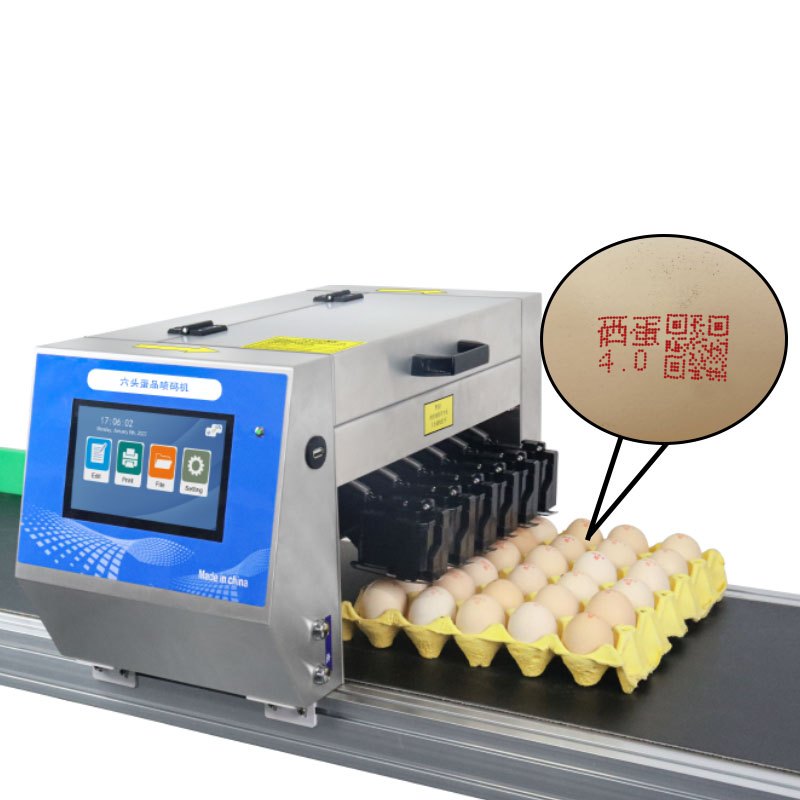
Six head egg inkjet printer(D100-6)
the build most often ordered in volume:
- Prints up to 20 trays per minute (5 x 6 trays standard)
- 2-5 mm optimal throw distance
- Food-grade water-based red ink
- Marks eggshells with dates, batch and traceability codes
An egg coding machine wholesale order also needs a stated language for the panel and the manual, since the operator in the shed is rarely the person who placed the order. Fixing that at the contract stage costs nothing and saves a translation later. The drop mechanics that decide whether a shell mark survives handling are covered in the general account of inkjet printing.
Wholesale Questions
- Does a larger order always lower the unit price?
- Usually, up to the point where the container is full. Past that the freight cost per unit rises again, so the cheapest order is often the one that fills a container exactly.
- Should spares be ordered with the machines or later?
- With the machines. A later order carries its own freight and its own lead time, and it always arrives after the first breakdown.
- Who sets up the first unit in a new market?
- Agree this in writing. Either a commissioning visit is included, or a video walkthrough with the height setting recorded is delivered with the first unit.
Ask for a Term Sheet, Not a Price
Send the quantities, the destination port and the ink volume you expect in year one. We will return a term sheet with the bands, the packing plan, the spares ratio and the ink lead time, so the comparison is made between comparable offers.
Next Steps
- Send your quantities and destination port. We return a written term sheet within one working day.
- Start at the contact page, on +86 17625427465 or kuangcy@126.com. We reply within 24 hours.