Last Updated: 2026-10-20
Searching for an alternative to Linx usually starts with a price and ends with an installed cost. The established continuous inkjet range is well regarded, so a switch is only rational where six measured differences add up to a better year on your own line.
Why an Alternative to Linx Gets Considered at All
A continuous inkjet printer is a long-lived purchase, and most sites look at a change for one of four reasons: a consumable that has become expensive or slow to supply, a service response that no longer fits a three-shift week, a line speed the installed unit cannot reach, or a data requirement the current panel cannot hold.
None of those reasons is a criticism of the technology. They are all questions about fit, and fit is measurable on your own product rather than on a brochure.
Six Tests to Run Side by Side
| Test | How to run it | What a good answer looks like |
|---|---|---|
| Mark on your substrate | Print the same three-line code on your own material, cold and warm | Readable at arm’s length without a torch |
| Speed headroom | Print at the fastest line speed you actually run, then ten percent above it | A clean mark at the upper figure, not at the nominal one |
| Throw distance | Set the gap to the distance your frame and product allow | Range that covers your largest mechanical tolerance |
| Consumable path | Price ink and make-up for a year at your duty cycle | A family that is stocked locally and reordered in days |
| Panel and data | Load a batch from a file or a signal, not by hand | A template that populates every field from one source |
| Spares and training | Name the print module and ask who trains the first operator | A part number and a named person, both in writing |
Run all six on the incumbent as well. A comparison where only the challenger is tested is a sales document rather than a decision. That is the discipline an alternative to linx deserves, because the incumbent already has a history on your line that no brochure can answer.
Installed Cost Beats the Unit Figure Every Time
The number that matters is the cost of the first year in service: unit, freight, duty, mounting, commissioning, the first ink order and the training hours. On a continuous inkjet install, mounting and commissioning are a meaningful share of that total, and they are the lines most often left out of a comparison table.
Year two is where the difference usually appears. Consumables, spare modules and service visits dominate, and they are driven by duty cycle rather than by the purchase price. A site printing eight hours a day spends a very different amount from one printing twenty.
Uptime Is a Consumable Question
Continuous inkjet heads need circulation, and circulation needs make-up. A machine that is stopped for a week without a flush will cost more in recovery than it saved in idle time, which makes the flush routine and the local availability of make-up the practical measures of uptime.
Ask two questions of any candidate. What is the flush procedure for a two-week stop, and who holds stock of the consumable within reach of your site. The answers predict the next twelve months better than any headline speed.
Data and Line Integration
Modern coding requests arrive as data. A retailer wants a batch reference loaded from a file, a serialised code, or a mark that a vision system can verify afterwards. A panel with a large industrial screen makes that workable at the machine, and a signal interface makes it workable without an operator.
The build below carries a 10.1-inch industrial touchscreen, prints to 400 metres per minute and offers a 2-20 mm print height with a 3-30 mm throw distance, which covers the majority of continuous inkjet work on film, carton and cable at a rated power of 120 W.
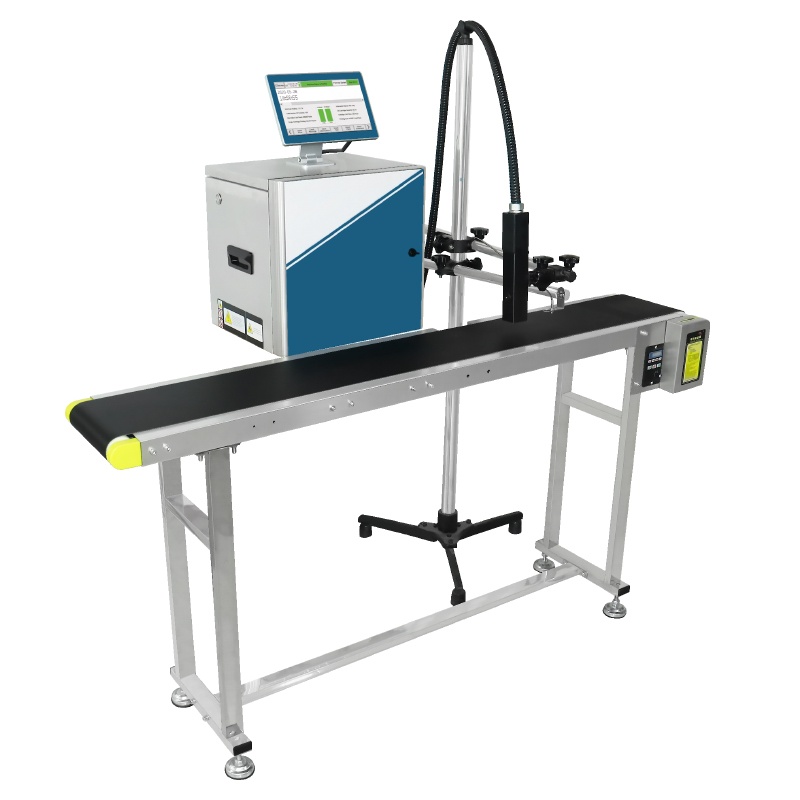
S1000 small character inkjet printer
the continuous build to test against an incumbent:
- Prints up to 400 Meters Per Minute
- 2-20mm print height
- 10.1-Inch Industrial Touchscreen
- 3-30mm throw distance
- Low 120W rated power
If a cheap Linx alternative is what the budget actually asks for, the honest route is a smaller build and a shorter duty cycle rather than a cheaper version of the same machine. SHICAI quotes the two side by side, so the difference between them is visible before an order. Builds follow the route described in ISO 9001 quality management, and the physics behind a continuous drop stream is set out in the general account of inkjet printing.
Switching Questions
- Can a switch be done without stopping production?
- Yes, where the incumbent keeps running until the new unit has proved its mark. Order the consumables first, then mount, then cut over on a planned stop.
- Do the codes have to be re-approved by the retailer?
- Only if the layout changes. Keep the field positions and the font metric, and a like-for-like mark usually passes without a new submission.
- Is a smaller build a downgrade?
- Only if the duty cycle needs the larger one. Match the build to hours and line speed, and the smaller unit is the correct purchase rather than a compromise.
Book a Sample Run on Your Own Product
Send the substrate and the code you print today. We will return a marked sample and a first-year cost sheet with mounting, commissioning and the first ink order included, so the comparison is like for like.
Next Steps
- Send your product sample and current code layout. We return a marked sample and a first-year cost sheet.
- Start at the contact page, on +86 17625427465 or kuangcy@126.com. We reply within 24 hours.