Last Updated: 2026-10-21
Piezo inkjet printer cost arrives as one number per machine, and that number tells you almost nothing about what a plant spends. Five figures turn a purchase price into a cost per code, which is the only figure that can be compared with a second supplier or a second process.
Why a Piezo Inkjet Printer Cost Figure Misleads
A cheap head with an expensive cartridge and a generous consumption rate can cost more per thousand codes than a dearer build with a leaner habit. The pattern is familiar from every consumable machine, and it repeats in coding because the mark is produced continuously rather than once.
It also explains why two plants with identical machines report different costs. One prints a short two-line date inside a fifth of the available height. The other prints a wide block with a logo on three shifts. The machine is the same; the consumption is not, and neither is the piezo inkjet printer cost that each plant should expect.
The Five Numbers You Need
| Number | Where to get it | Why it dominates |
|---|---|---|
| Codes per month | Counted from the line, not from last year total divided by twelve | Everything else is divided by it |
| Coverage per code | Measured height and width of the actual block, not the maximum | Consumption scales with area, roughly |
| Cartridge yield at that coverage | Ask the supplier for codes per cartridge at your block size | The quoted yield is usually at a smaller block |
| Cartridge price | Your invoice, including freight and duty | Freight is a real share on small orders |
| Downtime per change | Minutes to swap and re-prime, multiplied by line cost per hour | Often larger than the consumable itself |
The second row is where most estimates go wrong. A supplier quotes yield at a compact date block because that is the flattering figure; a plant that prints a 40 mm code with a logo consumes several times as much.
A Worked Example, With Your Numbers
Suppose a line prints 40,000 codes a month, the block covers about a third of the available height, and a cartridge delivers 900,000 codes at that coverage. Consumption is then roughly one cartridge every twenty-two months, which sounds trivial, and the cost per code is driven by something else entirely.
Now change two variables. Add a logo, so coverage doubles. Move to a three-shift schedule, so codes per month reach 120,000. Consumption rises to about one cartridge every four months, and the annual consumable line becomes a visible item in the budget rather than a rounding error. Nothing about the machine changed.
Do the same arithmetic for downtime. If a swap costs twenty minutes and the line earns 300 USD an hour, each change carries 100 USD of lost output. Four changes a year is a rounding error; twelve is a decision about cartridge capacity.
Three Costs That Stay Off the Quote
Freight on consumables. A cartridge is small and light until it is ordered alone, and a single urgent shipment can double its landed cost. Waste at start-up. Every change produces a few test prints, and a plant that does not count them understates consumption. Rejects. A missed or partial code is a rejected pack, which costs more than any of the three items above.
Those three explain why a plant that tracks cost per code usually ends up buying consumables in batches rather than one at a time, and why the same plant tends to standardise on one or two builds across several lines.
There is a fourth item that only appears in the second year: the cost of a change that was never planned for. A retailer who adds a customer field, or a move from a two-line date to a three-line block, quietly raises consumption without changing the invoice that was used to justify the purchase. Plants that keep a cost-per-code sheet update it when the code layout changes, not when the cartridge runs out, because the layout is the variable they control.
Where a Piezo Inkjet Printer Wholesale Order Fits
A multi-line order changes the arithmetic in one specific way: consumables can be bought once, in one shipment, for every line. That spreads the freight and removes the urgent single-cartridge purchase that quietly carries the highest unit cost. It also makes the coverage question sharper, because a batch sized for the widest block wastes money on the narrowest one.
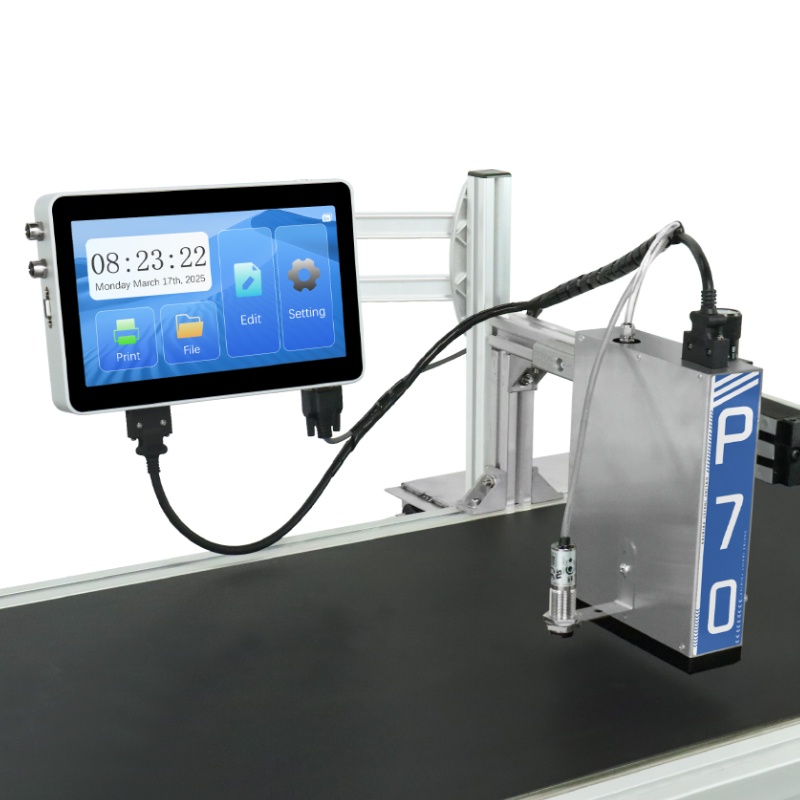
P70 Online inkjet printer
the build whose running cost is easiest to model:
- Print speed 1-100m/min
- 180dpi print accuracy
- 3-71.8mm print height
- 10 Inch Capacitive Touch Screen
- 2-15mm throw distance
It is listed at 699 USD as a single head, and the print height range is what makes the coverage figure easy to control: printing a 12 mm date inside a 71.8 mm window uses a fraction of a full-height block. Builds follow the route described in the ISO 9001 quality management standard, and the way a drop-on-demand head forms a character is set out in the account of inkjet printing.
Cost Questions
- Should cost per code include the machine?
- Yes, if you want a comparable figure. Divide the purchase price over the codes the machine will mark in its service life, and add that to the consumable line.
- Is a bigger cartridge always cheaper per code?
- Per code, usually. Per year, only if the shelf life covers the interval between changes at your volume.
- How do I compare two suppliers fairly?
- Ask both for codes per cartridge at your block size, then apply your own cartridge price and your own downtime cost.
Send Your Five Numbers
Give us the monthly code count, the block size and your cartridge price. We will return the cost per code and the interval between changes, so the comparison is made on running cost rather than on purchase price.
Next Steps
- Send the monthly count and a photo of the printed block. We return a cost-per-code sheet for one line or for ten.
- Start at the contact page, on +86 17625427465 or kuangcy@126.com. We reply within 24 hours.