
Last Updated: 2026-10-22
Every coding machine for sale listing carries one number that a buyer can compare and dozens that decide the outcome. The number is the price. What sits behind it, from the head count to the trigger wiring, is the part that determines whether the unit earns its place in year three.
A Coding Machine for Sale Is a Price, Not a Build
Two units advertised at the same figure can differ in almost everything that matters. One is a single head with a fixed bracket and a cable set. The other is a twin head on a frame with a sensor, an encoder tap and a mount designed for a specific line. Both are honestly described as a coding machine for sale, and only one of them will be printing a clean code in week two without a return visit.
The reason buyers get this wrong is that the listing is written for comparison and the purchase is made for installation. Comparison wants a single figure. Installation wants a drawing. The six checks below move the conversation from the first to the second before any money changes hands.
Six Checks Before the Deposit
| Check | The question to ask | What a weak answer sounds like |
|---|---|---|
| Build definition | How many heads, what model, and what frame | A price without a part number |
| Scope of supply | Sensor, bracket, cables and encoder in or out | All standard accessories included |
| Sample on your product | Who marks the actual substrate before payment | Photos of marks on a demo plate |
| Spares path | Which part is named, priced and stocked | We support all models |
| Installation | Who sets the trigger window on site | Plug and play |
| Acceptance | What is measured, by whom, before the balance | You will be happy with it |
The third row is the one that settles most arguments. A mark on a supplier demo plate proves the head works. A mark on the customer carton, at the customer cycle time, proves the purchase works, and the two are not the same claim.
What the Price Usually Leaves Out
A quotation built to look small tends to exclude the same four items. The bracket is quoted separately because the frame depends on a site visit. The sensor is optional because the buyer might already own one. Installation is a day rate. Freight and duty sit outside the figure, though they land on the same invoice at the border.
Add those four back and two quotations that differ by ten percent often converge, sometimes inverting. The honest comparison is landed and installed cost against the same message string, and the only way to get there is to ask each supplier for a line-item breakdown rather than a total.
A Sample on Your Own Product
Send the substrate, not a description of it. A coated carton accepts ink differently from an uncoated one, and a coder set up on the wrong board produces a mark that looks dry at the factory and smears at the customer. What comes back should include the print height, the gap and the resolution used, written on the sample rather than in an email.
Ask for two samples if the job is seasonal: the widest message the customer may ask for, and the message you print today. The wide one is where a narrow build is exposed.
The Spares Question
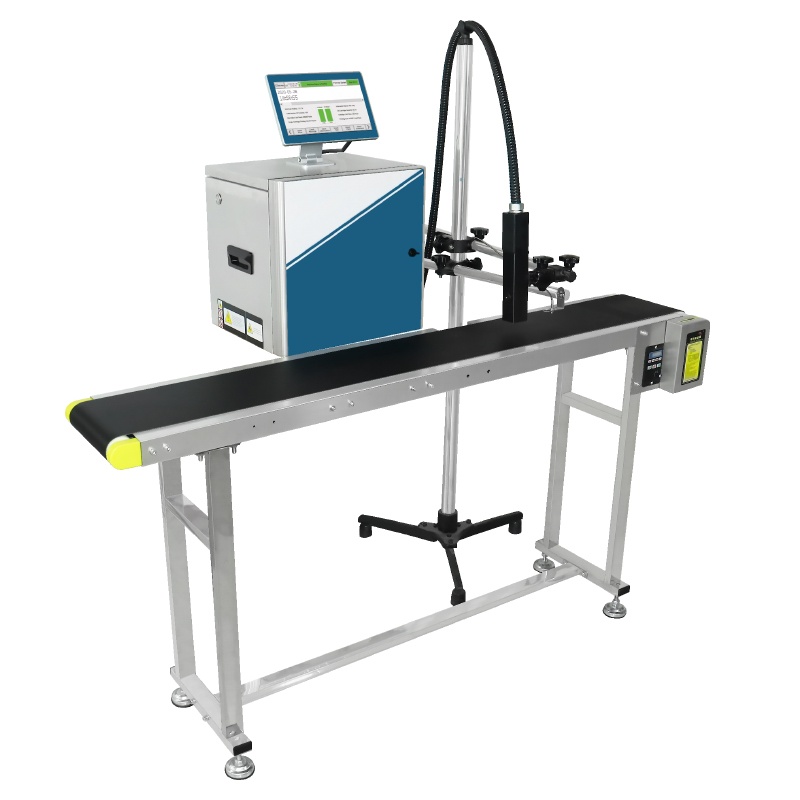
S1000 small character inkjet printer
a build specified at board level rather than at brochure level:
- Prints up to 400 Meters Per Minute
- 2-20mm print height
- 10.1-Inch Industrial Touchscreen
- 3-30mm throw distance
- Low 120W rated power
Ask which consumable and which print module are covered by a named part, a fixed price and a stated lead time. A supplier who can answer in one sentence has a parts path. A supplier who answers with a warranty period has a warranty.
The distinction matters most at the moment a line is stopped. A module in stock turns a bad afternoon into a swap; a module on order turns it into a week of manual marking and a customer conversation. Builds follow the route described in the ISO 9001 quality management standard, and the mechanics behind a small character mark are covered in the general account of inkjet printing.
The Acceptance Test That Ends the Argument
Write the test before the order and keep it short enough to run in an hour. Mark fifty units at production speed, read every one of them, and count failures rather than describing them. Check the first unit after a two hour stop, because start-up behaviour is where a marginal installation shows. Then photograph the settings screen so the next operator starts from a known state.
Pay the balance against that record. A supplier who resists a written acceptance test is telling you something useful about the installation visit, and it is better to hear it before the deposit than after the pallet arrives.
Buyer Questions
- Should a first machine be new or used?
- New, when the parts path is the risk. A used unit is a reasonable buy only if the module is still supplied and a sample has been printed on your own product.
- Is a twin head worth the extra cost?
- Only where the message needs two lines of different ink or a width one head cannot cover. Otherwise it adds a second alignment job.
- How long should installation take?
- One day for a single head on an existing conveyor, including the first sample. Two if a frame has to be fabricated on site.
Send the Drawing, Not the Wish List
Give us the product, the message string, the line speed and a photograph of the mounting point. We will answer with a build, a scope of supply and an acceptance test, so the coding machine for sale becomes a specification you can hold a supplier to. Any coding machine supplier who cannot produce those three documents has told you where the risk sits.
Next Steps
- Send the substrate, the string and the line speed. We return a build sheet and a one-hour acceptance test.
- Start at the contact page, on +86 17625427465 or kuangcy@126.com. We reply within 24 hours.