
Last Updated: 2026-10-27
An inkjet printer for wood is one of the few purchases where the sample matters more than the specification. Timber varies from board to board, so the checks below are all about evidence: a marked offcut, a named grade, a stated block height and a spare part number you can hold a supplier to.
Six Checks an Inkjet Printer for Wood Has to Pass
A sawmill, a pallet yard and a joinery buy the same class of machine for three different jobs, and all three are badly served by a demonstration on planed stock. The checks below are ordered by how much they cost when they are skipped.
| Check | Evidence to ask for | Cost of skipping it |
|---|---|---|
| Sample on your own board | A marked offcut from your stack, not a photo | A machine that works on the sample and not on the pallet |
| Grade named and batched | The grade and batch written on the sample | A second order for a grade that should have been quoted first |
| Block height in millimetres | The tallest block the unit prints in one pass | A pallet number a driver cannot read from a truck |
| Gap tolerance on rough timber | How the head is held at a constant height | Strikes on high spots and a fence built on site |
| Spares for the module | Part numbers held in stock | Air freight for one part in month two |
| Acceptance terms | The rub test written into the order | Arguing about adhesion after the balance is paid |
The fourth row is unique to timber. A planed board is flat within a fraction of a millimetre; a sawn deck has high spots of two or three millimetres, and a head set at a fixed gap will meet the tallest one. A supplier who has marked pallets will propose a fence or a pair of rails without being asked.
Sawn, Planed and Treated Behave Differently
Planed timber takes a fine stroke and holds an edge, which makes it the easiest surface and the least representative. Sawn timber lifts fibres, so a thin character feathers and a bolder dot is the answer rather than a finer resolution. Treated timber is often easier than raw pine, because the treatment seals the fibres a water-based grade would otherwise follow.
Resin is the fourth variable and the one that hides. A resinous board can leave a tacky surface that a mark will not key to, and the failure appears on one pallet in twenty rather than on the sample. Asking what the supplier does about resinous stock separates a company that has marked timber from one that has marked cardboard.
Sample, Grade and the Rub Test
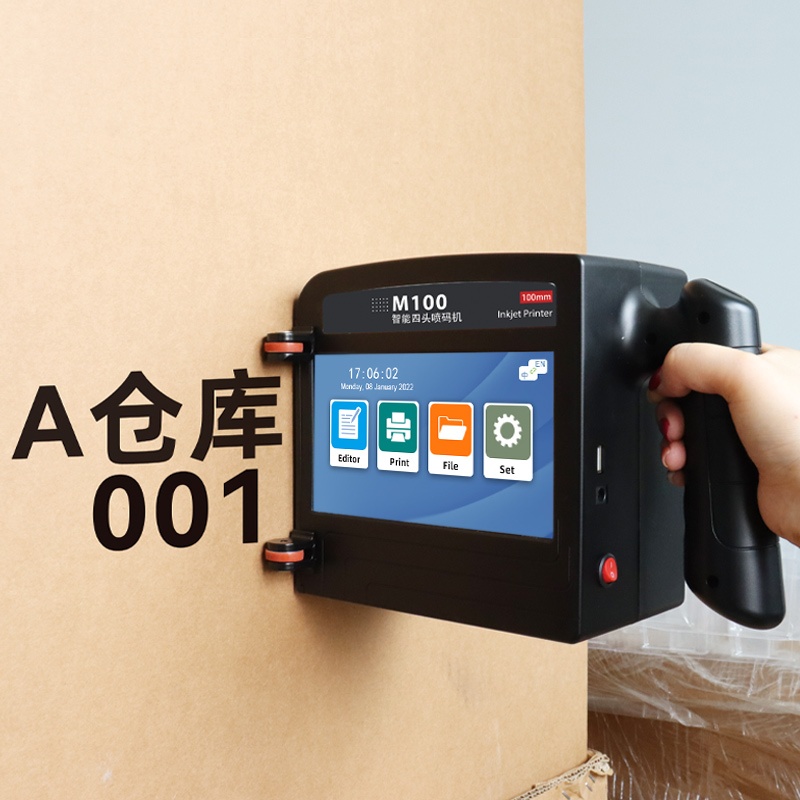
M100 Handheld inkjet printer
the large character build for pallets and crates:
- 2-100 mm print height for large characters
- 600 dpi print accuracy
- 2500 mAh battery for full-shift runtime
- 7-inch touch screen
- Prints Chinese/English, numbers, pictures, QR codes and barcodes
The sample is only half the evidence. A marked board without a grade beside it proves that something worked once; a marked board with a grade, a batch and the block height written on the back proves what to reorder. Keep it with the purchase order, and compare the first pallet of the first delivery against it in the same light.
The rub test belongs in the acceptance terms: mark ten boards, leave them an hour, rub one with a dry thumb and one with a cloth damped in the fluid the yard already uses. A mark that fails the second rub fails in a lorry, and that failure arrives as a rejected load rather than as a service call. Builds follow the route described in the ISO 9001 quality management standard.
Height Decides the Machine, Not the Price
The block height is the specification that sorts the market. A 12 mm date on a crate is a small character job; a pallet number read from the seat of a forklift is a 40 to 100 mm block, and that is a different class of unit with a different head, a different battery and a different price.
Two numbers should be written down before an enquiry: the tallest block the customer will ever ask for, and the distance from which it has to be read. Both are cheap to change on paper and expensive to change after delivery, because a unit that tops out at 25 mm cannot be stretched to 60 by a setting. Builds follow the route described in the wood section of any material reference, and the marking side is set out in the general account of inkjet printing.
Spares for a Slow Line
A timber yard is a low-volume, high-variation customer, and the consumable pattern follows: a cartridge that lasts weeks, a battery that is charged twice a week, and a module that fails from sitting idle rather than from work. Ask what a module costs and how many the supplier holds, then divide the answer by the number of units the yard runs.
The idle question is worth asking directly. A unit that sits for a fortnight between batches needs a capping routine that someone actually follows, and a supplier who mentions it before the order is a supplier who has supported this kind of customer before.
Buyer Questions
- Is a hand-held enough for a pallet yard
- For tens of pallets a day it is, and above that the arm becomes the bottleneck before the unit does.
- Can one unit cover crates and timber
- Yes, with a saved job for each block and a grade that suits both, and the sample should include both surfaces.
- What block should the artwork allow
- The height that reads from the distance the code is checked at, which is usually 40 mm for a pallet and 12 mm for a carton.
Send a Board and the Block
Cut a piece from the deck you actually use and write the block text beside it. We will mark it, rub it and return it with the grade and the height, so the inkjet printer for wood is bought against timber rather than against a catalogue.
Next Steps
- Send a deck board and the block text. We return it marked, rubbed and labelled with grade and height.
- Start at the contact page, on +86 17625427465 or kuangcy@126.com. We reply within 24 hours.