Last Updated: 2026-10-27
A laser marking machine for aluminum is quoted in watts and paid for in everything around them. Field size, extraction, fixture and the alloy in front of the lens move the real cost far more than the power band, and the invoice rarely shows any of them.
The Cost Stack Behind a Laser Marking Machine for Aluminum
Five lines sit between a headline price and a machine that runs a shift. They are the source and its cooling, the lens and the field it covers, the extraction that takes the plume away, the fixture that puts the same part in the same place, and the enclosure or interlock the site requires. Only the first of those is visible on a quotation by default.
The order in which they are decided matters. Field size follows from the largest mark on the largest part, and it changes the lens, the working distance and the size of the cabinet. A buyer who starts from the power band and works outward usually ends up with a machine that marks beautifully on a sample plate and misses the corner of the real component.
Aluminium Is Not Steel, and That Changes the Price of the Mark
Bare aluminium reflects most of a 1064 nm beam, so the energy that reaches the surface has to be delivered in short, dense pulses rather than a long dwell. In practice that means the marking window is narrower than on steel: too little overlap and the mark is a pale ghost that disappears under handling, too much and the surface melts into a raised bead that a customer rejects.
Anodised aluminium behaves the opposite way. The oxide layer absorbs well and marks dark at low power, which is why a plant running anodised housings can often use the smallest band in the range. Cast alloys are the third case: porosity scatters the beam, and the mark that is crisp on an extruded profile looks mottled on a die-cast cover. Three alloys, three recipes, and one machine has to hold all of them.
Power Bands and What They Actually Buy
| Band | What it covers | Where it runs out |
|---|---|---|
| 20 W | Anodised parts, thin plates, fine text at low duty | Deep marks on bare alloy, or a large field at speed |
| 50 W | Bare aluminium, painted surfaces, most housings | Three-shift duty at a wide field without headroom |
| 100 W | Deep marks, wide fields, high throughput | A workshop with no extraction and a small power supply |
The middle band is where most aluminium work lands, and the honest question is not which band marks the sample but which band still marks it at four in the afternoon on the third shift. A unit run at ninety per cent of its rating in a warm room loses contrast before it loses the mark, and contrast is what an inspector judges.
What the Invoice Leaves Out
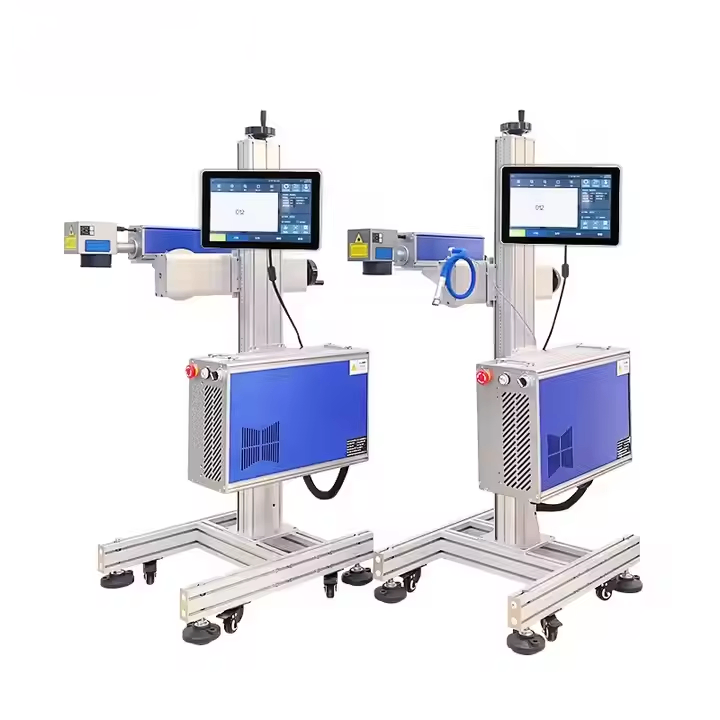
G-20 Fiber laser inkjet printer
the air-cooled build with 20 W to 100 W options:
- Fiber laser output options from 20W to 100W
- Permanent marks on metal without consumables
- Air-cooled design for continuous duty
- Marks hardware, electronics and metal parts
Because the process needs no consumable, buyers assume the running cost is electricity and nothing else. The four omissions below are what that assumption misses.
Extraction. Marking aluminium throws a fine plume, and a workshop without extraction coats its own walls, its lenses and its operators. A fume arm and a filter are a real line on the budget, and in some countries they are a condition of operating.
Fixture. A laser marks where it is pointed, which is not the same as marking where the part should be. A nest that repeats within a tenth of a millimetre costs money once and saves a scrap bin every week.
Field and lens. The marked area is a rectangle, and a part that does not fit has to be indexed or the lens changed. Both are cheaper to specify than to retrofit.
Power and air. An air-cooled cabinet removes the chiller from the shopping list, which is why this class of build suits a workshop rather than a plant room. It also makes the ambient temperature part of the specification, so a bay at 40 degrees is a different duty from the same bay at 22.
Cost per Part Beats Cost per Hour
A laser is fast in the way a pen is fast: the time is spent drawing, not preparing. A part that needs a fixture, a program recall and a height adjustment can consume more minutes than the marking itself, and that is where the comparison with a printing process is usually settled in the wrong direction.
The arithmetic that holds up counts seconds per part across a real batch, including the first part of the shift and the changeover between two part numbers. On a batch of two hundred small brackets the marking might be twelve seconds a part and the handling forty. On a batch of twenty large panels the marking dominates instead. Same machine, two different cost curves, and only the second one justifies the wider field.
Where the volume is real, the running cost falls to power, extraction filter changes and the occasional lens clean, which is a small number per thousand parts. Where the volume is thin, the fixed costs dominate and the honest answer is that a marking service or a different process is cheaper than owning the machine.
Buyer Questions
- Does a 20 W unit mark bare aluminium
- It marks it, slowly and with less contrast than a 50 W build, and it is the correct choice only for thin marks at low duty.
- Is anodised material easier to mark
- Yes. The oxide layer absorbs the beam and produces a dark mark at low power, which is why anodised housings are the friendliest aluminium job.
- Does air cooling limit a three-shift plant
- Not by itself, and it does tie the duty cycle to room temperature, so ventilation at the machine is part of the specification.
Send the Alloy and the Drawing
Send one part of each alloy you mark, with the drawing tolerance for the mark. We will return a marked sample photographed at the same scale, the band and field that hold it, and a laser marking machine for aluminum cost sheet that names the extraction and fixture rather than leaving them to the site.
Next Steps
- Send one part per alloy and the mark tolerance. We return marked samples plus a cost sheet.
- Start at the contact page, on +86 17625427465 or kuangcy@126.com. We reply within 24 hours.