
Last Updated: 2026-11-04
Industrial grade is a phrase, not a rating. A batch coding machine industrial grade label means something only when it names the three parts that fail on a packing line: the body, the duty cycle and the alarm path, and each of those is measurable.
What Batch Coding Machine Industrial Grade Really Names
It names survivability, not speed. A unit that carries the label is supposed to keep the same code position through vibration, dust from corrugated board, and an operator leaning on the head to clear a jam.
Those three are the whole difference between a bench unit and a line unit, and only one of them appears on a datasheet. The others are inferred from the case, the bracket and the way the machine behaves after a stop.
Body, Duty Cycle and the Alarm Path
| Element | Claim worth paying for | Claim that means nothing |
|---|---|---|
| Body | Sealed panel, alloy or stainless shell | Heavy duty, unqualified |
| Duty cycle | Hours at a stated ambient | Twenty-four hours, no conditions |
| Alarm path | Stops the line, calls a phone | A red light in the corner |
| Restart | Clean block after a stop | A purge cycle and a scrap tray |
The second row is where the label usually breaks. A unit rated for continuous work at 25 degrees behaves differently in a chilled packing hall, and the honest figure states the ambient alongside the hours.
The third row is the one that decides whether a bad shift is caught. A coder that keeps printing a stale date after the job changed produces a pallet of compliant-looking product, and the recall starts from there.
What a Two-Shift Packing Line Asks For
A packing line asks for a head that returns to the same place after a stop, a body that survives a knock from a pallet truck, and a screen an operator can read with gloves on.
None of that is exotic. It is simply the difference between a machine specified for a bench and one specified for a place where a forklift passes twice an hour.
How SHICAI Writes the Specification
We list the body material, the print height and the throw distance as separate lines rather than as an adjective, because a buyer can compare figures and cannot compare a phrase. Export builds ship factory-direct, with records kept under ISO 9001 quality management.
What recurs in our export orders is the bracket, not the cabinet. A head fixed to a vibrating guard drifts a millimetre a week, and a millimetre is the difference between a code on the panel and a code on the flap.
The Build for Continuous Shifts
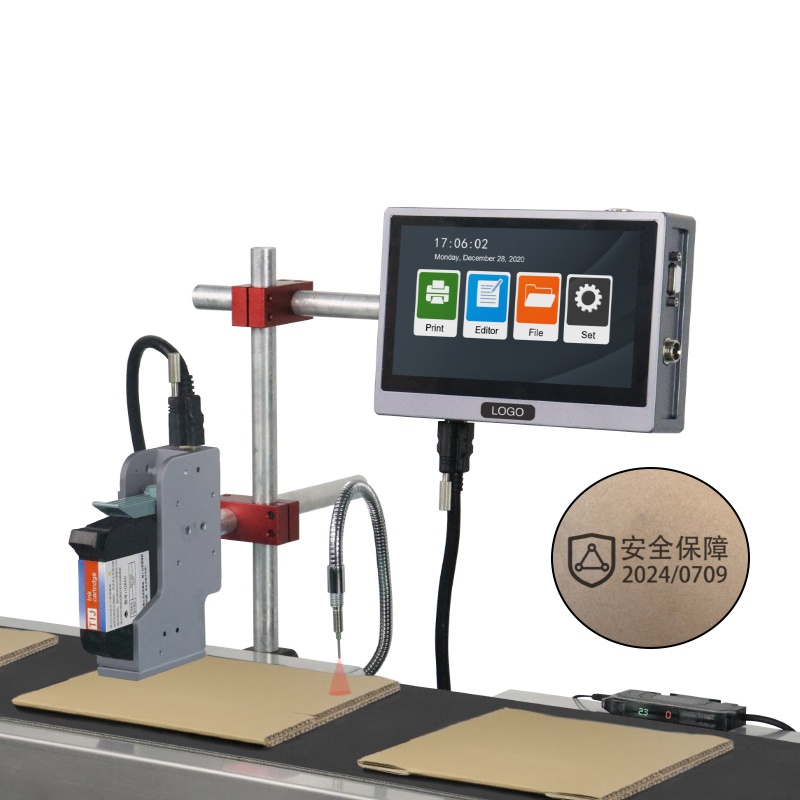
K20 online inkjet printer
the single-head build for a carton face and a batch code:
- Prints up to 120m/min
- 600dpi HD print accuracy
- 2-25.4mm print height
- 7-Inch Touch Screen
- 2-5mm throw distance
The height is the useful line on a packing line. At 25.4 mm a three-line batch code fits in one pass, and the 2 to 5 mm throw lets the head sit clear of a guide rail. The mechanism behind it is described under inkjet printing.
Questions Buyers Add
- Does industrial grade cost much more
- The body adds less than the downtime it prevents, and the alarm path adds nothing at all.
- Can a bench unit be upgraded
- Not to a sealed body, and that is the part the label is really about.
- Is a touch screen part of the grade
- No, but it removes a laptop from every changeover on a two-shift line.
Send Your Shift Pattern, Not a Print Sample
Send the hours, the ambient and the surface. We will answer with a body specification, a duty figure at your temperature and a bracket drawing, so the batch coding machine industrial grade label on the quote is one you can check.
Next Steps
- How the same body survives a shop floor: five shop-floor tests.
- Start at the contact page, on +86 17625427465 or kuangcy@126.com. We reply within 24 hours.
Need help choosing the right printer?
Talk to our engineers for a free production-line assessment and quotation.
Request a Quote