
Last Updated: 2026-11-06
Continuous inkjet printer maintenance is a fluid problem before it is a cleaning problem. Six habits decide whether a CIJ head runs five years or five months: filter intervals, viscosity, wash cycles, capping, spares on the shelf and a log that gets written.
Why Continuous Inkjet Printer Maintenance Is Not a Cleaning Job
A thermal or handheld unit holds ink in a cartridge and fires it on demand. Nothing circulates, so nothing has to be kept moving, and a cartridge left alone for a week is still a cartridge.
A continuous system is the opposite. Ink is pumped from a cabinet, forced through a nozzle, charged, deflected and then caught by a gutter and returned. The loop runs all shift, and every part of it is either moving or drying out.
That difference explains everything that follows. The enemy is not dirt but a solvent that evaporates, a viscosity that drifts and a filter that loads up until the pump works harder than it was designed to.
Six Habits That Pay for Themselves
| Habit | Interval | What it prevents |
|---|---|---|
| Filter change | Per the manual, then halved in a dusty hall | A pump running hot against a loaded filter |
| Viscosity check | Every top-up, not every month | Thin marks and a nozzle that blocks |
| Wash at stop | Every stop over an hour | A dry nozzle at the start of a shift |
| Capping the head | Every overnight and weekend | Solvent loss and a hard start |
| Spares on the shelf | One filter kit and one pump seal | Two weeks of a stopped line |
| Written log | Every intervention | Repeating a fault nobody recorded |
The second row gets skipped because the machine has an automatic top-up. Automatic means the cabinet adds solvent on its own schedule, not that the mixture suits a cold loading bay.
The fifth row is not maintenance at all, it is procurement. A plant that keeps one filter kit on the shelf turns a fault into an hour, and a plant that orders on failure turns the same fault into a fortnight.
Filters, Viscosity and the Window That Closes Slowly
A filter is a consumable with a stated interval and an actual one. The stated figure assumes a clean room, and a hall with corrugated dust halves it, so the first sign is a pump that sounds different rather than a code that looks wrong.
Viscosity is the second window. Every grade is specified for a range, and the range assumes a temperature. A cabinet in an unheated bay in winter reads thin, the drop size changes, and the operator compensates by slowing the line.
The mechanism sits under continuous inkjet, and a build for export should carry records under the ISO 9001 quality management route. Neither tells you what your hall does in February, which is why the first winter tests the plan.
Mixing grades is the third window, and buyers cause it themselves. Two solvents from two suppliers can each be correct and jointly wrong, because the additive packages differ, and the symptom is an intermittent block rather than a clear failure.
The Log Nobody Keeps
Most plants that call a technician cannot say when the last filter went in. The machine holds an hours counter and the shift book holds a production figure, but the two are never joined, so a fault repeating every eleven weeks looks like bad luck.
One line per intervention is enough: date, hours, what was changed, and how the code looked before and after. Six months of that turns a plan from a manual into a record of what this line demands.
It also changes the conversation with a supplier. A plant that can say the filter loads in nine weeks gets a realistic spares pack rather than a standard one.
How We Set a Plant Up for This
A CIJ build leaves our floor with the intervals written for the buyer hall rather than for a test room: filter, wash, cap, and the viscosity band the grade was proved in. Where a plant runs two shifts, the sheet carries two columns rather than one.
What goes wrong most often in our export orders is the capping habit. The first week is disciplined, the second is occasional, and by the fourth the head is left open overnight because the line stopped late and nobody wanted to stay.
The Unit Behind the Habit List
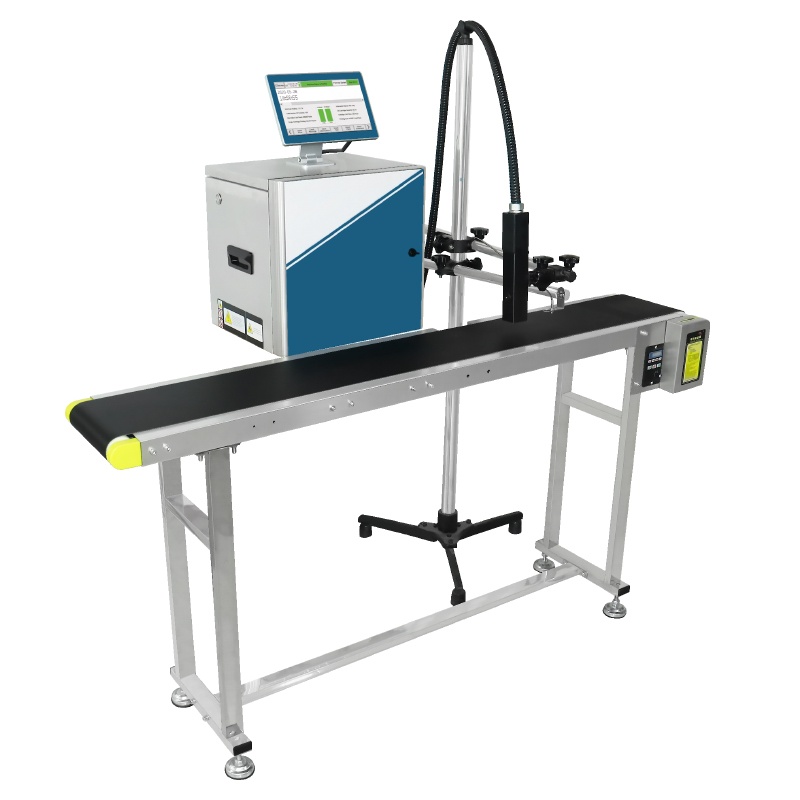
S1000 small character inkjet printer
the build for a line that runs three shifts and cannot stop for a filter:
- Prints up to 400 Meters Per Minute
- 2-20mm print height
- 10.1-Inch Industrial Touchscreen
- 3-30mm throw distance
- Low 120W rated power
The 3 to 30 mm throw matters for maintenance as much as layout. A head that stands back from a rail can be capped and wiped without a ladder, and a habit that needs a ladder stops.
Send the Shift Pattern, Not the Manual
- How often should the filter change
- Per the manual at first, then halved once the hall dust is known, and the log is what proves it.
- Is an automatic top-up enough
- No. It keeps the level right and says nothing about viscosity at the ambient temperature.
- What spare should sit on the shelf
- One filter kit and one pump seal, which cover the two faults that stop a line.
Send the shift pattern, the ambient conditions in the hall and the grade you run. We will return the interval sheet with the viscosity band filled in, so the continuous inkjet printer maintenance plan you follow is written for your building rather than for a laboratory.
Next Steps
- What a bad handover costs in the first week: five commissioning checks.
- Start at the contact page, on +86 17625427465 or kuangcy@126.com. We reply within 24 hours.