Last Updated: 2026-11-10
A code that survives day shift often fails on nights. A TIJ printer industrial grade is proved by what happens at the handover, when a new operator inherits a half-loaded cartridge, a recipe nobody wrote down and a line already running.
Why Handover Decides a TIJ Printer Industrial Grade
The demo is run by the person who bought the machine. The night shift is run by somebody who was shown once, six weeks ago, and who has a changeover waiting at two in the morning.
Most complaints about print quality trace back to that gap rather than to the head. The machine did what it was told, using a recipe the new operator did not know existed.
What the Outgoing Operator Has to Leave Behind
Three things, in writing: the recipe name, the cartridge state and the belt speed at the marking point. Everything else is recoverable, and those three decide the first ten minutes of the next shift.
A verbal handover loses all three. The new operator runs a test print on the nearest carton, decides it looks fine, and finds the failure two hundred packs later, when the sensor has already drifted off the seam.
Recipe Naming That Survives a Roster Change
Name by product and panel, not by customer or date. A file called order-8842 means nothing in March, while carton-500ml-side-panel still reads correctly to a stranger.
Keep one recipe per printed panel and lock the ones that are signed off. An unlocked recipe invites the small adjustment that fixes tonight and breaks the audit trail next quarter.
Cartridge State and the First Ten Minutes
Record the level and the lot. A cartridge swapped mid-shift without a note leaves the next operator guessing whether a light code came from a nearly empty reservoir or from a dirty nozzle plate.
Agree a rule for partial cartridges: either finish the lot or park it labelled. Mixed lots in one box are how a shade difference turns into a customer complaint about two batches of the same product.
Line Speed Notes the Next Shift Needs
Line speed is not constant on most packing lines, and a code that holds at forty metres a minute can thin out when the line is pushed. Leave the number the recipe was proved at, plus the ceiling it should not pass.
The same note should carry the trigger position. A sensor nudged by a pallet does not announce itself, and the print simply lands later on every pack, which reads as a design fault rather than a setup drift.
What to Check Before the Guard Closes
Five minutes at the start of a shift covers most of it: a nozzle check on scrap, the guard seated, the cable clear of the conveyor edge and the recipe matching the product on the belt.
Write the result down. A tick box that nobody can audit is worthless, while a line in a book with a name and a time is enough to settle most arguments about when a fault started.
The Unit We Hand Over
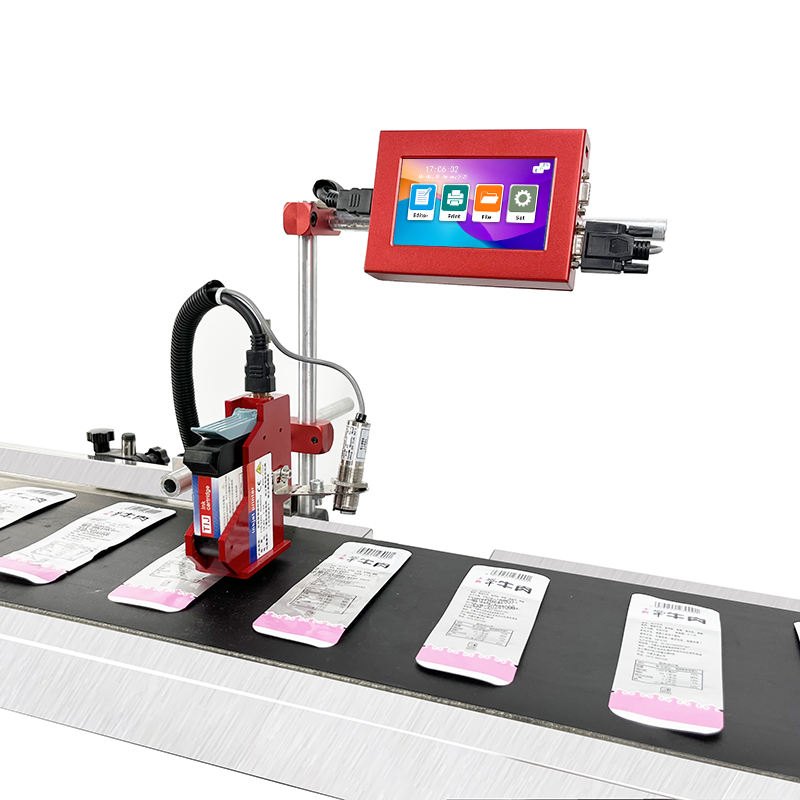
Y110 Online inkjet printer
the build for a hall that changes operators more often than products:
- 300-600dpi print accuracy
- 2-12.7mm print height
- 4.3-inch touch screen
- Weighs only 3.0 kg
- food-grade/water-based/oil-based/42ml ink cartridge ink
Three kilos matters at a handover. A head that one person can lift and re-aim without a second pair of hands gets re-set properly, instead of being left where the last shift left it.
Build a Handover Sheet, Not a Training Day
- How long should a handover take
- Five minutes at the machine, plus a written line with a name, a time and the recipe used.
- What if the recipe list grows too long
- Archive per season, and keep only the panels still running on the current packaging.
- Do we need a second operator trained
- Yes, because a single trained operator turns a roster gap into a stopped line.
Send the panels you print and the shift pattern you run. We return a recipe structure and a handover sheet sized to it, so the TIJ printer industrial grade you install keeps printing the same code whoever is standing at it.
For the machine side of the same question, our comparison of two, four and six head builds explains where a second head buys uptime. The print process is described under thermal inkjet printing, and export paperwork usually follows ISO 9001.
Next Steps
- If the line has no coder yet: what a coding conveyor does.
- Start at the contact page, on +86 17625427465 or kuangcy@126.com. We reply within 24 hours.