
Last Updated: 2026-11-12
Drying fluid inside a wide head is the expensive failure. A piezo inkjet printer earns its place where the mark is wide or the fluid is unusual, and it costs more than a cartridge head for reasons worth understanding. The case for it is narrower than a brochure suggests.
How a Piezo Inkjet Printer Fires
A piezo inkjet printer bends a ceramic element behind the channel and squeezes the fluid out. Nothing boils, so the fluid is not asked to survive a few hundred degrees several thousand times a second.
That difference widens the menu. Solvent, water based, oil and light cure fluids can all be fired, because the head does not rely on the fluid vaporising on cue. The effect is described under piezoelectricity.
Wide Bands and the Resolution Trade
Piezo heads are built in wide arrays, which is how a unit reaches a seventy millimetre band in one pass. Wider bands suit a drum, a sack or a panel that a narrow head would have to stitch together.
The trade is dot density. A wide array firing large droplets resolves around one hundred and eighty dots per inch, enough for a date and a batch block, not enough for a dense barcode at small size.
Why the Head Lasts Longer
Without a heating cycle there is no thermal stress on the channel walls, so the head is not consumed by the act of printing. Wear moves to the fluid path and the filter, which are service items rather than replacements.
That changes the cost model. The head costs more at the order and less per thousand codes, and the crossover arrives sooner on a line that prints a wide block daily under an ISO 9001 quality routine.
Where It Loses to a Cartridge Head
Drying is the enemy. A solvent fluid left in a wide array overnight skins over, and a head that needs a purge every morning eats the saving in fluid and in operator time.
Short runs are the other weak spot. A plant that prints two hundred codes a week rarely justifies the head cost, however good the fluid range looks on paper.
The Wide Band Unit for a Drum or a Sack
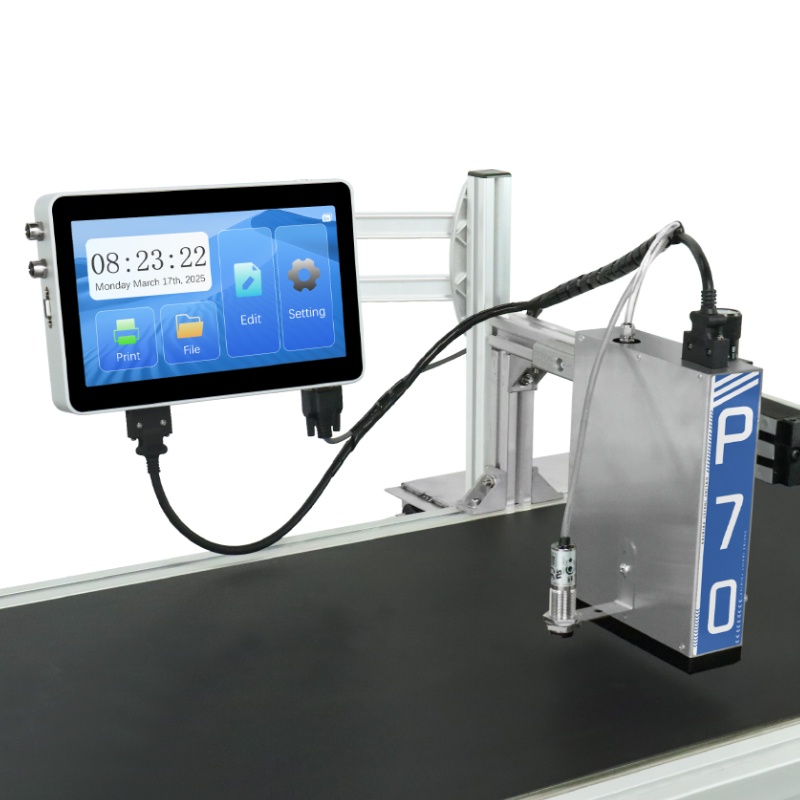
P70 Online inkjet printer
a ten inch screen and a seventy millimetre band on one bracket:
- Print speed 1-100m/min
- 180dpi print accuracy
- 3-71.8mm print height
- 10 Inch Capacitive Touch Screen
- 2-15mm throw distance
The fifteen millimetre throw is the flexible part. A sack that bulges will not hold a five millimetre gap, so a head that can stand back without losing the drop placement is what makes the job possible.
Related Questions
- Can it print a full width logo
- In one pass up to the band height, at the dot density the array supports. Fine detail at small size is not what this class is for.
- Does it need a daily purge
- A daily wipe and a short purge after a long stop, yes. Skipping it is what turns a solvent fluid into a blocked channel.
- Is light cure fluid an option
- It is one of the reasons to choose this family, since the head does not depend on heat to fire the fluid.
Send the Band and the Fluid
Tell us the width of the block and what the fluid has to stick to. We check the array against the layout and name the fluid, so the unit you install is chosen for the mark rather than for the brochure.
Next Steps
- Wiring and signal checks: five wiring checks before start up.
- The family boundary: who a piezo printer suits.
- Start at the contact page, on +86 17625427465 or kuangcy@126.com. We reply within 24 hours.
Need help choosing the right printer?
Talk to our engineers for a free production-line assessment and quotation.
Request a Quote