
Last Updated: 2026-09-08
A crooked label looks like a small problem until a customer treats it as a sign of everything else. An automatic label applicator places labels at the same position, angle, and pressure on every product, at line speed. Here is what the machine actually does and when it earns its place.
The Short Answer
An automatic label applicator unwinds a roll of pressure-sensitive labels, peels each one from its backing at a controlled point, and presses or wipes it onto a product as it passes. A sensor tracks product position so the label lands in the same place every time, and a drive keeps web tension steady so labels do not stretch or drift.
| Your situation | Applicator fit |
|---|---|
| Hand application at a bench | Slow, position varies by operator |
| Conveyed products, one label | Standard inline applicator |
| Variable data on each label | Print-and-apply unit |
| Wrap-around or two-panel labels | Applicator with a wrap station |
The distinction that matters most when specifying one is whether the label content is fixed or variable. Fixed artwork needs only application; variable data such as a date, a lot code, or a serial needs a printing stage upstream, either integrated into the applicator or as a separate coding station before it.
What to Know in Practice
Application method follows product shape. A tamp pad presses the label onto flat or slightly irregular faces without contact from the web; a wipe-on roller suits curved bottles and jars; a blow-on method handles delicate or uneven surfaces from a short distance. Choosing the wrong method shows up as lifted edges and air bubbles rather than as an obvious fault.
Verify placement the way an inspector will. Measure position on a sample run of twenty, not on the first one, because drift appears after the web warms and tension settles. Then check adhesion after handling, since a label that sits perfectly at the machine can lift at a corner in transit.
Where the label carries variable data, treat printing and applying as one system. A coding station upstream of the applicator must be synchronised with it, or codes land across label boundaries and seams. That synchronisation is usually the harder half of the project, and it is worth specifying early rather than retrofitting.
About SHICAI
SHICAI builds industrial coding and marking equipment across inkjet and laser lines, for production and warehouse use. Machines ship with genuine components and tested consumables, and service and spares are arranged for export markets. The technical team answers directly rather than through a reseller chain.
Related Questions
- What is the difference between a label applicator and a print-and-apply system?
- An applicator places pre-printed labels. A print-and-apply system prints variable data on each label immediately before applying it, which is what date, lot, and serial coding needs.
- How accurate is automatic label placement?
- Typically within a millimetre or two on a stable line, far tighter and far more repeatable than hand application. Accuracy depends on product registration and web tension rather than on the applicator alone.
- Can one applicator handle several label sizes?
- Yes, within the machine’s rated web width and with adjusted guides and sensor settings. Changeover time is the figure to ask about, since it consumes line time on every SKU switch.
A Model Worth Looking At
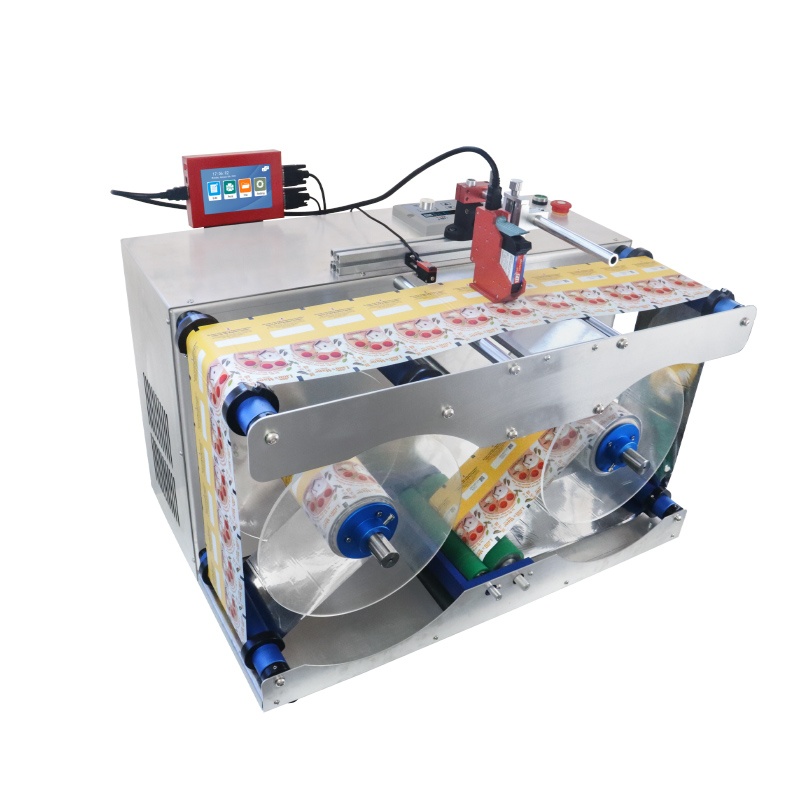
Automatic label spray coding rewinding machine is built for this kind of work:
- 2-12.7mm print height
- Available in 7 ink colors
- Marks paper labels, stickers, PVC film, tape and silver foil
Click the image to see the product page.
Learn more about pressure-sensitive labelling and ISO 9001 quality management.
Next Steps
- Read related FAQ guides on coding and marking basics.
- See the automatic label coding and rewinding machine for the coding station that feeds an applicator.
- Get a free sample print on your material. No commitment, reply within 24 hours.
Need help choosing the right printer?
Talk to our engineers for a free production-line assessment and quotation.
Request a Quote