
Published 2026-09-10 · By the SHICAI technical team · Industrial marking & coding equipment guide
Last Updated: 2026-09-10
No. Inkjet industrial printers scale down as well as up, and a workshop running one shift can often justify one. What changes between a small installation and a large plant is the duty cycle, the substrate, and how much of the code has to change with each batch.
What Makes a Printer Industrial
The word describes the duty rating and the mounting rather than the footprint. An industrial unit is built to sit above a conveyor or bench and run for hours without drifting out of position, to hold the print head at a fixed throw distance while brackets warm up and vibrate, and to take inks matched to carton, film, metal, or plastic instead of paper.
That is why a compact model can carry a full industrial rating while a large office-style unit cannot: inkjet industrial printers are judged by the environment and the run length, not by size.
For a small operation the question is not size, but whether daily volume justifies the unit.
Where Small Operations Use Them
Job shops are the clearest case. A workshop filling drums, pails, or pipes for several customers cannot pre-print packaging, because the lot and the date change with every order. One unit with saved templates covers the whole range.
Food and agricultural producers add a regulatory driver, because retail chains ask for a legible date or batch code on the pack. Hand-stamping rarely survives a cold room or a handling step.
Short-run manufacturers add a third case: a part number or a QR code for traceability, where pre-printed labels get expensive as variants multiply.
| Requirement | What a small operation should look for |
|---|---|
| Volume | A duty rating that matches the hours actually run, not the maximum in the brochure |
| Substrate | An ink list that covers carton, film, or metal rather than one general-purpose ink |
| Code changes | Saved templates so the operator changes the date or lot in seconds |
| Mounting space | A throw distance that fits the bracket you can actually install |
The first row matters most: buying for a duty cycle you never reach adds cost without output, while buying below it turns long shifts into corrections.
How SHICAI Approaches It
SHICAI builds industrial coding and marking equipment for packaging and production lines, covering conveyor-mounted, bench, and handheld formats. Units are configured to the substrate and the code rather than sold as one fixed package, with consumables and support organised for export markets.
Product
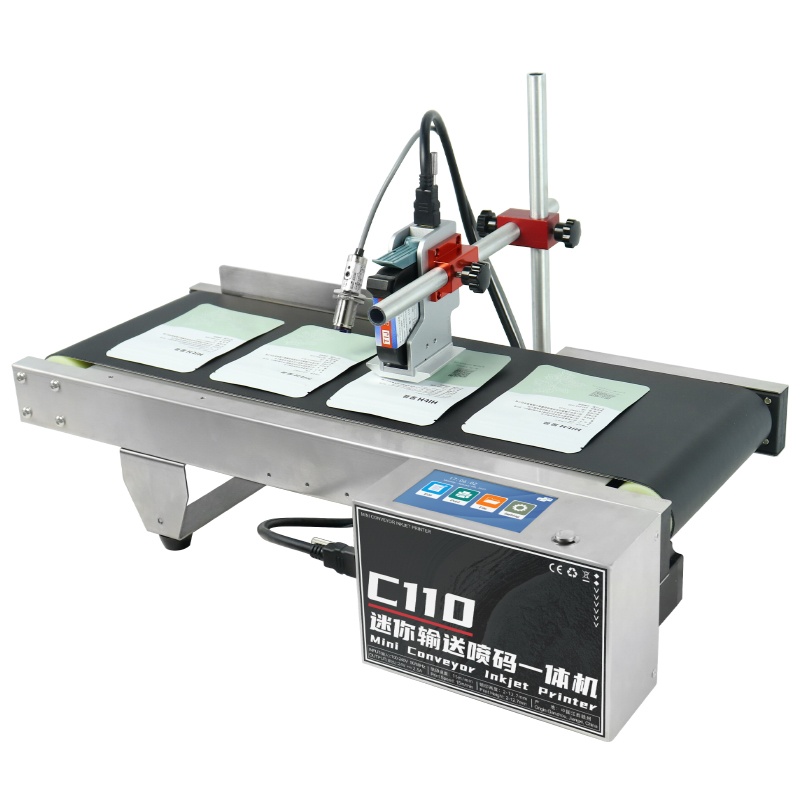
C110 Mini online inkjet printer
- Prints up to 15m/min
- 600DPI print accuracy
- 2-12.7mm/2-25.4mm print height
- 4.3-inch Touchscreen
- 2-5mm throw distance
A small conveyor-mounted unit for lines running up to 15 m per minute, with 600 DPI print accuracy and a print height adjustable from 2 to 12.7 mm or 2 to 25.4 mm depending on the head. The 2 to 5 mm throw distance keeps the bracket compact, which suits benches and short conveyors.
Related questions
- What makes a printer industrial rather than office grade?
- The duty rating and the mounting, not the size. An industrial unit is built to run continuously on a conveyor, hold its print position under vibration, and use inks matched to packaging materials instead of paper.
- Can a small workshop justify one?
- If a customer, retailer, or regulator requires a legible date or batch code, yes. The alternative is hand-stamping or pre-printed packaging, and both fail when the date or the lot changes.
- What should a first-time buyer check?
- Match the ink to the substrate, confirm the throw distance fits the mounting space, and check that the trigger works at the line speed you actually run rather than the maximum on the sheet.
Next Steps
- See the C110 Mini online inkjet printer for print height and head options.
- Read related FAQ guides on inks, print heads, and code setup.
- Share your setup for a free fit check. No commitment, reply within 24 hours.
Learn more about inkjet printing and ISO 9001 quality management.
Need help choosing the right printer?
Talk to our engineers for a free production-line assessment and quotation.
Request a Quote