
Last Updated: 2026-10-19
An industrial barcode printer puts the code straight onto the pack, the part or the pipe instead of onto a label that has to be stuck there. It is the right tool wherever a label would peel, curl or cost more than the mark, and the wrong one where the surface cannot take ink at all.
What an Industrial Barcode Printer Covers Here
The search term is used for two different machines. One prints adhesive labels from a roll, which is a thermal transfer device that consumes ribbon and a die-cut web. The other fires ink at the product itself, with no label, no ribbon and no liner waste. This page covers the second kind, because that is what SHICAI builds, and mixing the two up is the most common reason a specification comes back wrong.
The distinction is practical. A direct-mark unit is rated on throw distance and print height; a label unit on media width and roll diameter. Buying against the wrong list fails on something nobody thought to ask.
Five Jobs It Handles
- Cartons and cases. A shipping mark and a barcode sprayed onto the case itself, which survives a pallet wrap that destroys a paper label.
- Pipes and profiles. An inline head codes a tube as it extrudes, at a height no label applicator can reach on a round surface.
- Metal and plastic parts. A data matrix on a machined component, marked while it sits in a fixture rather than carried to a bench.
- Foam and board. A compressible face marked on the fly, where a label would sit proud of the surface and snag.
- Secondary packs. A date and lot string added at the case packer, printed from the same job file as the primary code.
Five jobs, one common condition: the code has to exist on the object, not on something attached to it.
Where the Direct-Mark Route Stops
Ink needs somewhere to sit. A heavily waxed board, a wet surface or a glass finish that beads water will reject a water-based drop, and no pressure behind the nozzle changes that chemistry. An industrial barcode printer in those cases wants a different ink family agreed against the substrate, or a label route.
The second limit is content density. A dense QR code printed at 2 mm is near the floor of what a direct head resolves cleanly, so a specification that calls for a large payload in a small area should be tested on the actual surface before the machine is chosen. A barcode printer automatic in the sense of self-triggering does not fix a resolution problem; it only fixes who presses the button.
Buying Questions
- Can one unit print both a barcode and a date string?
- Yes. The fields are set in one job file, so the dates advance on their own while the barcode payload stays fixed or changes by batch.
- Does it need compressed air?
- No for the thermal inkjet builds here. The cartridge carries the ink and the head fires electrically, which keeps the install to power and a trigger signal.
- What surface should be tested first?
- The hardest pack in the range, not the easiest. A trial on the most difficult surface tells you whether a direct mark is viable at all.
Send a Code
Send the barcode payload, the surface and the line speed you run. We print it on your material and return the sample, so the decision rests on a mark rather than a sheet.
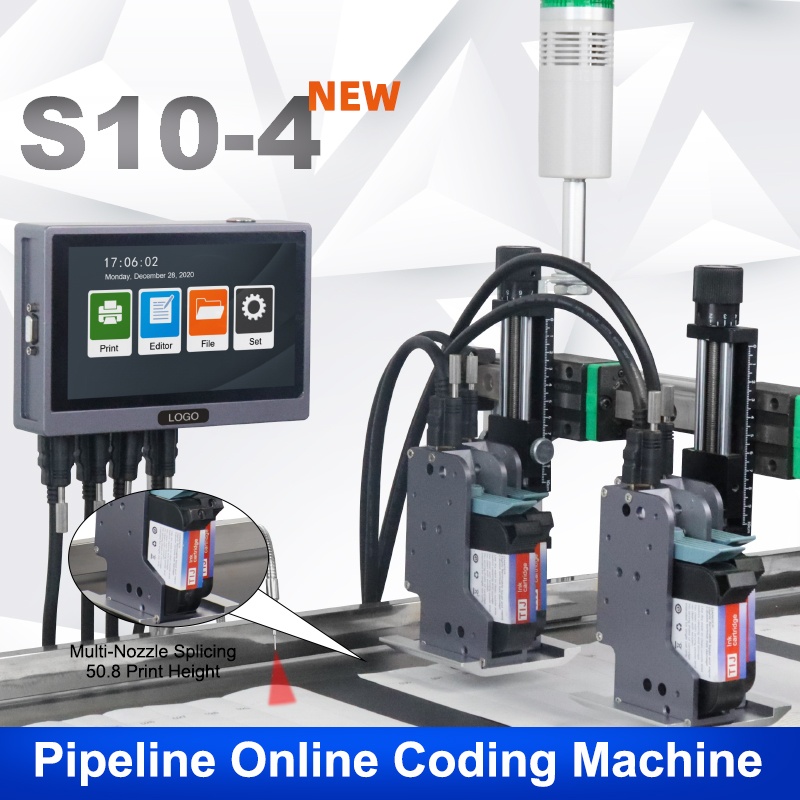
S10-4 online inkjet printer (standalone)
the direct-mark build for tall codes:
- 2-50.8mm print height
- 2-5mm throw distance
- Prints Chinese, English, date, QR code and barcode
- Marks metal, plastic, pipe, foam and carton
Builds follow ISO 9001 quality management, and the code standard itself is defined in the GS1 application identifier list.
Next Steps
- Send one pack from the hardest end of your range. We mark it with your own payload and return it free of charge.
- Start at the contact page, on +86 17625427465 or kuangcy@126.com. We reply within 24 hours.
Need help choosing the right printer?
Talk to our engineers for a free production-line assessment and quotation.
Request a Quote