Last Updated: 2026-10-03
A wrong date is caught at the customer’s end, never at yours. A date coding machine automatic build fails in two places only: the signal that tells it to print, and the mount that decides where the mark lands. Both are settled before delivery.
What a Date Coding Machine Automatic Build Depends On
A hand stamp is wrong because a person is wrong. An inline coder is wrong because a signal was wrong: the part arrived earlier than the delay assumed, so characters land on the leading edge or miss the part. The build that fixes this detects the part instead of counting time.
That is where a single-head frame earns its place. With a band of 2-12.7 mm there is no room to waste on a second pass, so the head has to be repositioned along the line as formats change, and repositioned without tools. A coder needing a spanner every Tuesday gets skipped instead, and that flexibility changes what the machine is used for, as below.
Three Duties a Movable Single Head Carries
What the frame does once it can be moved by hand:
- One-line date and lot on cartons Best-before and batch on one band, the head swung to a new position when the panel changes.
- Small parts and electronics trays A 600 dpi band on a narrow face: characters must stay closed or the line-end reader rejects the tray.
- Retouching and awkward positions A fitted lid, a curved shoulder, a part standing on end at a packing bench.
None of the three asks for speed; a date coding machine automatic build asks for a trigger that repeats and a head that moves, both settled in the five checks below.
Five Checks on a Date Coding Machine Industrial Grade Frame
Settle these with the supplier, in order of cost to change:
| Check | What the figure has to settle | Where it shows up |
|---|---|---|
| Trigger source | Sensor on the part, not a fixed time delay | Date drifting as throughput changes |
| Head positioning | A rail an operator can move without tools | Formats skipped |
| Band against content | What 2-12.7 mm actually holds | Date, lot and symbol on one line |
| Resolution stated | Print accuracy as a figure, not a photo | Codes that pass the eye, fail the scanner |
| Substrate list | Whether plastic, pipe and foam are named | A grade chosen for the wrong face |
A build answering all five is a date coding machine industrial grade frame in substance rather than wording. GS1 application identifiers govern how the date and lot are carried inside a symbol, and ISO 9001 quality management is where the grade approval and line record sit when audited. How that is done comes next.
How SHICAI Sets Up an Automatic Date Coder
SHICAI assembles inline coders and commissions a date job at the machine rather than in the office: the sensor position is chosen on your conveyor, the delay is set against a moving carton, and the mark is read back before the frame leaves the bench. Single-head frames carry 600 dpi accuracy on a 2-12.7 mm band, enough for a date, a lot and a short code.
What customers ask for after six months is rarely more speed. It is the ability to move the head when a new pack arrives, which is why this class rides on a sliding module, below.
Questions on automatic date coding
- What makes an automatic date coder print in the wrong place?
- A trigger that times the line instead of detecting the part. As throughput changes, a fixed delay puts the mark earlier or later, so a sensor or encoder must fire the print, not a clock.
- Is one print head enough for date and batch?
- For most packs, yes. A 12.7 mm band holds a date and a lot on two lines, or one line plus a compact symbol. A second head is needed when the block must be taller.
- Can the same coder mark metal and plastic?
- The frame can, where the grade suits both faces and the drop is given time to set on the non-absorbing one. The grade is what changes, not the head.
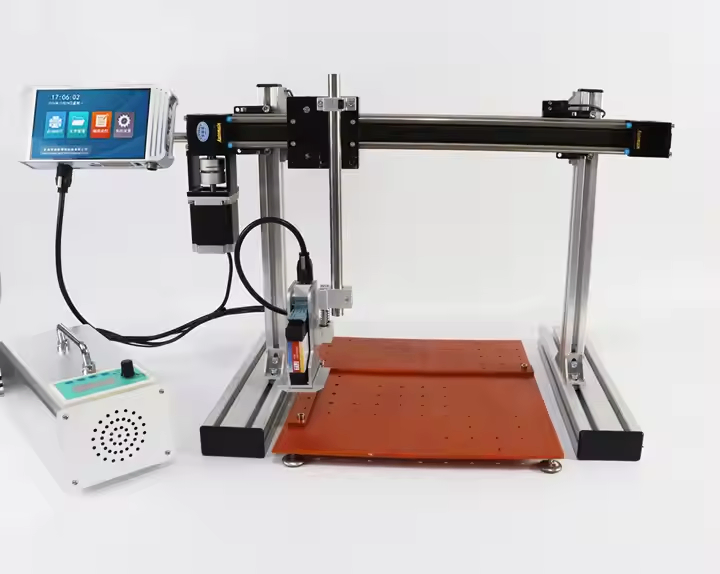
S10 Sliding module inkjet printer
the single-head frame that moves with the format:
- 600DPI print accuracy
- 2-12.7mm print height
- Marks metal, plastic, pipe, foam and carton
Where to Go From Here
- See the product: S10 Sliding module inkjet printer
- Read next: the solutions index
- Talk to us: send a photo of your trigger point through our contact page. We set the delay and print a sample, free of charge, replying within 24 hours.