Last Updated: 2026-10-06
Every other code on a carton stays the same for weeks. The date is the one block that changes while the line runs, and a date coding machine is judged on how quietly that change happens. Below are the parts that decide it.
Why a Date Coding Machine Is Judged at Shift Change
A lot string is written once and repeats. A date has to advance on schedule whether anyone remembers or not, which makes it the one mark where the operator can be the fault. Two failures matter: a wrong date, a human slip, and a late date, a timing fault.
The first is prevented by locking the format, so nobody retypes a month by hand at 23:50. The second is prevented by the trigger, because a sensor reading a belt joint fires milliseconds late and drops the mark nearer the trailing edge. Neither is solved by a faster printer.
Three Duties Where the Date Rolls Over
Three date jobs recur on export lines, and each fails differently:
- Daily rollover on one product One format, one change at midnight, and the risk is an operator editing it instead of letting it advance.
- Batch changeover A new lot and a new date loaded together, where the risk is loading half of the pair.
- Short runs across several SKUs A format selected per product, where the risk is running the previous format on the next pallet.
All three are decided before the code is ever printed, which is what the specification below is for.
What a Date Coding Machine High Speed Line Needs
Put each of these against a line you already run, because speed alone settles very little:
| Choice | What it prevents | Where a weak setup shows |
|---|---|---|
| Stored job, selected not typed | A month retyped by hand | One pallet with the wrong month |
| Format locked to the product | Running yesterday’s layout | A date in the wrong position |
| Trigger taken from the pack edge | Marks drifting late | Codes creeping toward the trailing edge |
| Edit rights limited to a supervisor | Silent changes at shift change | Two shifts printing different formats |
| A scan-back after the head | Bad codes reaching the pallet | A reject found at the customer |
Read that list as a changeover procedure rather than a purchase list, because four of the five entries are settings rather than hardware. GS1 General Specifications govern how a date sits inside a symbol a third party scans, and ISO 9001 quality management is where the ink grade for your surface gets approved and recorded.
How SHICAI Sets Up a Date Job
SHICAI builds inline coding frames for export lines, and a date job is set up on the customer’s own pack. The format is stored on the panel and locked to the product, the trigger point is measured from the pack edge, and an operator selects the job at changeover rather than typing the date.
Frames in this range carry a TIJ thermal inkjet head with no maintenance-heavy ink system, and each head comes in seven ink colors so a dark pack and a bright one can share a line. The wide build below fits a full date and lot block into one pass on a large carton.
Questions Buyers Ask Before Ordering
- Can the machine turn the date over automatically?
- Yes, if the format is stored as a job with a date field. The panel advances it on schedule; letting an operator retype it is the most common cause of a wrong month.
- Why does the mark drift late on some packs?
- Almost always the trigger. A sensor reading a belt joint fires a fraction late, and the mark lands nearer the trailing edge. Moving the trigger to the pack edge fixes it.
- Do I need a scan-back on a date line?
- Not always, but it is the only way to catch a bad code before it reaches a pallet. On regulated products it is usually the cheapest option on the list.
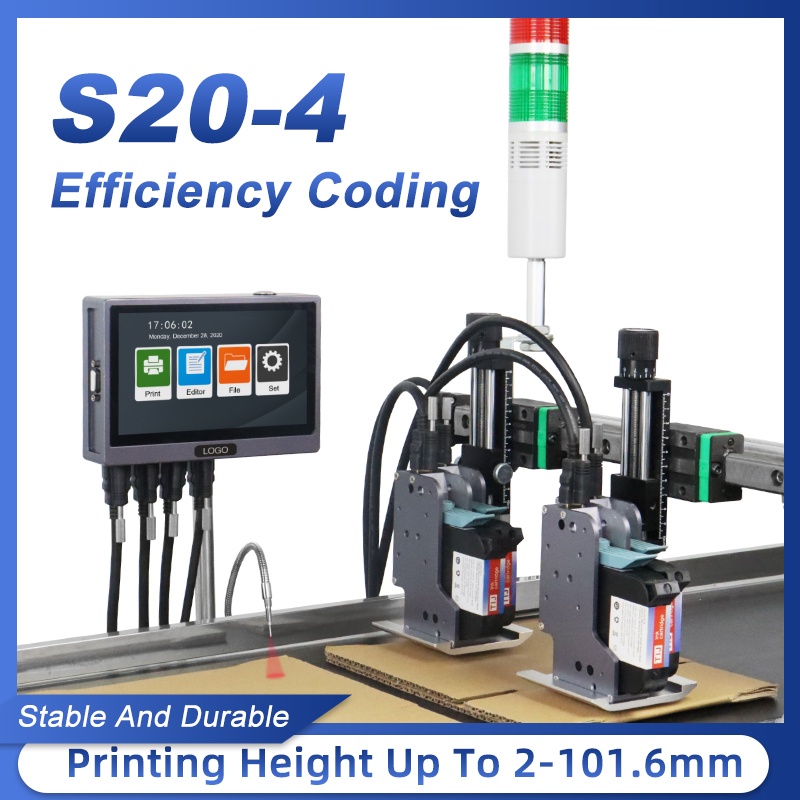
S20-6 online inkjet printer (splicing)
the wide build for a full date and lot block in one pass:
- Prints up to 120 m/min
- 2-152.4 mm print height with six spliced heads
- Weighs only 3.5 kg per unit
- Available in 7 ink colors
Set Up Your Own Date Job
- See the product: S20-6 online inkjet printer (splicing)
- Read next: why an automatic date coder misses its trigger, which is the other half of a clean code
- Talk to us: send the date format and the pack you run through our contact page. We return the stored job settings and trigger point for your line, free of charge.