Last Updated: 2026-10-08
An egg is one of the harder surfaces in a packing hall: small, curved, and often still damp from a wash line when the mark goes on. That is why the choice of an egg printer manufacturer matters more than a station count on a quote. A factory that knows the surface treats ink grade, head height and tray speed as one decision, and shows its evidence before you commit to a first order.
What an Egg Printer Manufacturer Controls
The label is applied loosely in this trade, and it separates a plant that bolts a shell around bought-in modules from one that controls the platform underneath. A real egg printer manufacturer keeps its own ink formulations on file, writes the firmware that drives the date and batch fields, and can tune a mark for a shell rather than for a generic surface.
That control shows up on the second enquiry, not the first. When a buyer wants a second ink colour for a dark-shell breed, or a font for a market script, a factory answers in days while a reseller forwards the question to whoever it bought from and waits.
What the Egg Itself Demands
Eggshell is porous and thin, so a mark has to sit on the surface rather than cut into it. Food-grade ink is the starting point, not an upgrade, because the shell touches both the contents and the consumer. Five properties then decide whether the mark holds.
- The wash line. Many grading halls wash and dry before marking, and a shell that is still damp pushes a water-based grade to its limit.
- Condensation on cold stock. Eggs moved from a cold store into a warm hall sweat, and a grade chosen in a dry room can bead instead of bond.
- Curve and size. A small shell leaves little flat area, so a short date and a compact logo fit far better than a long traceability string.
- Tray speed. The mark has to land at the hall’s trays-per-minute, not at a figure measured on a bench.
- Read-back. When a code is scanned later, contrast on a pale or a brown shell decides whether it reads at all.
A buyer who sends two or three sample eggs, washed and dry as they run, will get a far more honest answer than one who asks for a machine by model name.
The Egg Printer Range and What Each Build Suits
Egg builds split by how many shells are marked at once and by how wide a mark each head can lay down. That split matters more than the series name.
- Single-head units for a date and a short code on one shell at a time, useful on a smaller farm line.
- Multi-head units that mark a whole tray in parallel, which is how a packing hall keeps pace at peak.
- Wide-character units for a large block, useful where a mark has to read across a crate or a pallet.
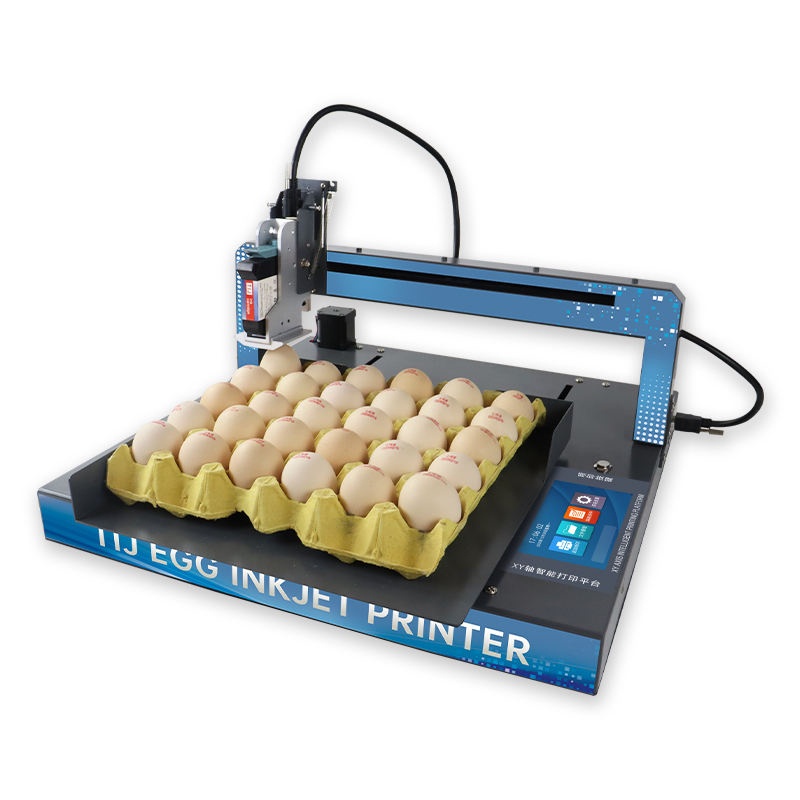
XY110 Egg inkjet printer
for a date and a logo on a single shell:
- 2-12.7 mm adjustable print height
- 5.0-inch touch screen
- Food-grade, water-based and oil-based ink options
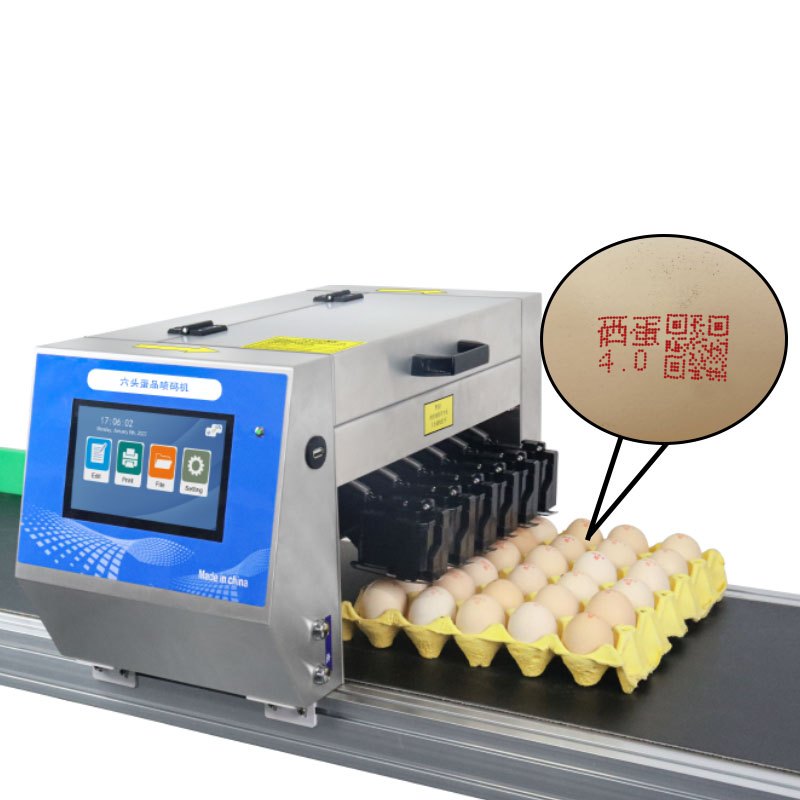
Six head egg inkjet printer(D100-6)
for a tray marked in parallel at line speed:
- Prints up to 20 trays per minute (5 x 6 trays standard)
- 2-5 mm optimal throw distance
- Food-grade water-based red ink
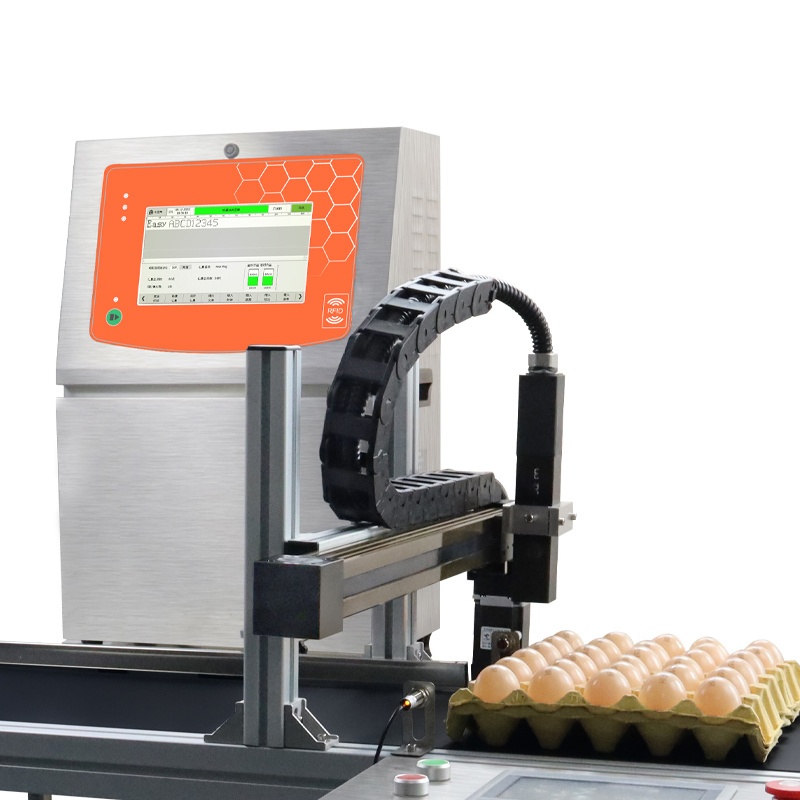
Small character egg printer
for a compact mark that keeps power draw low:
- 2-20mm print height
- 3-30mm throw distance
- Low 150w rated power
A build for halls that run more than one lane, such as the Six head egg inkjet printer, rounds out the range.
Records, Ink Traceability and the Spares Path
Two documents settle most first-order doubts about an egg printer manufacturer. The first is a certificate whose scope names the site that actually builds the unit, not a group holding company, which is where ISO 9001 quality management is worth reading closely. The second is an ink data sheet that lists the substrates a grade was approved on and the shelf life of an opened cartridge.
How a drop of ink behaves on a porous shell rather than soaking through it is covered by the general inkjet printing process, and that background is useful when two quotes disagree sharply on resolution or on print height.
Consumables come next. Eggs run continuously through a season, so the replenishment route and the lead time belong in the agreement rather than in a conversation after the first delivery arrives short.
Buyer Questions
- How much does food-grade ink really matter?
- A great deal on a shell that touches the contents. Ask for the data sheet and check the substrates the grade was approved on, not just the word food-grade on a page.
- Can one machine handle several breeds and sizes?
- Usually yes, within a print-height range. What changes between breeds is the head height and the ink, not the frame, so a stored job per grade keeps a changeover short.
- What should I send for an accurate quote?
- Sample shells as they run on your line, washed and dry, plus the string you need and the trays per minute you must hit. That is enough to size the build.
Start a First Order
- See the range: XY110 Egg inkjet printer for single-shell work, or the D100-6 six head build for trays.
- Read next: why a factory, not a trader, changes the second order
- Talk to the factory: send your sample eggs and code format through our contact page. We answer within 24 hours with the build and the ink grade that fit, no commitment.