Last Updated: 2026-10-09
A bag sealing and coding machine does two jobs on one pass, and that is exactly where it can go wrong. Seal pressure, dwell time and code position are set together, so an adjustment made for the seal quietly moves the print. Five checks keep both jobs honest.
Why a Bag Sealing and Coding Machine Is Judged on One Pass
On a bag line the sealer and the coder share the same few centimetres of travel. The jaw closes, the film fuses, and somewhere inside that motion the head has to throw a drop onto a surface that is still moving and still warm. Miss the window and you get a code that is legible but off position, or a seal that holds while the print smears under the jaw.
That is why the two settings cannot be tuned apart. Anything that changes dwell time changes the instant the print lands, so a unit bought on seal quality alone will shift its mark the first time the film gauge changes.
Where the Seal and the Code Meet
Three bag jobs recur on export lines, and each stresses the pair differently:
- PE bags for dry goods A thicker film that needs a longer dwell, which narrows the print window.
- Foil and laminated sachets A coated surface where a drop must anchor on contact or bead.
- Short runs across sizes A bag width changed between jobs, which moves both the jaw and the head.
None of these is solved by a faster printer, because the limit is the seal cycle rather than the head.
Where a PE Bag Coding Machine Earns Its Place
Weigh each point below against a line you already run, then against the film you intend to use next season:
| Point | What it prevents | Where it shows |
|---|---|---|
| Dwell window set with the code running | Print drifting into the jaw | A smear on every twentieth bag |
| Head offset from the seal line | A code half-lost in the crimp | A scanner miss at the dock |
| Ink grade matched to the film | Beading on coated foil | A code that wipes off in the tray |
| Print height set to the bag | Oversized characters that blur | A block that will not fit one pass |
| A template check at changeover | Running the last bag’s date | One crate dated to the wrong week |
Four of the five are settings rather than parts, so treat the list as a changeover routine. GS1 General Specifications fix how a date and lot pair is written inside a symbol a third party scans, and ISO 9001 quality management is the frame the ink grade for your film is documented against.
How SHICAI Sets Up a Bag Sealing and Coding Machine Job
SHICAI builds sealing and coding units for bag lines, and each one is set on the customer’s own film rather than a sample roll. The dwell window is measured with the code running, so the seal point and the print point are fixed as a single figure instead of two guesses.
The frame below carries a TIJ head with no solvent system to top up, and it comes in seven ink colors so a clear film and a printed one can share a line. On a narrow bag, the head offset is the setting that decides whether the code survives the crimp.
Questions From the Packing Floor
- Can one unit really seal and code in the same pass?
- Yes, if the dwell window is measured with the code running. The two jobs sit in separate hardware but share one timing figure, and that figure is the first thing to fix.
- Why does the code smear on laminated film?
- Usually the ink rather than the head. A coated surface needs a grade that anchors on contact, and the same drop that works on PE will bead on foil.
- How often should the setting be re-checked?
- At every film change and at the start of each shift. A gauge change of a few microns is enough to move the print point back inside the jaw.
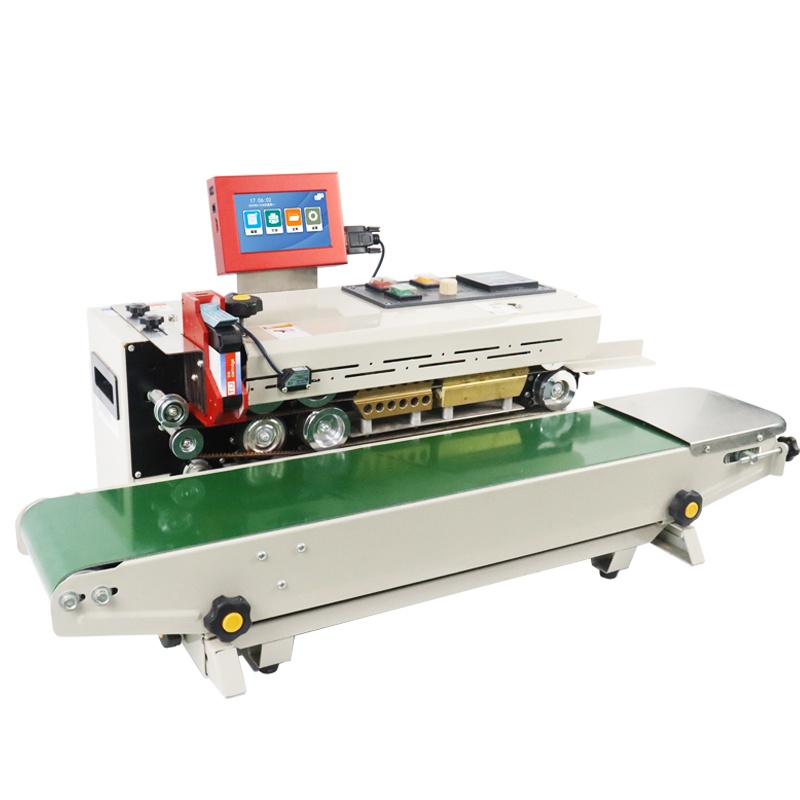
T110-K Sealing inkjet printer
the unit built for a seal and a code on one pass:
- Available in 7 ink colors
- Marks carton, plastic, metal, wood and pipe
- USB/Bluetooth connectivity
Set Up Both Jobs in One Pass
- See the machine: T110-K Sealing inkjet printer
- Read next: what a sealing machine with a printer actually saves, which is the other half of the argument
- Talk to us: send a bag and your film through our contact page. We return the dwell window and head offset for your line, free of charge.