Last Updated: 2026-10-09
A thermal inkjet printer industrial line is judged over a month, not a shift. A head that prints a perfect code on Monday and a thin one by Friday has failed on duty cycle rather than on resolution, and five checks decide which side of that line you land on.
What Three Shifts Ask of a Thermal Inkjet Printer Industrial Head
A lab can run a head for an afternoon and call it tested. An export line does not stop there. The same head prints through a warm afternoon, a cool night and a weekend shutdown, and the fault that matters is the slow one: a code that starts clean and thins out across ten thousand packs.
Thermal inkjet throws a drop from a resistor and a bubble, with no ink circuit to keep the fluid moving. That is both the strength and the weakness. There is nothing to flush between runs, and nothing to keep the nozzle wet when the line pauses.
Three Runs That Wear a Head Differently
Duty cycle is not a single number. Three runs punish a head in ways a speed test never shows:
- One film, one job, all week A single stored format, where the risk is a parked head and a nozzle that dries between breaks.
- Frequent changeovers across packs A purge before each job, where the cost is ink and time rather than sharpness.
- Cold-store packs A surface below ambient, where a drop has less time to anchor before the film carries it away.
Each appears as a print fault, and each is answered by a setting rather than a repair.
Five Checks for a Three-Shift Build
Weigh each check against a thermal inkjet printer industrial line you already run. Peak speed appears nowhere on the list:
| Check | What it prevents | Where a weak build shows |
|---|---|---|
| Head array stitched to the block width | A seam through the characters | A digit that reads on one line and not another |
| Duty rated per shift, not at peak | A head that fades by week three | Print that thins out on the late shift |
| Nozzle parking between runs | Dry-out over a weekend | A purge that never quite clears |
| Ink grade matched to the substrate | Beading on a coated film | A code that wipes off on the pallet |
| Throw distance measured on the pack | A soft, feathered edge | A scan that passes on one line only |
Four of the five are routines rather than parts, so read the table as a start-up procedure. Inkjet printing sets out why a thermal drop is thrown rather than sprayed, and ISO 9001 quality management is where the ink grade for your surface is approved and recorded.
How SHICAI Sets Up a Thermal Inkjet Printer Industrial Job
SHICAI builds inline coding frames for export lines, and each head is set against the shift pattern the customer actually runs rather than a single sample pack. Throw distance is measured from the pack, the block width is fixed before the head array is chosen, and the resting position of the head is part of the specification.
Every frame carries a TIJ head with no solvent system to top up, and heads come in seven ink colors so a dark film and a bright one can share one line. Where a full date and lot block has to land in a single pass, the wider build below carries it without a second station.
Buyer Questions From the Line
- How long does a TIJ head last on a three-shift line?
- It is a duty figure rather than a calendar one. A head that parks between runs lasts far longer than one left wet over a weekend shutdown.
- Why does print thin out on the late shift?
- Usually ambient temperature. Drop formation shifts with it, so a head set in a cool morning room drifts once the line has warmed through the day.
- Can a TIJ head print on a cold pack?
- It can, but the drop has less time to anchor. In a cold store the answer is usually an ink grade change rather than new hardware.
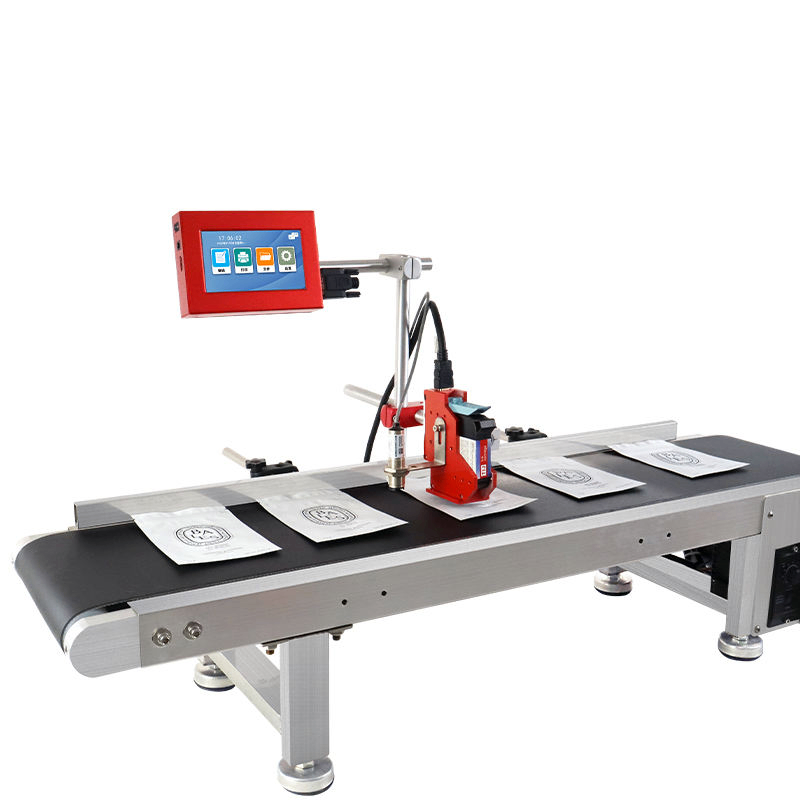
T110Online inkjet printer
the frame for a full date and lot block in one pass:
- 600DPI HD print accuracy
- 2-12.7mm print height
- 4.3-inch Touch Screen
Check Your Own Line
- See the machine: T110Online inkjet printer
- Read next: how many TIJ heads a line really needs, which settles the block width
- Talk to us: send the pack and the code block through our contact page. We return the head setting and duty figure for your line, free of charge.