Last Updated: 2026-10-11
A thermal inkjet printer industrial enough for a three-shift line is judged on how it holds a code at the end of a shift, not at the start. Six applications set the brief, and the print height, ink grade and trigger position follow from the line rather than the model.
What Three Shifts Demand of a Thermal Inkjet Printer Industrial Build
Workshop conditions separate a coder meant for a bench from one meant for a production floor. Dust settles on a head that runs all day, washdown sprays the frame between products, and a code that is legible at 08:00 has to read the same at 23:00 on the last pallet of the shift.
Three requirements repeat across most enquiries. The head has to keep a fixed print height without an operator re-setting it, the ink has to bond on a surface that may be damp or coated, and the trigger has to place the code on the same spot whether the line runs at full rate or is slowed for a short order.
None of the three is hard on its own. Together they rule out the lightest bench units, because a machine that has to be re-set after every product change will not survive a floor that runs three shifts and washes down between them. The build has to be chosen for the worst hour of the shift, not the first one.
Ink drying is the requirement that is most often overlooked. On a porous board a water-based grade disappears into the surface in seconds, but on a coated film or a laminated pouch the same drop sits on top and smears if the pack is stacked too soon. A thermal inkjet printer industrial enough for a film line has to be paired with an oil-based grade on those runs, and the settling length on the conveyor matters as much as the head. How a drop spreads on a coated surface is covered by the general inkjet printing process.
Six Production Lines It Fits
Each line below asks something different of the head, which is why one build rarely covers all six without a change of ink.
- Food and beverage. Dates and lot codes on cartons, trays and film, where the ink grade and the washdown routine decide the mark more than print height does. Food-grade and water-based grades carry most of this work.
- Pharmaceutical. Small, dense blocks on cartons and foils, where a lot number and an expiry have to stay legible in the smallest field of the block, and contrast matters more than size.
- Cable and wire. Marks that run along a moving surface, where a trigger on the leading edge keeps the code in line as the drum turns and the surface curves away.
- Building materials. Pipe, board and profile, where a wider print height up to 25.4 mm carries a batch across a coarse or dark surface that swallows a small font.
- Electronics and components. Short codes on small parts, where resolution matters more than speed and a stable print height keeps a serial readable under a bench magnifier.
- Packaging and carton. High-volume lines running at up to 120 m/min, where the head and the belt have to be set to the same pace or the code stretches at full rate.
| Line | What the head must hold | What usually fails first |
|---|---|---|
| Food and beverage | Bond on a damp or chilled surface | Ink grade chosen for a dry room |
| Pharmaceutical | Contrast in the smallest field | A block copied from another product |
| Cable and wire | Register along a moving, curved surface | A trigger aimed at the gap |
| Building materials | A wide mark on a coarse face | Print height set for a flat carton |
| Electronics | A stable height on small parts | A head nudged between runs |
| Packaging and carton | Register at full line rate | Belt speed set above the print window |
Most sites start with one line and add the second within a year, so the ink route and the spares list matter as much as the first build. A quotation that names only the frame and leaves the cartridge grade open is the one that usually turns into a second order for the wrong ink.
The cheapest way to move forward is a printed sample. Send two or three packs from each line you intend to run, plus the exact code you need, and the grade, print height and trigger setting can be checked against real stock rather than chosen from a table. That one step removes more doubt than any specification sheet.
Builds That Cover These Lines
A range rather than a single model carries the six applications above, and the print height each build offers is the quickest way to match one to a line. No single TIJ inkjet printer covers all six on one ink grade, so treat the platform as the constant and the cartridge as the variable:
- K11Online inkjet printer for a standard line that needs a 2 to 12.7 mm block at up to 120 m/min behind a 7-inch screen.
- K20 Online inkjet printer for a wider 25.4 mm block, which is the build that usually covers building materials and large cartons.
- Y110 Online inkjet printer where the frame has to move between belts and weighs only 3.0 kg.
- C110 Mini online inkjet printer for a short line or a single station that does not justify a full frame.
Choosing between them is usually a question of block width first and line speed second. A build that holds 25.4 mm covers every narrower job, so it is the safer first order when a second product is expected within the year.
Whichever build is chosen, four settings should be confirmed before it ships: the print height against the tallest block on the line, the ink grade against the surface each product presents, the trigger position against the leading edge, and the belt speed against the print window. A supplier who asks for those four details is working from your line rather than from a catalogue, and the records a coded pack supports are audited against ISO 9001 quality management.
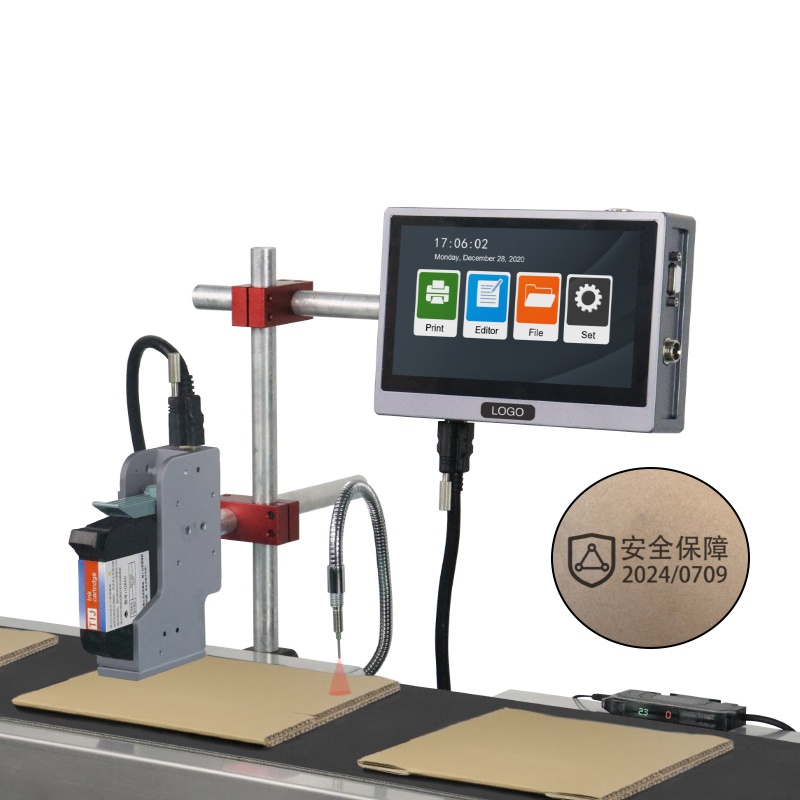
K20 Online inkjet printer
for a wider block on a working line:
- Prints up to 120m/min
- 600dpi HD print accuracy
- 2-25.4mm print height
Industry Questions
- Is a TIJ printer fast enough for a high-speed line?
- For many carton and pouch lines it is. A standard online build prints up to 120 m/min, and the limit is usually the ink drying time on a non-porous film rather than the head itself.
- How many shifts can one cartridge cover?
- It depends on the block size and the stock. A short date on porous board runs far longer than a dense barcode on coated film, so the figure belongs on your own sample rather than on a datasheet.
- Can the same build run on metal and on film?
- The frame can, but the ink grade changes with the surface. Confirm the grade for each substrate before a line is commissioned, because a grade that bonds on film may not hold on bare metal.
Pick Your Line
- See a build: K20 Online inkjet printer when the block has to be wide, and Y110 Online inkjet printer when the frame must move with the job.
- Read next: why a TIJ printer suits a short-run line, and TIJ versus CIJ for a 2026 line.
- Talk to us: send the stock, the code and the line speed through our contact page. We map the build and ink grade to your line, free of charge.