Last Updated: 2026-10-12
A small label shop loses a whole reel when the code drifts partway. An online inkjet printer small business owners can operate alone closes that gap, coding and rewinding in one pass, so five checks decide whether it holds up without a second pair of hands.
What a One-Operator Line Has to Solve
On a small reel line the same person loads stock, watches the code and closes the roll. That leaves no room for a step that needs constant correction, so the machine has to hold its own settings from the first label to the last.
Most failures on these lines are not print failures. A reel that winds loose, a count that drifts by a few, or a code that slides off the edge of a narrow web all start upstream of the head. Getting the feed and the wind right is what a batch coding machine small business build should be bought for, and the traceability it supports is audited against ISO 9001 quality management.
Three Small-Reel Jobs
Three jobs cover most of what a shop of this size runs:
- Own-brand labels. Short runs of self-adhesive stock coded with batch and expiry before they go out.
- Sample and pilot reels. A few hundred labels that prove a design before a larger order is placed.
- Refill and top-up runs. Small reels ordered between bulk deliveries, where waiting for a converter would cost more than coding in-house.
Each of these is measured the same way, which is whether the last reel of the day matches the first.
Five Checks for the Online Inkjet Printer Small Business Build
Settle these before the frame is ordered, because each one is harder to change after the machine is on the floor.
| Check | What good looks like | What it prevents |
|---|---|---|
| Web width | Set inside 20 to 300 mm for the stock | Narrow stock that tracks sideways |
| Print height | 2 to 12.7 mm with a TIJ nozzle | Tall characters clipped at the edge |
| Finished roll size | Matched to the reel you ship | A core too small for a 500 mm reel |
| Label counter | A 1 to 15 digit range | A reel closed by guesswork |
| Throw distance | 2 to 5 mm from head to stock | Soft edges where the gap widens |
The first and the last carry the most risk on a narrow web, because a small change in web tension moves the code sideways faster than it does on wide stock.
How SHICAI Sets a Small Reel Job
SHICAI supplies rewind coders to label shops that run without a full production line, and each unit is set against the stock the customer sends. A one-operator build is tuned to the web width rather than to a default, and the counter is set to the reel size the shop actually ships.
The unit on this line handles label widths from 20 to 300 mm, prints at 2 to 12.7 mm with a thermal foaming nozzle, and winds finished reels up to 500 mm outer diameter while counting labels across 1 to 15 digits.
Small-Shop Questions
- Can one person run it?
- Yes. Coding and rewinding share one drive, so once the reel is threaded the operator only loads stock and cuts the finished roll.
- What stock does it take?
- Self-adhesive paper, PVC film, tape and coated paper all run, provided the web falls inside the rated width. The ink choice then follows the surface.
- Why does the code move between reels?
- Usually because web tension changes as the finished roll grows. Matching the drive to the roll diameter keeps the code in the same place from core to core.
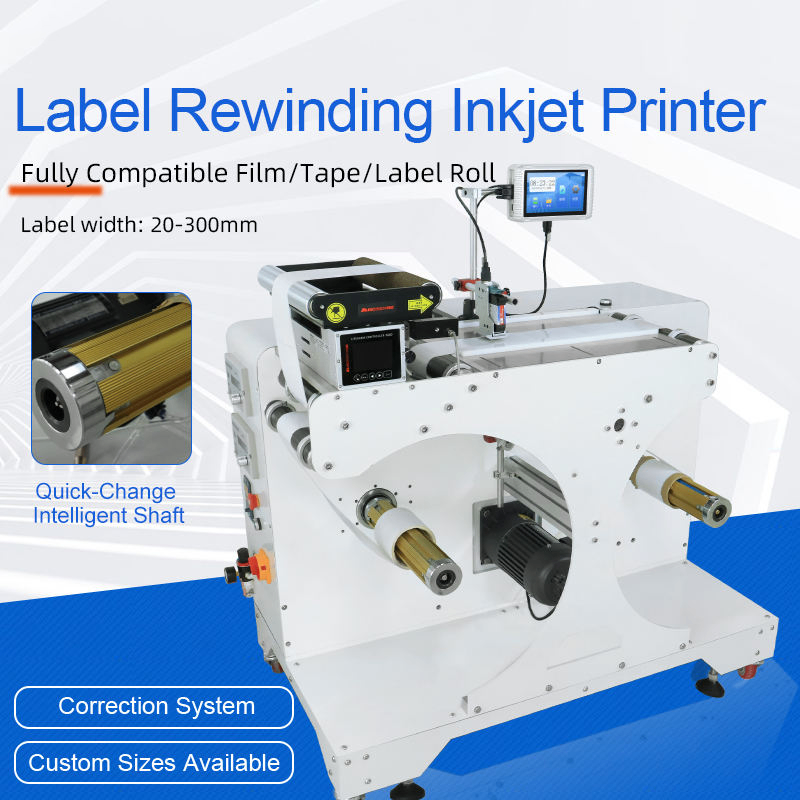
L10-FJ30 rewinding inkjet printer
a one-operator unit that prints and winds the same reel:
- Handles label widths from 20-300 mm
- 2-12.7 mm print height with TIJ thermal foaming nozzle
- Rewinds finished rolls up to 500 mm outer diameter
- Counts labels with 1-15 digit counter
Price Your Own Reel
- See the machine: L10-FJ30 rewinding inkjet printer
- Read next: the F320 rewinding machine, the narrower unit that pairs with a coder on small reels
- Talk to us: send your web width and target reel count through our contact page. We reply within 24 hours with a configuration and a no-commitment quote.