Published 2026-09-10 · By the SHICAI technical team · Buying guide
Last Updated: 2026-09-10
A barcode that fails to scan at the pallet stage costs a warehouse a manual re-label, and the fault usually traces back to the coding unit rather than the reader. Barcode printer manufacturer selection therefore matters more than the purchase price, because the machine has to hold scan quality across thousands of marks and a range of surfaces. This guide covers the five checks that separate a supplier you can build a line around from one you will be re-sourcing within a year.
What a Coding Supplier Should Be Able to Show
Barcode printing sits at the intersection of printing and materials handling. The unit has to place a machine-readable code on a moving product, at the speed the line runs, and repeat it when the substrate changes from coated carton to shrink film to aluminium.
That combination is why capability claims are worth less than evidence. A supplier should be able to describe the duty rating of a given head, name the inks that suit your material, and produce a sample printed on your own stock rather than a photograph of a perfect code.
The checks below are the ones that repeatedly catch problems in real installations, from head duty rating to what happens when a spare is needed in a hurry. They take an afternoon of questions, not a factory visit.
5 Verification Checks Before You Order
| Check | What to ask for | Why it matters |
|---|---|---|
| 1. Duty rating | Continuous duty confirmation at your line speed, in writing | A head rated for intermittent work drifts out of tolerance on a two-shift line |
| 2. Scan quality on your stock | A sample printed on your carton, film or label, verified with your reader | Resolution figures do not predict how a code scans on a real surface |
| 3. Ink and consumable supply | A written list of formulations for your substrates | A single general-purpose ink fails on coated or low-energy surfaces |
| 4. Documentation | Manual, wiring diagram, and message-setup guide in English | Operators cannot maintain a machine they cannot look up |
| 5. Support reach | Named spares list and a stated response time for your region | Downtime is measured in the days a shipment of parts takes, not in the part cost |
Check 2 is the one buyers skip when a deadline is close, and it is the one that predicts the outcome. A code that scans on the supplier’s sample board can still fail on your coated stock, and the difference only appears when the line is running.
Check 5 is the quiet cost. A unit is only as good as the fastest route to a replacement head or a cartridge, which is why a supplier with export logistics in place is worth more than a small discount on the machine.
A Product Line Rather Than a Single Machine
Barcode work spreads across several formats. Case coding on a conveyor calls for a mounted head, short runs and mixed jobs suit a compact unit near a bench, and large blocks of variable data on wide cartons need a wider print height. A supplier with the whole range can match the machine to the job instead of stretching one model across every task.
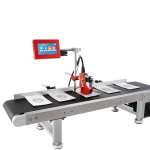
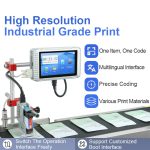
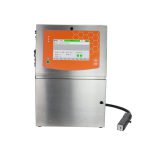
Four units in the SHICAI line cover most of that ground: the T110-Mini online inkjet printer for lines running to 100 m per minute, the Y110 Online inkjet printer for compact conveyor mounting, the C110 Mini online inkjet printer for slower benches and short conveyors, and the P70 Online inkjet printer for wide codes on cases.
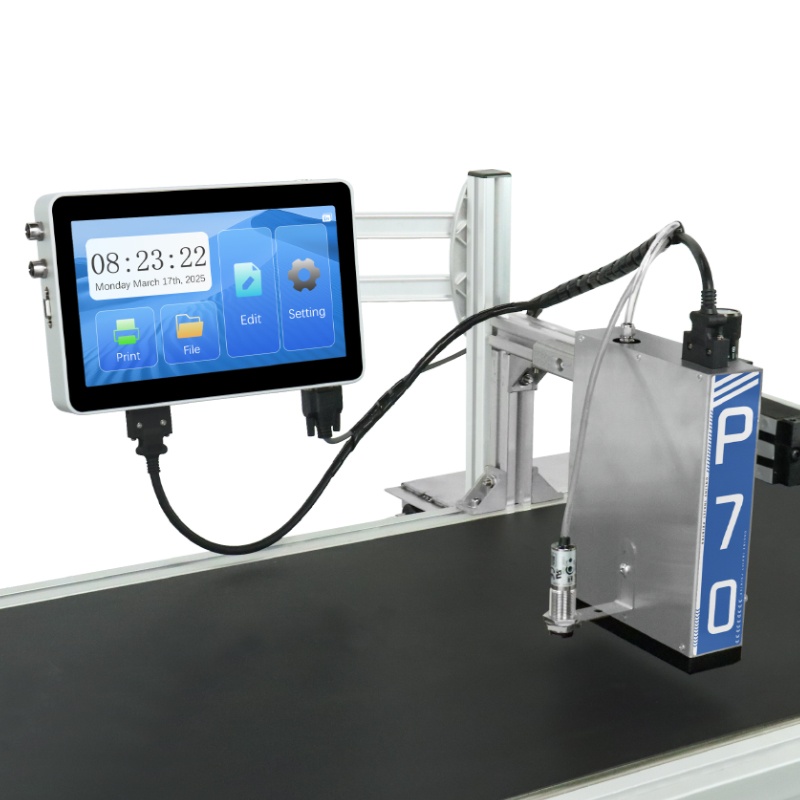
P70 Online inkjet printer
- Print speed 1-100m/min
- 180dpi print accuracy
- 3-71.8mm print height
- 10 Inch Capacitive Touch Screen
- 2-15mm throw distance
A wide-format unit for large codes and case marking, with a print height from 3 to 71.8 mm and a throw distance of 2 to 15 mm that suits a bracket mounted clear of the conveyor. Speed runs from 1 to 100 m per minute, so the same unit covers a slow start-up line and a full production run.
Quality Control and Compliance
Ask how each unit is tested before it ships. A factory that runs a print and scan test on every machine leaves a paper trail you can request, and that trail is the difference between a supplier and a reseller.
ISO 9001 certification covers the process behind the build, including incoming inspection and final testing, and it is worth asking which certificate scope applies to the coding line rather than to the company as a whole. For export orders, request the documentation package that customs and your own quality team will need, and confirm that the ink list states food-contact status where relevant.
Delivery and support terms belong in the same conversation. Confirm the lead time for your configuration, the minimum order for spare heads and cartridges, and who answers a technical question on your working hours, not theirs.
Common questions
- What should I ask a barcode printer manufacturer before ordering?
- Ask for the duty rating at your line speed, the ink list for your substrate, a sample printed on your own material, and the response time for spares in your region. Answers in writing are more useful than a specification sheet.
- Can one printer handle both cartons and labels?
- Usually yes, if the ink list covers both surfaces. Porous carton board takes a fast-drying ink, while coated labels may need a different formulation or a laser unit for a permanent mark.
- How do I check print quality objectively?
- Print the smallest barcode your customer scans, then verify it with a reader at the distance and angle used on the line. Resolution figures matter less than a code that scans first time.
Next Steps
- Compare coding and marking units across conveyor, bench and wide-format formats.
- Read other buying guides on coding equipment cost and selection.
- Request a sample print on your own stock before you commit to a configuration.
Talk to SHICAI
Send a sample of your carton, film or label and tell us your line speed. We will return a printed sample, the ink recommendation for your substrate, and a configuration that fits the bracket you have.
Phone: +86 17625427465 | Email: kuangcy@126.com | Request a quote
Free sample testing, no commitment, replies within 24 hours.
Learn more about barcodes and ISO 9001 quality management.