Last Updated: 2026-10-26
A bottle coding machine supplier is chosen on six things a quotation never shows: a marked sample, the ink behind it, the spare part number, the acceptance test, the document set and who answers the phone in month eight. Price comes after those, not before them.
Six Checks a Bottle Coding Machine Supplier Must Pass
Every enquiry gets a price within a day, and almost every price looks similar once freight is added. What separates suppliers is what happens between the enquiry and the first production week, so the checks below are ordered by how much they cost when they fail.
| Check | Evidence to ask for | What failure costs |
|---|---|---|
| Sample on your bottle | A marked bottle, not a photograph of one | A machine that works in a video and not in your room |
| Ink grade in writing | Grade name and batch on the label | A mark that fails a retail or export check |
| Spare part numbers | Print module, filter and pump numbers | Air freight for one part in month two |
| Acceptance test | The test written into the order | Arguing about faults after the balance is paid |
| Document set | Invoice, packing list, certificate of origin | A container held at the port |
| Named contact | A person, with a direct address | A ticket that closes without an answer |
The first row has no substitute. A supplier who marks your actual bottle, at your actual line speed, on your actual ink, has answered a question no catalogue can. A supplier who sends a video of a similar bottle has answered a different question.
What a Video Tour Shows and What It Hides
A tour is useful for four things: whether the floor is organised, whether units are built in a batch or one at a time, whether there is a test bench with bottles on it, and whether the person filming knows the machine. It is useless for judging print quality, because a phone camera at arm’s length flatters every mark.
Ask for the tour to end at the test bench with a bottle marked during the call. That single request filters most trading companies from most builders, and it costs nothing to make.
Sample and Ink Proof Travel Together
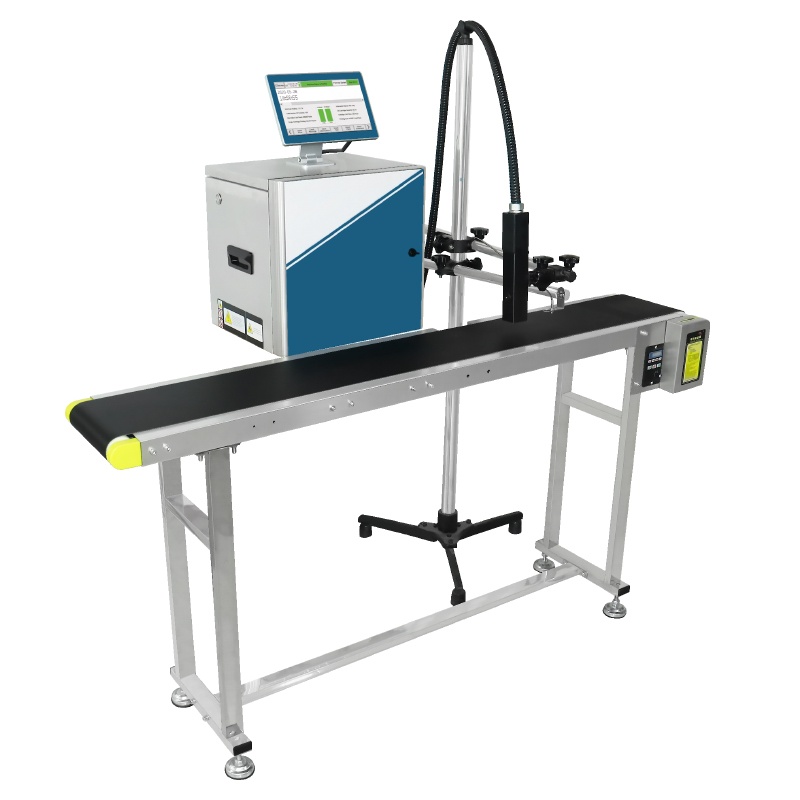
S1000 small character inkjet printer
the line build behind most bottle enquiries:
- Prints up to 400 Meters Per Minute
- 2-20mm print height
- 10.1-Inch Industrial Touchscreen
- 3-30mm throw distance
- Low 120W rated power
A marked bottle without the ink grade beside it proves nothing, because the mark may have been made with a grade that is not in the quotation. Insist on three lines in the offer: the ink grade, the batch, and the substrate it was proved on. On glass and PET the same grade behaves differently, and a supplier who cannot name both has not tested both.
Keep the sample. When the machine arrives, the first bottle off the line is compared against it in the same light, and that comparison ends most disputes before they start. Builds follow the route described in the ISO 9001 quality management standard, and the behaviour of a continuous stream is set out in the general account of inkjet printing.
The Spares Path Is the Real Warranty
A warranty is a promise about a period. A spares path is a promise about a Tuesday in the third year, and it is the one to test. Ask for the part numbers of the print module, the filter and the pump, then ask which of them the supplier holds stock of. A supplier who holds all three can support a line. A supplier who orders them one at a time is a broker with a catalogue.
Ask also what the consumable ratio is in practice: how many litres of ink and solvent a month of your production consumes. Two suppliers quoting the same machine often differ by a third on running cost, and the difference is in the pump settings and the flush routine, not in the price list.
Lead Time and the Document Set
A realistic lead time for a built unit is quoted in weeks from deposit, with the deposit date written down. A lead time quoted from the enquiry date is a sales figure, not a production figure.
The document set matters as much as the machine. A commercial invoice, a packing list and a certificate of origin are standard. Hazardous goods paperwork for solvent-based ink is not, and a supplier who ships ink without it creates a problem at the port rather than at the factory. Ask early whether the ink travels with the machine or separately, because the answer changes both the freight and the paperwork.
Acceptance and the Balance
Write an acceptance test before the order is placed: a fixed number of bottles marked at a stated speed, a legibility check at a stated distance, and a scan check if a code is involved. Hold part of the balance against that test rather than against delivery, because delivery only proves the crate arrived.
The last check is the least popular and the most useful. Ask who will answer a technical question in month eight, and get a name. A supplier who answers with a department is telling you the answer will depend on who opens the message.
Buyer Questions
- Is a factory visit necessary
- Not if the video tour ends at a test bench with your bottle marked, and the sample arrives with the ink grade attached.
- Should ink ship with the machine
- Only with the hazardous paperwork. Otherwise buy the first fill locally and let the supplier quote the second.
- How many spare modules should a first order include
- One per line for a single-shift plant, and one per two lines where a stoppage costs a shift.
Send the Bottle and the Line Speed
Send one bottle, the block you print and the speed the line runs. We will return a marked sample with the ink grade, a part number list and an acceptance test you can hold a supplier to, which is the point of choosing a bottle coding machine supplier on evidence.
Next Steps
- Send a bottle, the block and the line speed. We return a marked sample plus the ink grade and part numbers.
- Start at the contact page, on +86 17625427465 or kuangcy@126.com. We reply within 24 hours.